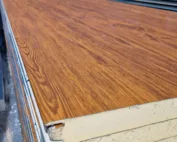
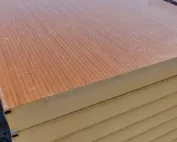
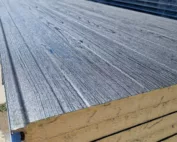
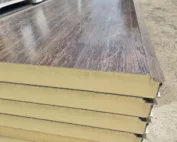
Panels in use
Checking the performance of second-grade 100 mm wall panels
In brief
The term “second grade” does not say which properties of the 100 mm panel have remained unchanged. First, the reason for the price reduction and the condition of the specific batch must be established. A difference in shade is assessed differently from damage to the core or the joint. The material should be considered under the conditions in which it will perform over the coming years. On a façade, a slight difference in gloss may only become visible in side light. A dent may cast a shadow depending on the time of day. If such an appearance is acceptable, the condition of the surface protection must still be checked. A scratch confined to the top layer is a different situation from deep damage exposing the metal. Do not assess both cases with the single word “blemish”.
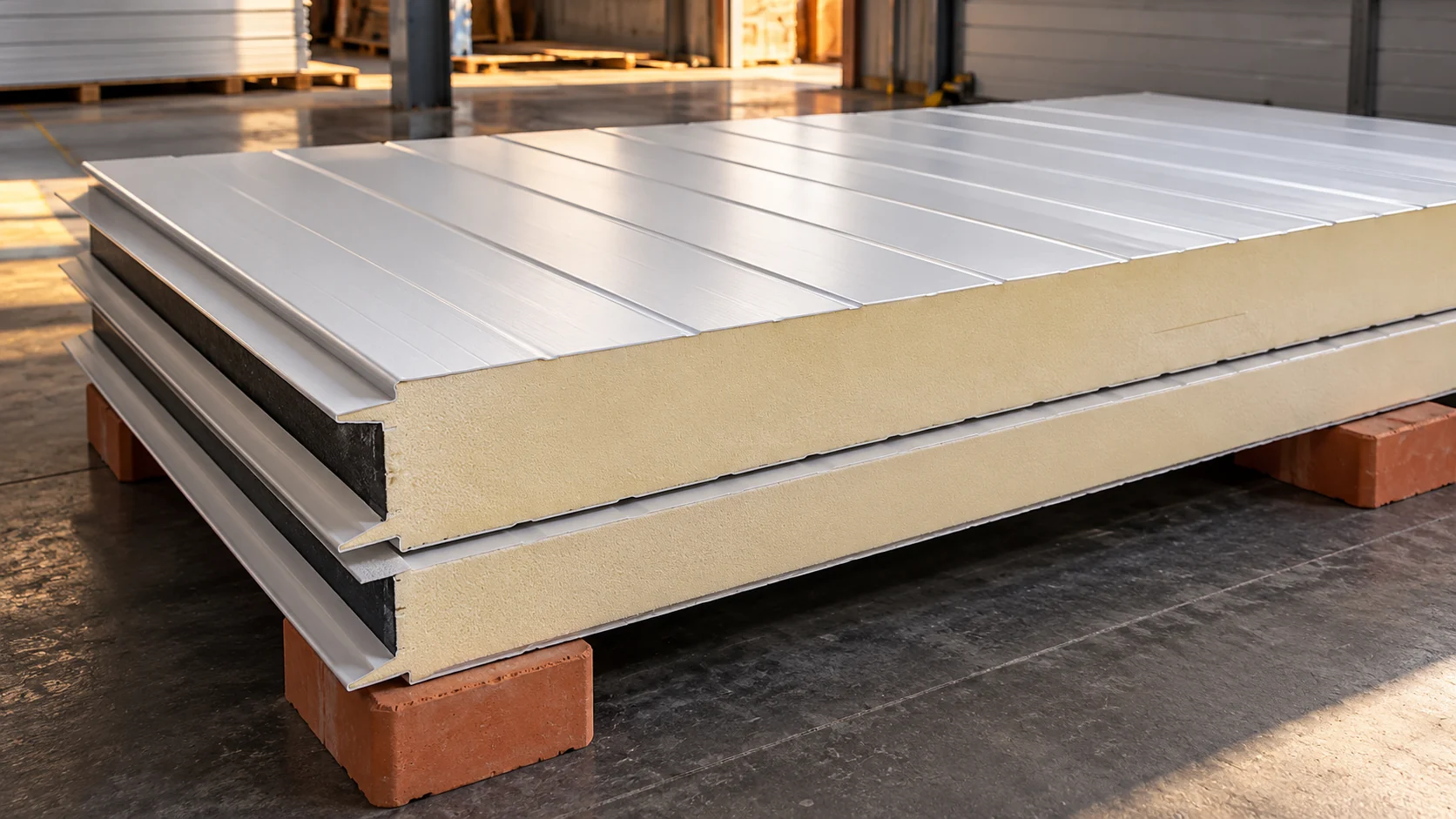
Is the defect only cosmetic?
Ask for the defects to be pointed out and inspect the entire available batch within the agreed scope. Pay attention to the surface on the interior side. In a small pavilion it may be just as visible as the façade. When buying on the basis of photographs, ask for close-ups and shots from different angles. A general photo does not confirm the quality of the coating on every piece.
What does the 100 mm thickness mean for insulation?
This is a dimension that must be linked to the type of core and the specific construction of the panel. An example wall variant with PIR foam with a reduced lambda has a stated U-value of 0.19 W/(m²K) at 100 mm. This is not a common result for all hundred-millimetre panels. Other cores and solutions may have different parameters.
A price reduction due to colour does not have to change the heat flow through an undamaged panel. However, this conclusion must not be extended to a batch with a crushed core or delamination. The material data must be related to the actual condition. The tightness of the joints and the details of the corners also affect the performance of the wall. Correct thickness alone does not eliminate the effects of draughts.
How does the environment change the significance of damage?
The same defect may have a different significance on a dry internal partition than on a wall exposed to moisture and dirt. The coating must be selected for the environment on both sides of the panel. Frequent washing, increased humidity or substances generated during operation may limit the suitability of a particular cladding.
Do not assume that hiding damage behind equipment solves the problem. A covered place may dry out less easily and be less accessible for inspection. The required repair must correspond to the type of coating and the extent of the damage. An arbitrary preparation does not provide confirmed durability. If the conditions in the building are demanding, the condition of the surface deserves particular attention before purchase.
What should be checked at the edges and joints?
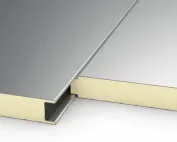
Inspect the interlock, the fastening points and both ends of the panel. A deformed edge may make it difficult to close the joint or to carry out sealing. Such a defect is not equivalent to a slight difference in shade. The joint should not be forced into place, nor should it be assumed that an additional trim will restore the properties of the damaged panel.
When joining batches, check the geometry, cover width and fixing variant. A thickness of 100 mm does not ensure mutual compatibility. If the plan requires a specific fire resistance, assess the entire system within the limits of the relevant classification. The condition of the edges, fasteners and support spacing may be significant. Do not retain the declared parameters of a new solution without confirming the suitability of the material with defects.

How do you assess the savings over the service life?
In addition to the batch price, calculate the length matching, additional work and possible repairs. Also consider access to the defective area after installation. Replacing a panel behind the cladding or in the middle of a finished façade may require significantly more work than setting it aside before installation. Therefore, a cheap piece does not always result in a cheap partition.
In a worked example, a 32 m² pack at an agreed €18.98/m² costs €607.36. If 27 m² is usable, the material alone corresponds to about €22.49/m² of used area. Transport, cutting and accessories are outside this figure. This is not a current offer. Such a calculation helps compare a purchase with full-value elements that have matching dimensions and do not require sorting out defects.
How do you prepare the decision to accept a batch?
Divide the elements according to the identified condition and the intended location. Note which pieces require cutting, repair or additional assessment. Do not automatically use the most damaged panel in the least visible place. First check its function. A hidden section must still meet the requirements for the partition and the loads transferred.
Record agreements regarding defects, dimensions and scope of responsibility before acceptance. Keep the information identifying the material. In the future, this will facilitate the selection of cleaning agents and the assessment of repairs. A discounted panel can be a reasonable choice when it has a known condition and the right application. However, this does not replace the identification of which parameters are confirmed and which cannot be safely assumed.
What else is worth asking about
Does a difference in gloss determine a worse panel?
It does not have to affect the performance parameters, but its cause should be known. Appearance is assessed separately from the condition of the core, coating and joints.
Is a sample of one piece sufficient to assess the entire delivery?
It does not provide certainty that the remaining panels have the same condition. The scope of inspection and the description of the batch should be established before accepting the material.
7 branches. Materials closer to your project.

- SEROCK — Dzierżenin 34 E
- BŁONIE — ul. Sochaczewska 138A
- RADOM — ul. Grobickiego 8
- ŁÓDŹ — Natolin 8
- OLSZTYN — Barczewo, ul. Prosta 9
- WROCŁAW — ul. Jerzmanowska 10C
- GORZÓW WLKP. — ul. Zielona 33/34