Roof and energy
Does an east-west photovoltaic roof make sense?
In brief
A roof does not need a single slope facing south for photovoltaics to be worth considering. An east-west layout can spread production across different hours of the day. This does not automatically mean a higher annual yield or better profitability. What matters is the building geometry, shading and the pattern of energy consumption. In an integrated system, both orientations can be incorporated into a coherent roofing concept. The eastern part of the roof benefits from different hours of sunlight than the western part. Instead of one strong midday peak, a broader distribution of system operation can be achieved. The details depend on the pitch and site conditions. Tall trees to the east or a neighbouring building to the west can significantly change the expected effect.
How does the production profile change?
This profile is worth comparing with how the house is used. If some appliances run in the morning and afternoon, spreading production out can help use more energy as it is generated. However, a general assurance that east–west “always suits the family” is not enough. You need data on actual consumption and separate forecasts for each roof slope.
Do you have to give up a uniform roof appearance?
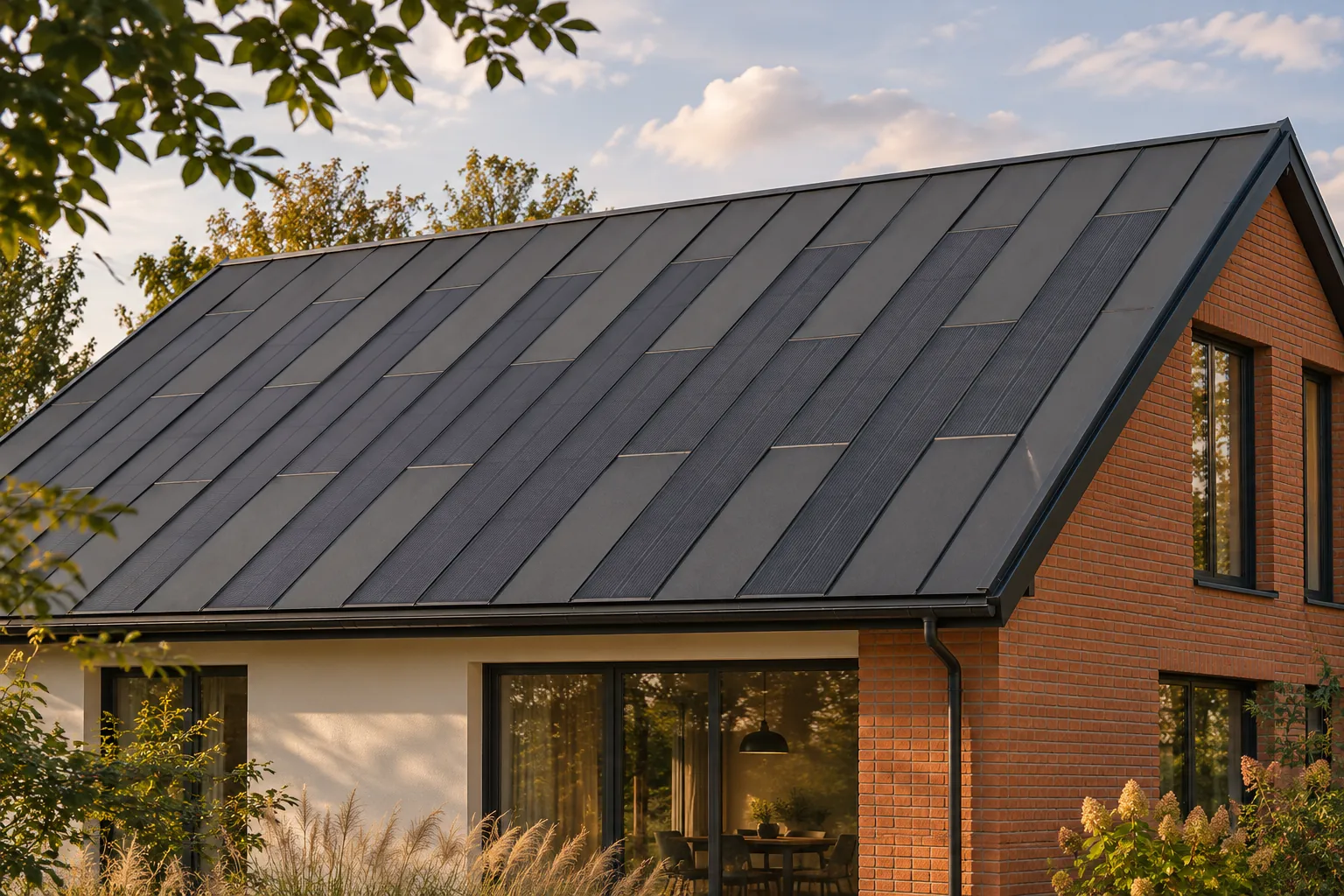
An integrated covering allows active fields to be planned on both sides of the ridge, with the remaining areas filled in with inactive elements. This means the energy layout does not have to impose an arbitrary external composition. The roof slope remains part of the house’s architecture, without an additional mounting frame clearly raised above the covering.
Uniformity does not mean identical capacity has to be used on each side. If one roof slope has a chimney, windows or shading, a sensible split may be uneven. The designer should explain the reason for such a decision. Well-distributed active fields are more important than symmetry achieved at the expense of system performance.
How do you connect both slopes electrically?
Elements operating under different conditions require a suitably selected electrical configuration. Depending on the system, the appropriate division of circuits, inverter inputs or compatible optimisers is used. It must not be assumed that any connection of two orientations will work the same way. The design must respect the voltage and current ranges of the devices.
For the owner, the most important thing is clear information on how the roof slopes were divided and how they will be monitored. If one side performs less well, the comparison should take its orientation into account. A simple map of the elements and circuits helps later to distinguish a normal difference between orientations from an actual fault.
Why is the annual result not enough?
Two variants may have different annual production while meeting the house’s needs differently. A higher yield during hours of large surpluses is not always of the same value as energy used on site. Assessment requires comparing production with the tariff, billing arrangements and how the loads operate.
It is worth comparing a single-slope variant with a split variant. In both, consistent weather data and the same method of calculating costs should be used. Do not add storage or automation to one solution if you are comparing the other without these devices. Otherwise you are assessing different setups rather than the effect of roof orientation.
A useful addition is a daily profile for representative months. It shows at what hours the additional roof slope actually helps. The annual total alone can hide differences that matter to a household member who only gets home from work in the afternoon.
What about cloud cover and the time of year?
Diffuse radiation also reaches the cells, but it does not remove the importance of orientation and pitch. On cloudy days the differences may look different from those on a cloudless morning. In winter, day length and the sun’s path change. A single photograph of shade from summer is therefore not enough to assess the whole year.
The analysis should take into account obstacles in the surroundings and foreseeable changes. Growing trees may worsen conditions on one side over time. If new buildings are planned nearby, their impact should also be identified. This is not a flaw of integration but a normal characteristic of an energy source that depends on access to light.
When is it worth choosing this layout?
An east–west layout makes sense when roof conditions and an analysis of needs confirm it. It is particularly convenient to consider it before the covering is installed, because the geometry of the arrays, the cabling and the equipment can be planned together. In a renovation, the condition of the structure and the feasibility of correctly executing all details must also be checked.
It is not worth rebuilding a good roof solely to achieve a textbook installation orientation. It is better to assess the available solutions and their full cost. A well-chosen integrated covering can use the existing building form without visual clutter. The choice should be decided by calculations and design, not by the compass alone.
Among the manufacturers and brands of photovoltaic roofs are Solarstone, SoliTek, Electrotile, MDM NT (MyRoof), SolRoof, Ennogie, Wienerberger Wevolt, GAF Energy, SunRoof and ML System.
7 branches. Materials closer to your project.

- SEROCK — Dzierżenin 34 E
- BŁONIE — ul. Sochaczewska 138A
- RADOM — ul. Grobickiego 8
- ŁÓDŹ — Natolin 8
- OLSZTYN — Barczewo, ul. Prosta 9
- WROCŁAW — ul. Jerzmanowska 10C
- GORZÓW WLKP. — ul. Zielona 33/34