Panels in use
What must be maintained for a PIR roof to meet fire requirements during use?
In brief
The fire properties of the roof result from a specific arrangement of panels and joints. After acceptance, later openings, repairs and changes to equipment also matter. In a small building it is easy to treat these as minor works. However, every change should preserve the conditions on which the selection of the entire assembly was based. PIR describes the core material, but does not give the full classification of the panel. The facings, thickness and joint construction are important. Identification of the exact variant is needed. Data cannot be transferred from a similar product solely on the basis of the foam name.
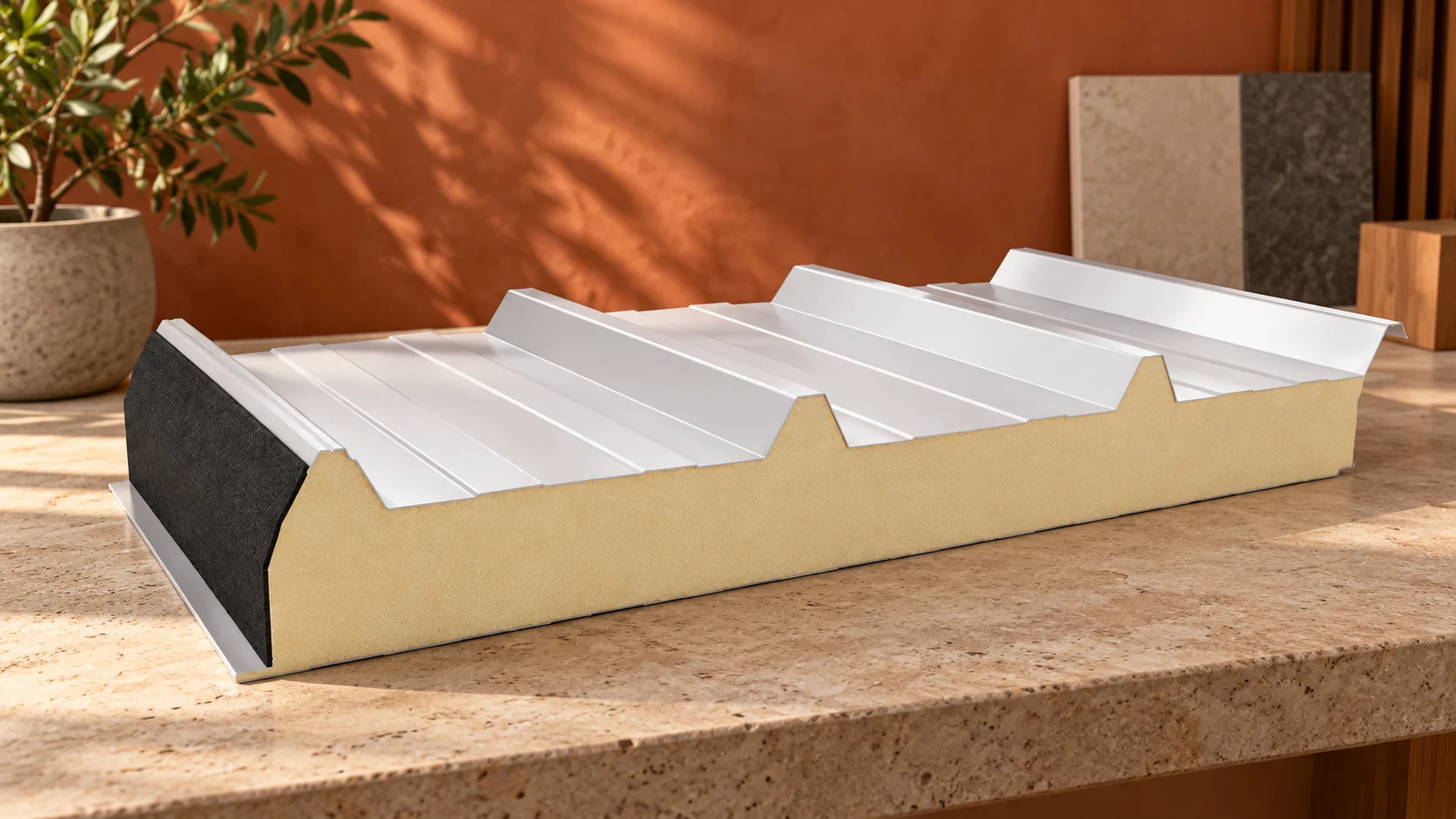
Why is the core name not enough?
An example panel family has a reaction to fire of B-s1,d0. This is not a non-combustibility designation. The additional symbols refer to smoke production and flaming droplets or particles under the conditions of a specific test. Such a classification does not by itself describe the resistance time of the entire roof.
Fire resistance and behaviour under external fire are assessed separately. The project determines which properties are required for a specific application. The small area of the pavilion does not allow this assessment to be omitted or one parameter to be freely replaced by another.
How to read RE and REI without overinterpretation?
The letter R denotes loadbearing capacity, E integrity and I insulation. The number indicates the time for which the given set of criteria is met under test conditions. It is worth reading the whole symbol. RE 30 is not the same as REI 30, because it does not cover the same set of requirements.
In one roof family, RE 30 and REI 20 are given for the 100/140 mm variant, with conditions specified in the classification. REI 30 must not be derived from this. These values should also not be attributed to a thinner panel without separate confirmation.
If NPD appears for a variant, the given property has not been declared. This is not a result that can be supplemented by one’s own assessment of appearance. Data covering the actual solution are needed. The classification time is also not a guarantee of the course of any fire in a building.
Which changes in use require verification?
A new way of conducting business may change the conditions of the facility. This applies to equipment, installations and the use of rooms. It should not be assumed that the earlier selection of the enclosure remains appropriate after every change. The requirements must be related to the current use project.
An additional duct, cable or device on the roof means a new connection to the separating layer. The opening requires a suitable solution and often separate support. The flashing alone does not confirm the fire properties of the penetration.
Heavier equipment should not accidentally load a thin facing. Changes in loads affect how the system performs. Adding a ceiling or an extra layer also requires assessment. A seemingly minor adaptation may go beyond the conditions of the original solution.

What must be maintained when repairing or replacing a panel?
Establish the exact type of the damaged element and the requirements for that area. The new panel should match the approved solution. Similar colour and thickness do not guarantee compatibility of locks, facings or fire properties.
Check the fasteners and seals specified in the detail. They should not be replaced with any material of similar appearance. Position, continuity and method of execution matter. Some connections must be inspected before they are covered again.
The repair should address the cause of the damage. If the panel got wet through a leaking joint, replacing the section alone may not be enough. The condition of the facings, core and connections should be assessed according to the problem. Maintaining aesthetics is not the only acceptance criterion.
What information should be kept for later works?
Keep the panel specification, connection drawings and the conditions of use of the classification. Photographs of areas covered during installation are useful. In future they will allow verification of what was actually done and which solution needs to be reproduced.
Record the openings made and the repairs. The person installing the next device should know about previous changes. Otherwise, decisions are easily based on an outdated drawing. This also applies to loads and the position of additional supports.
During inspections, examine the condition of joints, flashings and the areas around penetrations. If damage is found, determine the repair method before temporarily covering the area. The properties of the partition must be maintained through correct installation and compliant changes. The class name alone in an archived offer does not ensure this.
What else is worth asking about
Can RE 30 be read as thirty minutes of full fire insulation?
No. The RE symbol does not include the I criterion. The exact classification and its conditions must be read. A missing criterion must not be added to the number itself.
Does replacing a panel with a thicker one always preserve the roof’s fire class?
It does not provide such an automatic guarantee. The scope of the classification, the compatibility of joints, supports and fixings must be checked. The correct option is the variant covered by the approved solution.
7 branches. Materials closer to your project.

- SEROCK — Dzierżenin 34 E
- BŁONIE — ul. Sochaczewska 138A
- RADOM — ul. Grobickiego 8
- ŁÓDŹ — Natolin 8
- OLSZTYN — Barczewo, ul. Prosta 9
- WROCŁAW — ul. Jerzmanowska 10C
- GORZÓW WLKP. — ul. Zielona 33/34