Panels in use
What is a panel with glass-fibre reinforced facing?
In brief
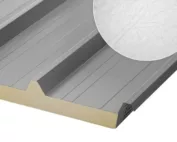
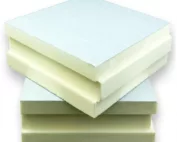
Some roof panels have a thin composite facing in place of the inner steel sheet. One example is glass-fibre-reinforced polyester resin, used in agricultural buildings. When choosing a panel, check the temperatures, moisture levels and cleaning agents it can withstand, as well as the joint details. The outer facing may be profiled steel. A rigid PUR or PIR foam core sits between this facing and the flat, glass-fibre-reinforced plastic surface facing the room. Together the layers form a sandwich panel. This construction differs from a simple translucent corrugated sheet.
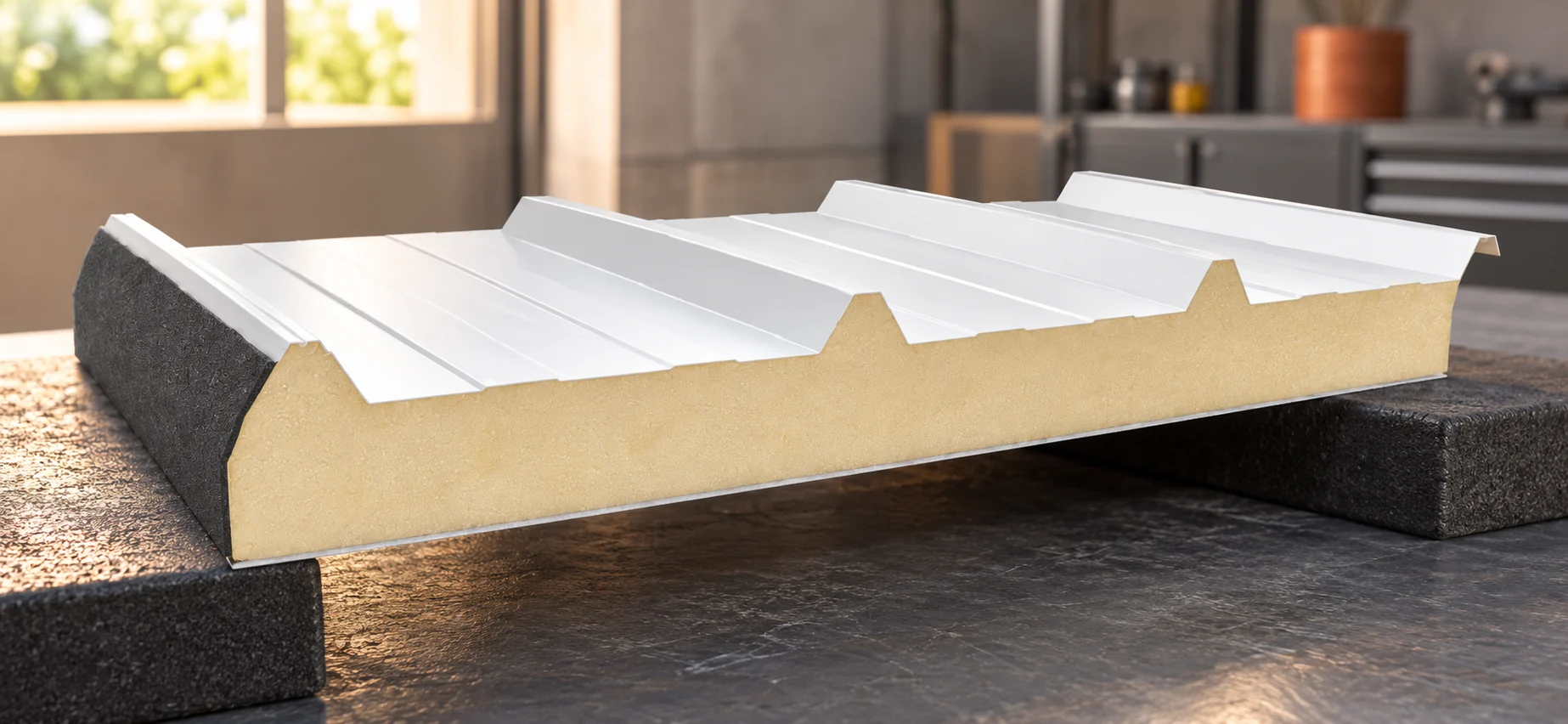
What is such a panel made of?
The glass fibre reinforces the composite. It is not a mineral core such as in a mineral wool panel. This is an important distinction when comparing fire, weight and thermal insulation. A name referring to the facing does not yet say which insulating material is inside the panel.
Why is the inner steel sheet replaced?
In rooms with a demanding environment, the inner surface requires appropriate resistance. Moisture, chemical compounds and frequent cleaning can strongly affect an ordinary coating. A properly selected composite facing is one of the available solutions. However, its properties should not be transferred to all plastics.
Temperature and the cleaning method are also assessed. A given material may be resistant to a specific factor, but not to any concentration or prolonged contact. The actual conditions of use must be stated. The description ‘for agriculture’ alone is too broad to determine suitability in every facility.
Which applications should be considered?
Such panels are used in the roofing envelope of warehouses and livestock buildings. They may be considered for a cowshed, pigsty or poultry house. However, the conditions differ between these facilities. Ventilation, humidity, emissions and the agents used during cleaning are significant. Selection requires these to be described.
In a small technical building, the composite may be justified by the local environment rather than the size of the facility itself. It should not be bought merely because of its modern appearance. It must be checked whether it provides the required property and whether the contractor knows the relevant details of joining the inner facing.
How to compare dimensions and insulation performance?
An example panel family has a cover width of 1050 mm and thicknesses from 40 to 160 mm. Lengths depend on, among other things, thickness and colour. They are not the permissible span between supports. That requires separate verification of load-bearing capacity and deflection for the relevant variant.
In one PIR 100 mm variant, the declared Uc is 0.22 W/(m²·K), and at 120 mm it is 0.18. These are data for this family, not for all panels with a composite. Values from a roof having two steel facings should not be copied. The element’s construction and its documentation remain important.

What to watch for in joints and fixing?
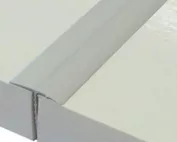
The composite facing does not exempt cut edges and joints from protection. Sealing must cover the entire detail. Water or chemicals can penetrate places not protected by the surface alone. Fasteners, flashings and sealants must be selected for the environment and the panel system.
Installations must not be suspended from the thin inner layer without a designated solution. Additional loads require appropriate support. At roof penetrations, insulation and sealing must be maintained. In a facility cleaned under pressure, the details should account for the approved cleaning method.
What to check during use?
Check joints, penetrations and areas at flashings. Assess the surface after changing the chemical agent or cleaning method. Cleaning parameters should correspond to the approved conditions. Excessive temperature, an aggressive agent or an unsuitable jet can also damage the material selected for a more demanding environment.
The documentation should identify the complete panel and its limitations. This also applies to fire classifications. Do not attribute the properties of the glass fibre alone to the entire panel with foam and resin. Selection is based on the properties of the finished product and the roof solution that is to perform in a specific building.
How to calculate the quantity of panels with a different module?
With an example cover width of 1.05 m, a panel 4.20 m long covers 4.41 m². A price given per metre of length must be divided by 1.05 to compare it with the price per square metre. The order length includes the required end treatments, not just the distance between supports. The calculation must include complete elements, flashings and waste. The correct cover width is therefore important both for cost and for the arrangement of joints on the structure.
What else is worth asking about?
Does a composite facing mean a mineral wool core?
No. In the described panels, the reinforcing fibre is in the facing, and the insulating core may be PUR or PIR. These are different parts of the product.
Can such a panel be washed with any cleaning agent?
The cleaning agent, concentration, temperature and method of washing must correspond to the approved conditions. Resistance to one agent does not mean resistance to every mixture.
7 branches. Materials closer to your project.

- SEROCK — Dzierżenin 34 E
- BŁONIE — ul. Sochaczewska 138A
- RADOM — ul. Grobickiego 8
- ŁÓDŹ — Natolin 8
- OLSZTYN — Barczewo, ul. Prosta 9
- WROCŁAW — ul. Jerzmanowska 10C
- GORZÓW WLKP. — ul. Zielona 33/34