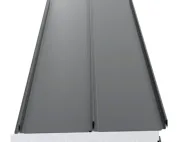
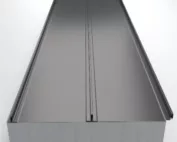
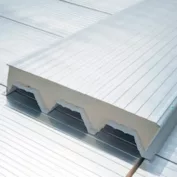
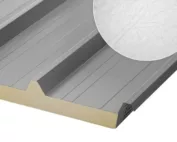
Panels in use
How to choose panels for cold rooms and freezers without guessing the thickness?
In brief
For a cold room, you do not choose a panel solely by the temperature shown on the thermostat. What matters is the conditions outside, door openings, the goods and the operating time. The thickness of the enclosure affects heat flow, but it is part of a larger balance. A freezer requires particularly careful joints as well as a floor and penetration solution. State the internal temperature and the ambient conditions. Determine whether the chamber stands inside a building or is itself an external structure. The quantity of goods introduced, their temperature and the frequency of door openings are significant. A small chamber with constant door traffic may have a different balance from a larger one that is rarely opened.
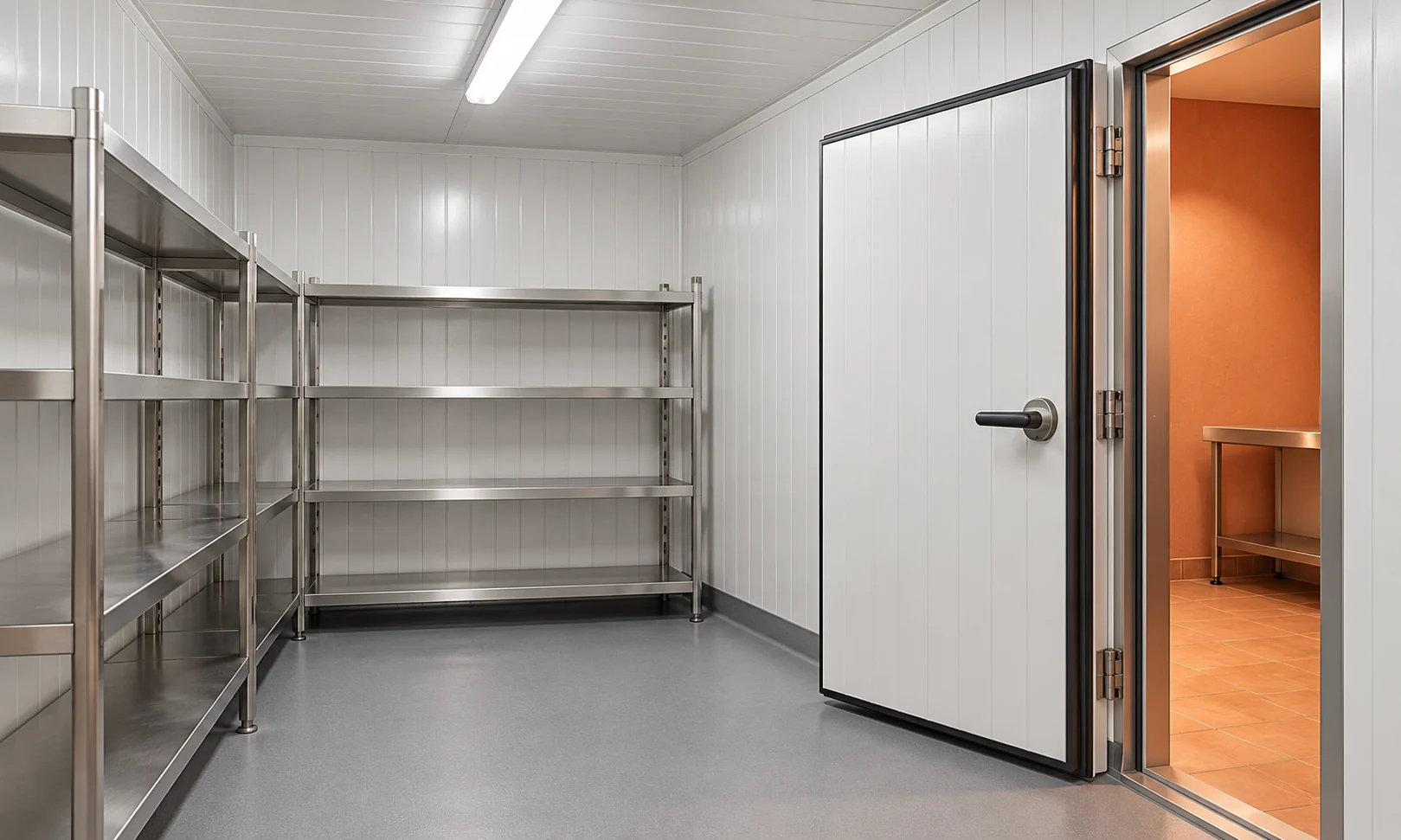
How to describe the actual operation of the chamber?
A distinction must also be made between storage and cooling or freezing of the product. These are different tasks for the installation. The wall area alone does not determine the required equipment capacity. The design should account for all relevant heat gains, not only transmission through the panels.
How does a cold-room panel differ from an ordinary wall panel?
It is intended for rooms with controlled conditions. The detail of the joint and the way it is sealed are important. It should not be assumed that an identical thickness of a standard wall panel gives the same assembly. Documentation for the panel and a solution for the entire cold room are needed.
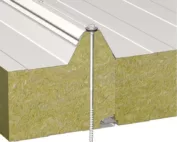
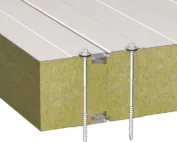
There are panels with a PIR core with low λ and cover widths adapted to the enclosure. Their maximum length is not the permissible ceiling span. Support and fixing must be selected separately. The ceiling should not be treated as a storage area or walkway without a suitable design.
What thermal values can specific variants have?
| Example PIR cold room panel | U in W/(m²·K) |
|---|---|
| 100 mm | 0.19 |
| 120 mm | 0.16 |
| 160 mm | 0.12 |
| 200 mm | 0.10 |
These figures apply to one product family with a declared core thermal conductivity λ of 0.019 W/(m·K). Other panels may have different values. The figures alone do not determine which thickness suits a given operating temperature. The final choice depends on the heat balance, energy costs and how the cold room is built.
Also check the permitted temperatures for the complete product and its components. Seals, facings and service penetrations must operate in the same environment.
What does a simple calculation of losses through the wall area show?
Assume an area of 50 m² and a temperature difference of 38 K. For U 0.16 the heat flow is approximately 304 W. At U 0.12 it is approximately 228 W. The difference is 76 W under the assumed conditions. This is solely the calculation U × A × ΔT for the specified area, not the capacity of the entire refrigeration system.
Door openings, goods, people and equipment add to the balance. The floor and thermal bridges must also be taken into account. Do not multiply the power difference by a year and call the result a certain electricity saving. Actual operation depends on usage time and system efficiency.

Why is airtightness just as important as thickness?
Warm, humid air can enter the cold zone through leaky joints. The result can be condensation or frost formation. A thicker core will not fix such a leakage path. The continuity of seals, corners and door connections must be designed. Materials must be selected for the temperature and cleaning method.
Cable penetrations and equipment fixings require separate details. They should not be cut after acceptance of the chamber without agreement. In a freezer, pressure differential control may also be important. The solutions for these elements result from the design, not from random selection of accessories.
What should be considered for the floor and doors?
The floor must carry traffic and loads while maintaining insulation. In a freezer, the risk of frost penetration into the substrate and the necessary protection must be assessed. A wall panel is not automatically a finished floor. The construction of the wearing layers requires separate selection.
Doors should match the temperature, intensity of use and dimensions of the goods being transported. Their tightness and opening time have a major influence on the operation of the chamber. Too small an opening hinders logistics, while an unnecessarily large one can increase air exchange. Selection is therefore also an operational decision.
How should the cold room be accepted before normal operation?
Check the panel documentation, seals and penetrations. Establish the commissioning procedure in accordance with the system design. Monitor temperatures and locations where moisture appears. Acceptance should not end with the statement that the unit is cooling the air.
Prepare cleaning and maintenance rules. A change of goods or intensity of use may require a reassessment of the balance. Keep a description of the panels and details used so that later repair does not rely on fitting a random element. The tightness of the enclosure is required throughout the service life.
What else is worth asking about
Is one thickness enough for every freezer at the same temperature?
No. The surroundings, dimensions, goods and opening frequency differ. Selection follows from the balance and the requirements of the entire system.
Can the chamber ceiling be used for storage?
Only if such a function was provided for and the appropriate structure confirmed. An ordinary panel ceiling does not automatically provide storage load capacity.
7 branches. Materials closer to your project.

- SEROCK — Dzierżenin 34 E
- BŁONIE — ul. Sochaczewska 138A
- RADOM — ul. Grobickiego 8
- ŁÓDŹ — Natolin 8
- OLSZTYN — Barczewo, ul. Prosta 9
- WROCŁAW — ul. Jerzmanowska 10C
- GORZÓW WLKP. — ul. Zielona 33/34