Mineral wool in panels
What needs to be checked in a 100 mm mineral wool wall panel?
In brief
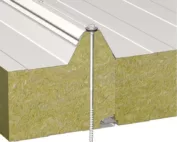
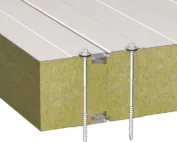
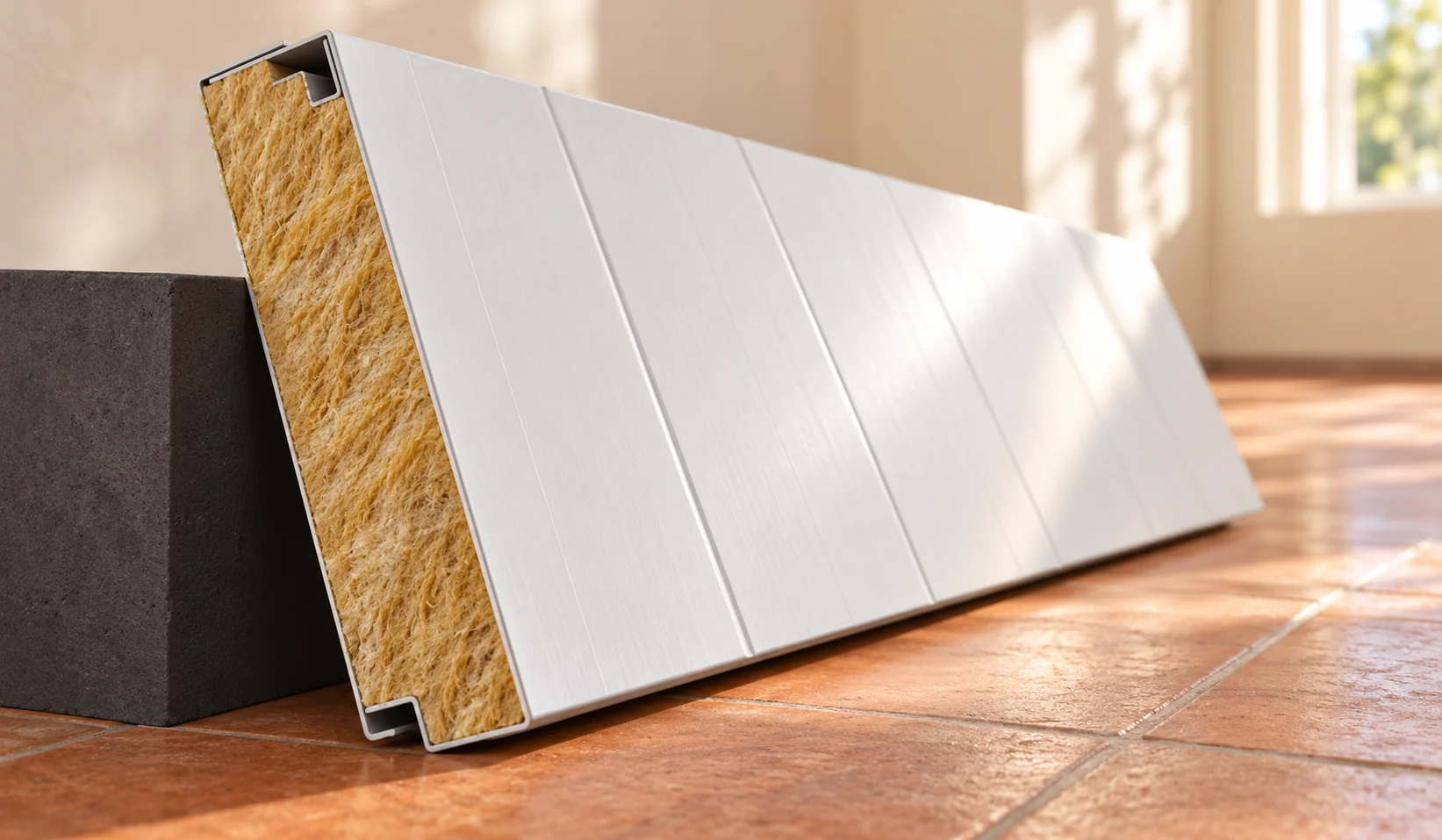
One hundred millimetres is a specific core dimension, but not yet a full wall specification. Panels with mineral wool of this thickness can differ in weight, insulation performance and joint. The choice should cover the entire variant and the installation method. Below we show how to assess 100 mm without treating this value as an automatic standard for every building. A 100 mm panel can have different mineral wool density and facing thicknesses. This affects weight and performance characteristics. The joint type can also differ. A variant with concealed fixing does not have to have the same U-value as a panel with visible screws. Do not combine the most favourable figures from several data sheets into one fictitious product.
Why is thickness alone not enough for comparison?
The quote should specify the core, both facings, coatings and the covering module. Only such a set allows the delivery to be checked for conformity. If the seller proposes a substitution, the entire specification must be compared. A similar colour and identical thickness do not guarantee technical equivalence.
What does an example of a specific variant look like?
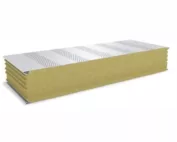
In the family with a mineral core of nominal density 105 kg/m³, the 100 mm panel with concealed fixing has a U-value of 0.44 W/(m²·K). With 0.5/0.6 mm facings, its mass is 20.3 kg/m for a 1000 mm module. In this configuration this corresponds to 20.3 kg/m². The data should be treated as an example of a specific configuration.
A panel 3.5 m long weighs a calculated 71.05 kg. This matters when lifting and setting down. Installation cannot be organised solely on the basis that the element is only 1 m wide. Length, mass and the required method of support must be assessed together. Packaging is added to the transport weight.
In the same family, the 120 mm panel weighs 22.4 kg per metre of length with a 1 m covering width. A 4 m element is therefore 8.4 kg heavier than the 100 mm version. A small change in thickness can matter for the lifting method.
Does 100 mm provide sufficient insulation?
The answer depends on the service temperature and the project requirements. U 0.44 describes the specified panel, not a complete wall with windows and details. A different variant may be needed in a building heated all year round. In an unheated enclosure the thermal criteria will be different. Thickness should not be selected solely on the basis of the name ‘garage’ or ‘hall’.
For an area of 20 m² and a temperature difference of 25 K, the flow at U 0.44 is 220 W. This is an example of an instantaneous calculation. It does not determine the entire heating output. The roof, floor, joinery, ventilation and air leakage must be taken into account. Such a balance allows assessment of whether the surcharge for a thicker wall will bring the expected effect.
How should fire performance be understood?
A finished panel may have fire reaction class A2-s1,d0. Fire resistance of the system is assessed separately. EI120 may appear in the documentation for a specific family, but it is not an automatic feature of every 100 mm panel. The scope of classification and the method of installation must be checked.
Supports, fasteners, spans and the joint detail matter. Openings require compatible details. If the wall performs a specific fire function, its route and fixings must not later be changed arbitrarily. The mere presence of a mineral core does not give such freedom.

What affects the price of this variant?
The price depends on the coating, facings, length and batch size. Add-ons and logistics come on top. A panel in a good dimension can produce less waste than a cheaper sheet from a random batch. It is worth comparing the cost of the whole wall area, not just the rate per purchased metre.
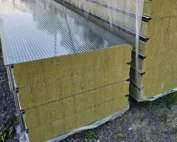
With concealed fixing, the elements required by the system must be taken into account. Saving on unsuitable fasteners is not a sensible change. Material acceptance is equally important. A crushed lock or a damp core can change the suitability of the panel, even if its thickness and colour match the order.
How do you decide for a small building?
Compare 100 mm with at least one thinner and one thicker variant, if they fit within the requirements. Set out U-value, weight, load-bearing capacity and fire properties. Add the cost of details. In a small pavilion with a large gate, changing the core alone may have less impact than improving the other parts of the envelope.
Choose a solution that matches the actual pattern of use. If you plan heating in the future, take it into account from the start. Keep the full specification for acceptance and later servicing. 100 mm can be a good choice, but only when it matches the specific task and confirmed parameters.
Also check the environmental conditions on both sides. A dry core and a suitable coating are just as necessary as a correctly selected thickness.
What else is worth asking about
Do all 100 mm panels have a similar weight?
No. The weight depends on core density, facings and geometry. Choose data for exactly the variant that is to be delivered to the site.
Does a concealed joint mean better insulation?
Not automatically. You need to compare the U-values of specific products. The type of fixing also matters for aesthetics and installation.
7 branches. Materials closer to your project.

- SEROCK — Dzierżenin 34 E
- BŁONIE — ul. Sochaczewska 138A
- RADOM — ul. Grobickiego 8
- ŁÓDŹ — Natolin 8
- OLSZTYN — Barczewo, ul. Prosta 9
- WROCŁAW — ul. Jerzmanowska 10C
- GORZÓW WLKP. — ul. Zielona 33/34