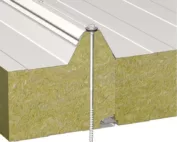
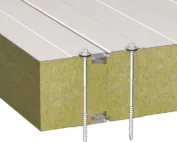
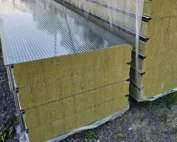
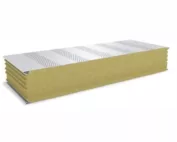
Mineral wool in panels
Does the whole panel with mineral wool have class A1, or does A2 need to be checked?
In brief
A mineral core alone is not enough to assign class A1 to the whole panel. The adhesive and facings must also be assessed. For many complete insulated wall panels with a mineral wool core, class A2-s1,d0 is declared. This must be distinguished from the fire resistance of the finished wall. This information describes different material behaviour and the two cannot be substituted for each other. Reaction to fire describes the product’s contribution to fire development under specified test conditions. The classification is read for the specified product. In a sandwich panel, that product is the element with core, adhesive and facings. The parameter of the mineral wool alone is not automatically the parameter of such an assembly.
What exactly does the reaction to fire class cover?
In the documentation one finds, for example, A2-s1,d0 for a panel with mineral wool. This designation should not be shortened to A1. In a question to the supplier it is worth using the words ‘reaction to fire of the complete panel’. This avoids an answer relating only to the insulating material that sits between the steel sheets.
What do the additional symbols s1 and d0 mean?
The s designation refers to smoke production in the test. The d symbol concerns burning droplets and particles. The indices are part of the result and should remain in the specification. It is not worth replacing the full designation with the general term ‘fire-resistant’. Such a word specifies neither the class of the product nor the conditions of its use.
A2-s1,d0 is also not a promise that there will be no smoke at all in every real fire. In a building, furnishings and stored materials also burn. The classification of the panel does not describe that entire event. Its role is to provide a specific parameter for the design assessment.
Why does A2 not replace an EI requirement?
EI concerns the fire resistance of the separating element. E means fire integrity, and I fire insulation. The number next to the symbols expresses the classification time in minutes. The result refers to the tested assembly or one covered by the approved range. Connections, spans and the method of fixing matter.
An example family of panels with concealed fixing has A2-s1,d0 for thicknesses of 80, 100 and 120 mm. For thicknesses of 80 and 100 mm, this data sheet states NPD, i.e. no declaration of this property. EI120 is given for the 120 mm variant, within the range of assemblies covered by the classification. This is a good example of why a common reaction to fire does not mean a common resistance of the entire wall.
How to check the wall in a small pavilion?
First the function of the wall is established. An ordinary room enclosure is assessed differently from a separating element with a fire requirement. The design should specify the required class and the conditions for achieving it. Only then are the panel, the supports, the fasteners and the details at corners and openings selected.
The small size of the building does not allow these findings to be omitted. The proximity of other structures, the way the building is used and the presence of people may affect the requirements. This cannot be resolved by core thickness alone. If the assembly departs from the classified solution, an assessment of its acceptability is required.

Which changes on site can matter?
A new ventilation opening, a larger door or another supporting structure changes the finished partition. Replacing the specified flashing with an arbitrary profile has a similar effect. A gap that looks good does not prove a correct fire performance solution. Service penetrations must be resolved in accordance with their function.
The result for a wall should not be transferred to a roof or ceiling either. Each assembly may perform and be tested differently. The R requirement, where it applies, relates to loadbearing capacity. It does not simply follow from the presence of steel facings. Load and method of support remain part of the assessment.
The NRO designation also relates to a different property than EI. It should not be used as a substitute for fire resistance duration. In the schedule of requirements, it is worth having separate fields for reaction to fire, fire spread and partition resistance. Each result requires verification of the scope to which it applies, rather than combining symbols into a single assurance of safety.
What should be written into the order and the acceptance?
Record the full identification of the panel, its thickness and the facing configuration. Add the required reaction to fire and the required partition resistance class. The documentation should relate to the variant supplied. It is also worth establishing which installation details must be maintained for the wall to fall within the scope of the classification.
During acceptance, check the delivery markings and the condition of the edges. A damaged joint does not become correct simply because the core is mineral. Any material substitution must be assessed before installation. Once the panels are installed, identification and repair of joints may be considerably more difficult.
What else is worth asking about
Is the word “non-combustible” sufficient in a quote?
It does not specify the full result. The class of the complete panel is required, together with a document for the relevant variant. The required fire resistance of the wall is checked separately.
Does the absence of an EI declaration mean a zero result?
The NPD designation means that this property has not been declared. It must not be assigned a value from another thickness, nor may such a panel be treated as a confirmed EI solution.
7 branches. Materials closer to your project.

- SEROCK — Dzierżenin 34 E
- BŁONIE — ul. Sochaczewska 138A
- RADOM — ul. Grobickiego 8
- ŁÓDŹ — Natolin 8
- OLSZTYN — Barczewo, ul. Prosta 9
- WROCŁAW — ul. Jerzmanowska 10C
- GORZÓW WLKP. — ul. Zielona 33/34