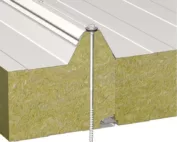
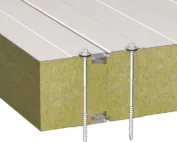
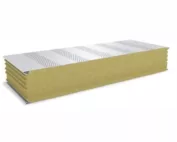
Mineral wool in panels
How much does an insulated wall panel with a mineral wool core weigh and how do you calculate the weight of a whole batch?
In brief
The weight of a panel with a mineral wool core is needed to check the structure, delivery and lifting method. It is not worth guessing it from thickness alone. The core, steel facings and module width matter. It is particularly easy to confuse kilograms per linear metre with kilograms per square metre. The examples below show how to calculate correctly. The weight consists of the mineral wool, both facings and the other components of the panel. Cores can have different densities. Steel sheets may be made in different thicknesses. Profiling changes the amount of material per covered area. Therefore the name “100 mm panel” does not define a single weight.
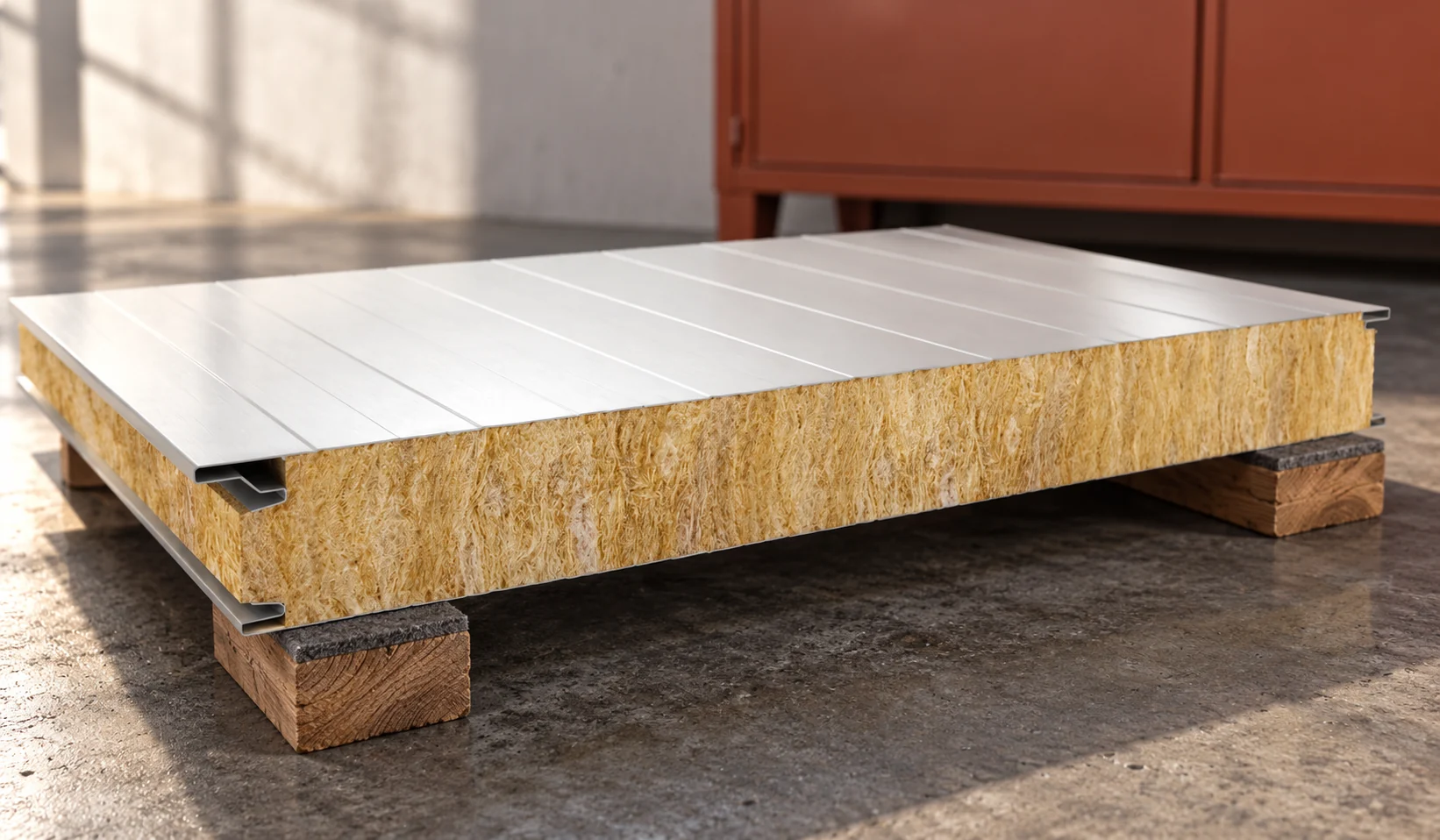
Why do panels of the same thickness weigh differently?
The entire variant must be identified in the comparison. If you are comparing two offers, check the thickness of both facings, not just the outer one. A lighter panel is not automatically worse. A heavier one does not necessarily have better load-bearing capacity in every configuration. These properties should be assessed separately on the basis of the relevant data.
What values can be assumed in the example?
Let us consider the family of insulated wall panels with a mineral wool core of nominal density 105 kg/m³, concealed fixing and facings of 0.5/0.6 mm. For a module of 1000 mm, the following weights are given. These are data for this configuration and cannot be transferred to any product.
| Thickness | Weight per 1 linear metre at a module of 1 m |
|---|---|
| 80 mm | 18.2 kg |
| 100 mm | 20.3 kg |
| 120 mm | 22.4 kg |
At a width of 1 m, one metre of length covers 1 m². The values are therefore numerically the same as kg/m². If the module is wider, this simplification no longer applies. You need to read the unit and the footnote below the table.
How do you calculate one panel and a pack?
For the 100 mm variant and a length of 4.6 m, the calculation is 20.3 × 4.6 = 93.38 kg. Ten such elements weigh approximately 933.8 kg without packaging and supports. This is a significant difference from thinking in terms of ‘a few light panels’. The delivery must account for the weight of the entire pack and its dimensions.
If the table gives kg/m², multiply that value by the length and the effective width. If it gives kg/mb, multiply by the length for the specified module. In the second case, you must not multiply by the width a second time. Always write the units next to the calculation. This makes it easier to spot an error before organising transport.
Unit example: when a material with a coverage of 1.15 m weighs 23 kg/mb, its surface mass is 23/1.15 = 20 kg/m². This is a calculation showing the conversion, without assigning it to a specific panel.
What does the weight say about the required structure?
Self-weight is one of the loads. The wall must also carry the action of the wind. The structure, fixings and supports should be checked together. A high column load capacity does not mean that any washer or screw will transfer the forces from the cladding. Every connection has a specific function.
When replacing an old enclosure, the new weight must be compared with the previous one. The difference may affect the locking bars and anchors. This should not be assessed solely on the basis of the structure’s appearance. For a series of small buildings, it is worth keeping separate schedules. A change in thickness or facings in one delivery can alter the load on the entire wall.

How should lifting and unloading be prepared?
In addition to the mass, the length and rigidity of the element are important. The panel must be lifted in the manner intended for its construction. Improper support can damage the edges or the bond between the facings and the core. The equipment and accessories must be matched to the actual load. The plan should not be based on nominal lifting capacity alone without taking working conditions into account.
Before delivery, prepare a level storage area and suitable supports. Establish the installation sequence to limit the repositioning of packs. A heavy mineral wool panel should not be dragged across an adjacent surface. The cost of damaging the coating or the lock can exceed the savings from improvised unloading.
What information should be passed on to the crew and the carrier?
State the number of packs, lengths, widths and masses. Add the packaging method and the planned unloading point. The schedule should distinguish between the mass of a single panel and that of the entire transport unit. If the data are estimated, this must be noted and confirmed before selecting the equipment.
Keep the table for the correct variant in the documentation. Do not use a mass found for a similar panel with different facings. The correct calculation is simple when the starting point is the correct unit. The error usually occurs earlier: in the selection of data, not in the multiplication itself.
It is also worth including the accessories. Flashings, profiles and packaging are not automatically included in the panel mass given in the catalogue.
What else is worth asking about
Can the mass be calculated from the mineral wool density alone?
This will give the approximate mass of the core alone. The finished panel also contains steel facings and other components. Planning uses the data for the entire product.
Do kg/m and kg/m² always mean the same thing?
No. The numbers coincide at a usable width of 1 m. For a different module, the units must be converted correctly.
7 branches. Materials closer to your project.

- SEROCK — Dzierżenin 34 E
- BŁONIE — ul. Sochaczewska 138A
- RADOM — ul. Grobickiego 8
- ŁÓDŹ — Natolin 8
- OLSZTYN — Barczewo, ul. Prosta 9
- WROCŁAW — ul. Jerzmanowska 10C
- GORZÓW WLKP. — ul. Zielona 33/34