Mineral wool in panels
What are the advantages and limitations of an insulated panel with a mineral wool core?
In brief
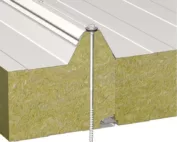
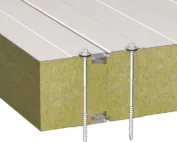
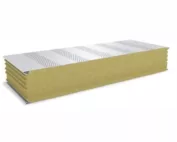
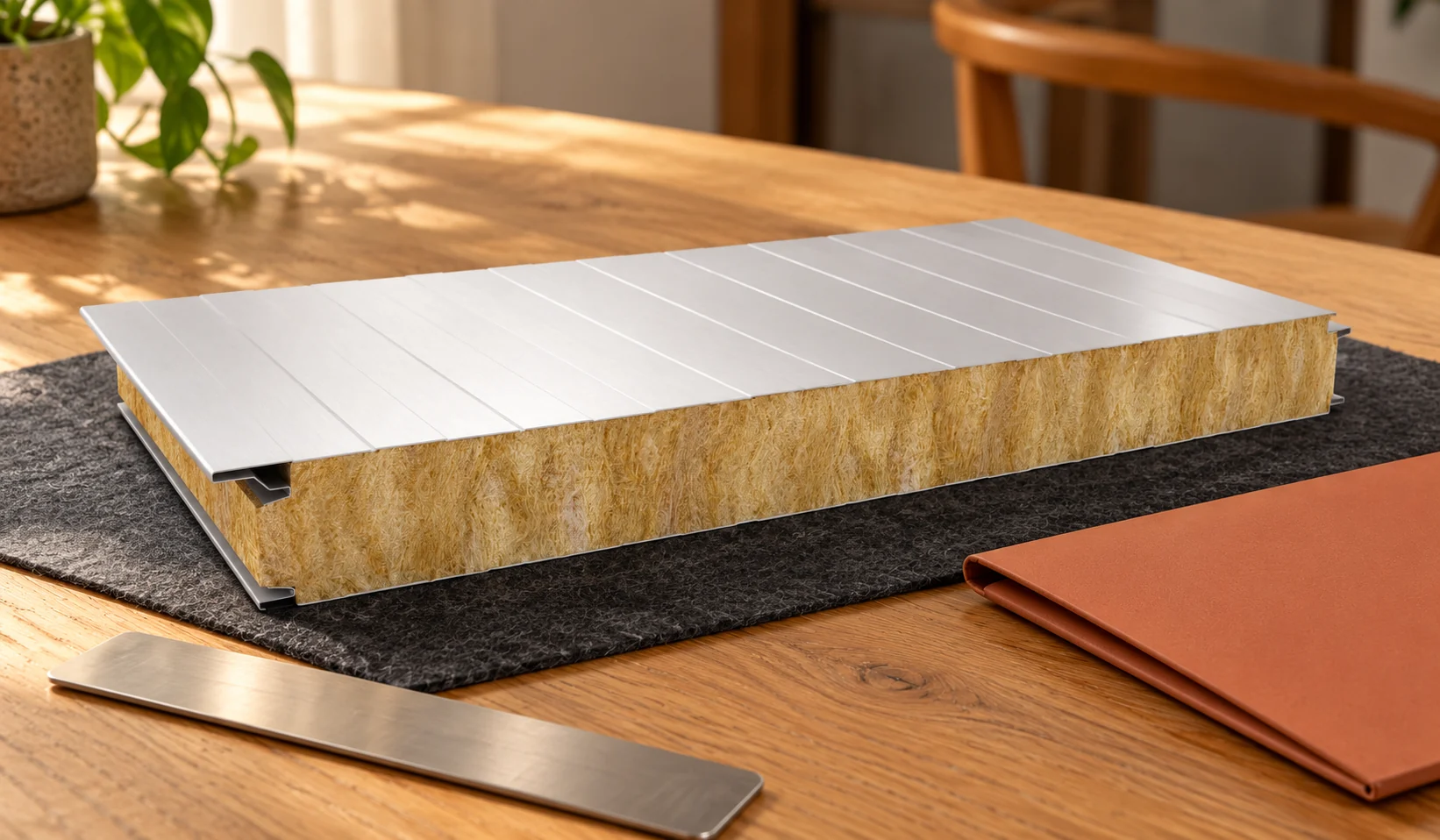
A mineral wool panel combines the casing and insulation in a single prefabricated element. It can be a good choice for specific fire requirements. However, it has a greater mass than many panels with a foam core and requires edge protection against water. A fair comparison should cover these characteristics together, without reducing the choice to a single slogan. Ready-made mineral wool panels can achieve reaction-to-fire class A2-s1,d0. This is a beneficial characteristic in many applications. However, it should not be used to replace the required fire resistance of a wall. The EI class relates to a specific assembly and duration for which defined functions are maintained. Installation, supports and connections remain part of the solution.
Where does the main fire-related benefit lie?
One advantage is the ability to match the system to a demanding building envelope. A limitation remains the need to maintain the classification conditions. A later opening, a different panel orientation or a change of fixing may require reassessment. It is not enough to state that the core is mineral, so every modification will be neutral.
What does the thermal insulation look like?
The mineral wool in the core restricts heat flow. For the same thickness, the result may differ from that of a PIR panel. The U-value of the finished variant must be compared. The lambda of the core alone does not cover all the characteristics of the joint and geometry. The U-value of the whole wall should not be calculated solely by dividing the thickness by the lambda.
An example panel with concealed fixing and a thickness of 100 mm has a U-value of 0.44 W/(m²·K), and 120 mm gives 0.37. This is a specific product family. If the project requires a lower value, another solution or a greater thickness must be considered. At the same time, the plinths, corners, joinery and the connection to the roof must be assessed.
What does the greater mass mean in practice?
A heavier element affects the structure and the organisation of installation. In the example variant of 100 mm, the mass is 20.3 kg/mb with a cover width of 1 m and facings of 0.5/0.6 mm. A panel 4 m long therefore weighs approximately 81.2 kg. This calculation applies to the specified configuration. Other facings will change the result.
Planning should not be based solely on the number of people available on site. Suitable equipment and a method of support are needed. A long panel requires protection against deflection and damage to the edges. Greater mass is not a disqualifying disadvantage, but it must be taken into account in logistics and in checking the structure.
Does mineral wool solve every noise problem?
A mineral core may be useful in selecting an acoustic building envelope. However, the declared insulation of the finished panel must be checked. Full steel facings separate the core from the room. The same absorption as from exposed mineral wool or a special perforated panel should not be expected.
Noise also penetrates through doors, windows and gaps. In a hall, reverberation from hard surfaces may dominate. Increasing the wall thickness will not always solve this problem. It is worth first establishing whether the issue is sound passing to the outside or speech comfort inside. These are two different design tasks.

Why is edge detailing so important?
The core should remain protected from water. An open end at the base or a leaky flashing can worsen the panel’s operating conditions. A dampened element requires assessment, not automatic acceptance as functional after superficial drying. The tightness of joints must be checked throughout the service life.
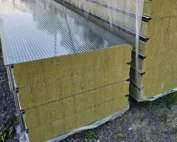
This feature also requires good storage. Packs should not lie directly on wet ground. Transport damage should be detected before installation. In buildings that are regularly washed, coatings and details must be matched to the cleaning procedure. The choice of mineral wool alone does not ensure resistance to any chemical.
How do you weigh up the pros and cons when choosing?
Record the requirements for fire, heat, sound and appearance. Then compare complete variants with the substructure and accessories. A mineral wool panel may prove suitable despite higher weight if it meets the key requirement of the partition. In another building, the thermal priority may lead to a different core.
There is no need to win a ranking of all materials. The aim is to meet the task at a reasonable cost and with feasible installation. In a small pavilion, it is worth considering the façade, the separating wall and the roof separately. One product group does not have to be the best solution for each of these parts.
Before purchase, also check the possibility of servicing. Access to joints and documentation of the applied system will facilitate later repair without accidental change to the wall’s properties.
What else is worth asking about
Is a mineral wool panel always heavier than every PIR panel?
Many comparable variants are heavier, but the result depends on thickness and facings. Compare the actual weights of specific products.
Can cut mineral wool be left exposed on the façade?
The detail at the destination should protect the core from water and damage. The open edge requires proper termination in accordance with the system.
7 branches. Materials closer to your project.

- SEROCK — Dzierżenin 34 E
- BŁONIE — ul. Sochaczewska 138A
- RADOM — ul. Grobickiego 8
- ŁÓDŹ — Natolin 8
- OLSZTYN — Barczewo, ul. Prosta 9
- WROCŁAW — ul. Jerzmanowska 10C
- GORZÓW WLKP. — ul. Zielona 33/34