Fixing and installation
How to calculate the number of screws for sandwich panels without guessing?
In brief
There is no single correct number of screws per metre for every panel. Panel data, supports and loads are required. Only from the fixing design can the quantity for ordering be derived. An average per m² helps logistically but does not determine the layout. On walls and roofs, it is also important to distinguish between main fasteners and secondary connections. You can ask about a square metre of surface area, a linear metre of panel or a linear metre of joint. These are different bases for calculation. For a panel 1 m wide, the first two figures may be equal, but with a different module they are not. Always state the unit and the fixing scope.
What exactly does a metre mean in the question about screws?
The most reliable schedule comes from the number of points on the drawing. An average can be calculated at the end for order verification. This order must not be reversed and screws must not be spread across the façade on the basis of a single value found for another building.
How does wind affect the number and layout?
Wind load depends, among other things, on the location, height and geometry of the building. Zones at the edges may require a different solution than the middle of the wall. The design also takes into account the direction of action and the relevant load combinations.
It is not enough to add one screw at each corner of the panel. What counts is the load-bearing capacity of the entire load path. It comprises the cladding, the fastener, the support and the structure. A narrow strip of façade at the corner may have different requirements than the rest of the surface.
Why does the type of support change the choice of fastener?
The screw must match the material and thickness of the component into which it is fastened. Steel, timber and systems based on other substrates require suitable solutions. The panel thickness, grip length and washer geometry are also important.
The possibility of pull-out from the support and pull-through through the cladding is checked. The strength of the shank alone does not describe the entire connection. A longer screw does not necessarily have a higher usable load-bearing capacity. A fastener selected for the wrong steel thickness may perform incorrectly.
In the connector’s specification, check the drilling range and the approved substrate. A tip designed for a different steel thickness can hinder correct installation. The choice is not determined by the screw’s external dimension alone, nor by the similarity of the washer to a component used previously.
How to distinguish main fixings from secondary ones?
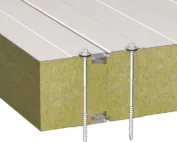
The main connectors transfer the panel loads to the structure. Other screws may stitch the sheet overlap or fix the flashing. They are not interchangeable just because they have a similar head. Each group has its own length, application and layout.
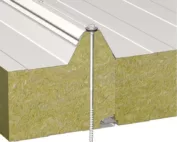
In panels with concealed fixing, the geometry of the lock and any pressure-distributing elements are important. Do not copy the layout from a face-fixed variant. Wall and roof do not have to share the same pattern either. The purchase schedule should preserve this division.

How do you turn a finished plan into an order?
The example concerns counting pieces only, not the fixing design. Assume the approved plan specifies 6 connectors for each of 20 panels and 9 for each of the next 10. You need 20 × 6 + 10 × 9 = 210 main connectors. Other groups are summed separately.
If these panels give 90 m² of surface, the average is 2.33 connectors per m². This does not mean placing two or three screws in any given metre of wall. The actual points remain in accordance with the plan. The order reserve is determined separately.
What should be checked during tightening?
The screw should hit the intended support and panel position. Too much pressure can deform the cladding and the seal. Too little leaves play. The tool setting must be checked during work, especially when changing the substrate thickness or connector type.
A screw that misses the support does not become correct by adding another next to it. The resulting hole requires proper repair. Swarf is removed from the surface. Non-conformity should not be masked with paint without assessing its effect on tightness and durability.
How do you carry out checks across a series of similar buildings?
Assign the fixing plan to the specific pavilion and delivery. A change of location or height can change the loads. A change of cladding thickness also requires assessment. The repetitive appearance of the buildings does not prove that all connections perform identically.
At acceptance, check the connector types, their layout and the condition of the washers. Keep the packaging markings and documentation. This will make it easier to reorder the correct parts. The number of boxes used can help with verification, but does not replace inspection of the fixing points.
What else is worth asking about
Does a larger number of screws always improve safety?
Not automatically. Additional holes may be in the wrong places or may weaken the connection. The correct type and layout must be selected instead of arbitrarily increasing the density of fasteners.
Can one type of screw be used for the entire cladding?
Only if it meets all the intended tasks, which is not the rule. Fastening to the support, stitching the lap and installing flashings often require different elements. Check each group separately.
7 branches. Materials closer to your project.

- SEROCK — Dzierżenin 34 E
- BŁONIE — ul. Sochaczewska 138A
- RADOM — ul. Grobickiego 8
- ŁÓDŹ — Natolin 8
- OLSZTYN — Barczewo, ul. Prosta 9
- WROCŁAW — ul. Jerzmanowska 10C
- GORZÓW WLKP. — ul. Zielona 33/34