Installation and details
Metal roof tiles on site: taking delivery, storing sheets and drying a wet pack
In brief
Before signing for a delivery of tile-effect sheets, compare the pack labels with your order. Do the sheet lengths, profile, finish and quantities tally? Look for dents in the packaging, signs that the sheets have slipped, and evidence of moisture. Photograph any damage before unloading, while it is still possible to show how the pack arrived. Choose a handling method suited to its weight and dimensions and a dry, ventilated storage space that meets the manufacturer’s instructions. An undamaged outer sheet can hide a wet or damaged sheet underneath.
What should be checked on delivery?
The labels should be compared with the order and the condition of the packaging inspected. It is worth checking for signs of impact, shifted sheets and moisture. Damage should be well documented before unloading. Later it is more difficult to establish at which stage it occurred.
It is also worth checking that the length, profile, colour and number of elements match. The outer sheet does not show the full condition of the pack, but it can reveal a problem requiring closer inspection. The inspection should not be postponed until the day of installation, especially when the material is to wait for a longer time. Delivery documents and labels must be kept.
How to unload long sheets safely?
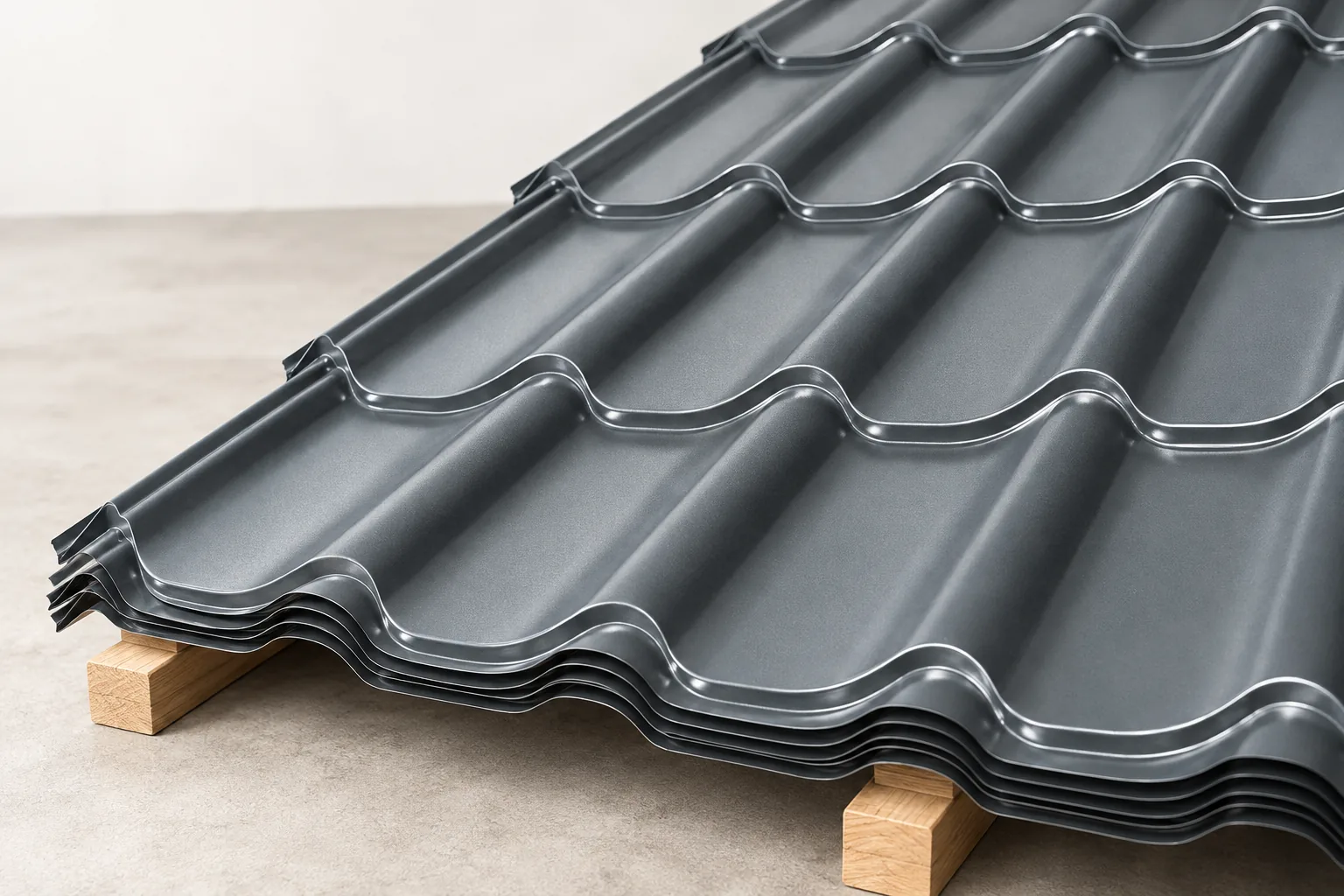
A long sheet is easily deformed if supported at only one point. The unloading method should match the dimensions and weight of the pack. More people may be needed, or equipment with an appropriate support spacing. Improvisation should not be left until the lorry arrives.
The sheets must not be dragged over one another or over the ground. The surface can be scratched by minor contamination. Gripping and carrying should limit bending. Modular tile-effect metal roofing is more convenient logistically, but also requires care. The small format does not protect the edges from impact or the paint from scratching.
Where should the material be placed while waiting?
The place should be dry, well ventilated and protected against accidental damage. The substrate must allow stable support of the pack in accordance with the instructions. It should not be placed directly on the ground or where water collects.
The method of covering must not trap moisture inside. Tightly wrapping a wet pack in additional film can hinder drying. Contact with aggressive substances and building materials should also be avoided. Mortar, fertilisers or chemicals can damage the coating. Delivery should ideally be planned as close as possible to the installation date, while allowing time for inspection.

What to do if the pack has got wet?
Water between adjacent sheets can remain for a long time, even if the surface of the packaging is dry. The manufacturer’s recommendations should be followed, usually ensuring separation and drying of the elements. It is not worth waiting for the pack to dry out on its own in its compact form.
During unpacking, protect the surfaces from rubbing. If deposits, discolouration or coating damage have appeared, document them and determine the next steps. Do not clean the sheet with an arbitrary acid, solvent or abrasive product. Such an attempt may worsen the condition of the material and make it harder to assess the original cause.
How should the protective film be handled?
The film is intended to protect the surface during specific stages of transport and installation. It is not a permanent functional layer. The manufacturer specifies the deadline and conditions for its removal. Prolonged exposure to sun and temperature can make peeling difficult or leave adhesive behind.
There is no single deadline for all coatings and products. The documentation for the specific order must be checked. The film must also be removed where it would be enclosed in the structure after installation. Peeling off a visible fragment is not enough if residues remain between the sheets. It is worth checking this during laying, not only after the roof slope is completed.
What else protects the sheet before installation?
Do not stack tools or other materials on the packs. Accidental loading can deform the profile. Limit the movement of crews in the immediate vicinity and do not carry out work above the sheet that causes sparks or filings to scatter.
It is worth designating a separate cutting area. Filings from processing can land on sheets waiting for installation and leave rusty marks after the first rain. The material intended for laying should be checked before it is passed onto the roof. Damage is easier to spot and describe on the ground than after an element has been fixed in the roof slope.
Good storage requires a plan, but it does not have to be complicated. The most important things are compliance with the instructions, a quick response to water and careful handling. It is worth agreeing with the contractor who is responsible for the material from the moment of unloading. A clear division of responsibilities helps avoid a situation in which a pack remains unchecked for many days.
7 branches. Materials closer to your project.

- SEROCK — Dzierżenin 34 E
- BŁONIE — ul. Sochaczewska 138A
- RADOM — ul. Grobickiego 8
- ŁÓDŹ — Natolin 8
- OLSZTYN — Barczewo, ul. Prosta 9
- WROCŁAW — ul. Jerzmanowska 10C
- GORZÓW WLKP. — ul. Zielona 33/34