Fixing and installation
How to maintain a sandwich panel roof without damaging the covering
In brief
Servicing a sandwich panel roof requires prepared access and protection of the facings. It must not be assumed that every panel can be walked on freely. The pressure of a foot, a toolbox or the base of a device acts locally. A planned route, proper support and inspection after work help limit damage. The sheet coating protects it from environmental exposure. During servicing it can be scratched by a tool, a metal filing or a small stone. Visible damage does not necessarily cause a leak immediately, but it requires assessment and proper handling. Denting the facing is also not neutral. It can change the local geometry and hinder water drainage.
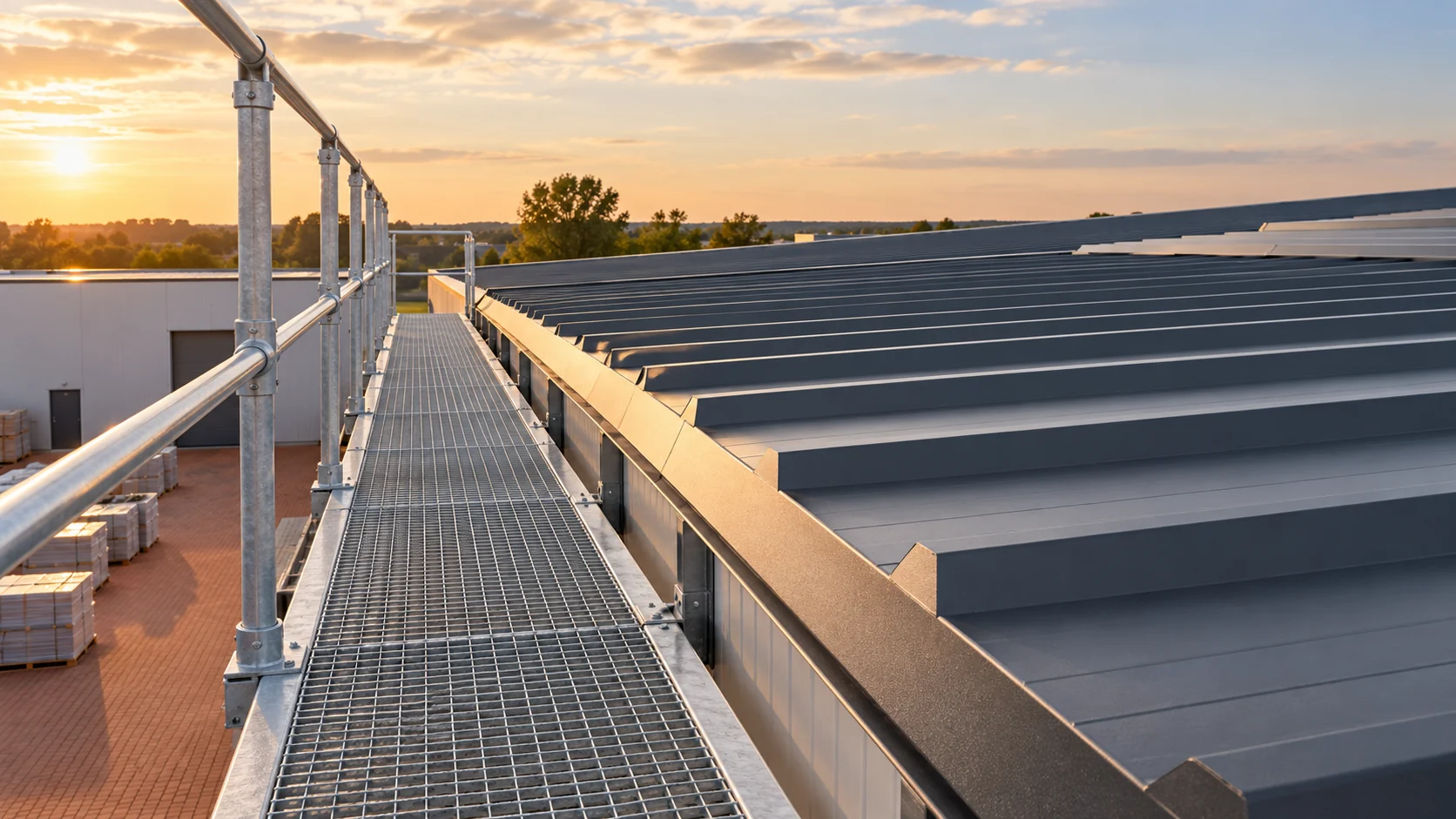
Why can a routine inspection leave a mark?
The way loads are transferred through the entire panel matters. Data for uniformly distributed load does not automatically confirm resistance to every point load. Strength should not be checked by test-stepping onto a questionable section. First, the condition of the element, its support and the permitted method of access must be established. The age of the building is not the only criterion for such an assessment.
How should servicing be prepared?
Start with the task that needs to be carried out. A short visual check is different from replacing a heavy component. Determine the number of people, the tools and how the parts will be delivered. Then check access to the work area and the possibility of a safe retreat. Take account of openings, skylights and roof edges.
Permanent access routes and platforms are selected to suit the structure and the covering. Their support must not accidentally crush the sheet. Fall protection requires suitable points and a correct method of use. An ordinary panel fixing screw does not thereby become an anchor point. If equipment has been moved, the service route must be checked again, not just the length of the cable.
When do conditions on the roof rule out work?
Moisture, frost and contamination can make the steel surface slippery. Wind makes it harder to carry tools and materials. Conditions are assessed before work begins and during the work. Good conditions on entry do not guarantee that they will hold throughout the inspection. The plan should allow for the possibility of interrupting the task.
An unknown roof condition can also be an obstacle. Corrosion, detachment, signs of overloading or loose fixings require clarification. Do not rest the platform on a section whose suitability is doubtful. A temporary covering of damage does not provide load-bearing capacity. If the inspection can be carried out from another safe access point, this method should be considered before going onto the covering.
How to protect the surface during repair?
Put tools down in the designated place, on a solution that protects the coating and properly transfers the load. Do not slide boxes directly across the roof. Avoid placing sharp items on the paintwork. Pay attention to particles produced when drilling. Leftover swarf can corrode and leave marks on the surface.
Use methods suited to the material. Do not use random chemicals or tools that damage the sheet’s protective coating. If the repair requires cutting, the method of execution and edge protection should follow the instructions. Do not cover joint damage with further layers of unspecified compound. The repair should restore the function of the detail, not merely hide the visible gap.

What to check after servicing is complete?
Check the access route and the work area. Look for scratches, dents, left-behind parts and dirt. Inspect the flashings, seals and fixings in the area of intervention. If a piece of equipment was removed, confirm it has been properly refastened. Do not leave material on the roof that could end up in the gutter or shift in the wind.
Record the scope of work and any problems noted in the report. Photos taken before and after the work make it easier to assess changes. There is no need to create an extensive album of every metre of roof. What matters are the areas of intervention and the specific findings. If the damage requires further assessment, mark it in the documentation and plan the appropriate action, rather than leaving a general note without a location.
How to make future inspections easier?
Keep the plan of supports, access routes and access points together with the building documentation. Add changes resulting from the installation of new equipment. A new team should know which solutions were intended for roof maintenance. It should not have to reconstruct these arrangements from the appearance of the covering. This shortens preparation for the next service.
Adapt the inspection schedule to the environmental conditions and the scope of use. A roof near trees may require more frequent inspection of drainage. Areas exposed to contamination require proper cleaning of the coating. A well-maintained roof is the result of design, execution and subsequent maintenance. None of these stages replaces the others, and random walking on the roof slope is not an inspection method.
What else is worth asking about
Is a soft sole enough for safe access?
No. Footwear is only part of the equipment. A roof assessment, proper access and suitable protection for the specific work are needed.
Can the equipment being replaced be stored on the covering?
Only if such a load and its support have been provided for and checked. A heavy component must not be placed at random on the cladding.
7 branches. Materials closer to your project.

- SEROCK — Dzierżenin 34 E
- BŁONIE — ul. Sochaczewska 138A
- RADOM — ul. Grobickiego 8
- ŁÓDŹ — Natolin 8
- OLSZTYN — Barczewo, ul. Prosta 9
- WROCŁAW — ul. Jerzmanowska 10C
- GORZÓW WLKP. — ul. Zielona 33/34