Fixing and installation
How should the anchoring of a steel hall be prepared for a concrete foundation?
In brief
The column-to-foundation connection transfers forces from the structure to the concrete. It is not selected solely on the basis of the weight of the panels. Bonded anchors can be part of the solution if they correspond to the design and the substrate. Geometry, hole preparation and curing conditions matter. There is no single set of diameters and depths for every hall. In addition to weight, wind, snow and other loads arising from the function of the building act on it. Tensile, shear and moment forces may occur at the column base. The base plate, anchors and concrete work together. Selecting a single rod without assessing this system is not a connection design.

What forces must the connection take up?
The foundation and the ground itself are equally important. A strong anchor will not compensate for a footing that is too small or for incorrect founding. The solution should follow from the calculation of the entire structure. Even a small hall with lightweight cladding can still be significantly loaded by wind.
What needs to be known about the concrete?
Its properties, the thickness of the element and its condition are needed. The design also takes into account cracking conditions and the position of the reinforcement. Old concrete may require investigation. The load-bearing capacity should not be selected on the basis of the surface appearance alone or a random measurement of a single characteristic.
The edge distances of the anchors and the spacing between them matter. A group of fixings does not always behave as the sum of independent individual anchors. A hole too close to the edge can change the mode of concrete failure. Such limitations are not eliminated by using more resin.
When can a bonded system be used?
When it has the correct intended use and the design confirms its use. The system comprises the mortar, the anchoring element and a defined method of execution. Random components should not be mixed. The documentation specifies the approved substrates, the hole conditions and the range of parameters.
Some solutions may be used in cracked concrete or under specified moisture conditions. Others have a narrower range. The specific configuration must be checked. It cannot be assumed that every “chemical anchor” is suitable for a structural hall footing simply because it works in masonry for minor equipment.
How should the holes be prepared without weakening the connection?
First, the spacing and position relative to the design and reinforcement are confirmed. The drilling method, diameter and depth must match the system. If the hole encounters an unforeseen obstruction, an assessment of how to proceed is needed. Reinforcement must not be cut arbitrarily, nor the fixing repositioned.
Cleaning is carried out exactly according to the instructions. Dust and contamination can reduce adhesion. There are systems with a specified drilling and extraction method, but their exceptions do not apply to any anchor. The general slogan ‘no cleaning’ cannot replace the conditions of a specific solution.

Why do temperature and time matter?
The mortar has a specified working and curing time. These are influenced by the conditions stated in the instructions, including the substrate temperature. A short working time must not be equated with readiness for full load. The anchor must reach the required condition before further operations specified in the design.
The storage conditions and the material’s expiry date are also important. Filling the hole and inserting the rod should correspond to the system procedure. Voids and uncontrolled changes in position during setting must be avoided. There is no single number of minutes suitable for all mortars and weather conditions.
What should be checked when setting the column?
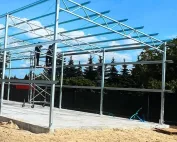
The connection must maintain the designed levels, the support of the base and the tightening method. If grouting is specified, its properties and execution are part of the solution. Accidental shims should not replace the designed transfer of forces. The temporary stability of the structure being erected is equally important.
The column should not be left without the required bracing merely because it stands on anchors. The assembly sequence and temporary securing must be agreed with the structure contractor. Panel cladding is not always a stabilising element. It must not be assigned such a role without design.
How should the fixing be documented and accepted?
Record the system used, the hole parameters and the execution conditions. Acceptance should confirm compliance with the design, not merely the presence of nuts. If necessary, the scope of inspection or testing is determined by the designer. A visible, level column base does not show the quality of the part concealed in the concrete.
Every deviation must be clarified before the structure is loaded. This applies to incorrect spacing, damage to the concrete and incomplete embedment. Repair after the entire hall has been erected can be considerably more difficult. Good anchoring begins with the design and ends with confirmed execution of all its conditions.
What else is worth asking about
Will a larger rod diameter always improve the fixing?
It does not determine load-bearing capacity on its own. The concrete, spacing, edge distances, depth and the interaction of the entire connection all matter. Any change must be recalculated.
Can an anchor be loaded when the mortar appears hard?
A touch assessment does not replace the required curing time under the given conditions. The system documentation and the acceptance rules for the connection must be observed.
7 branches. Materials closer to your project.

- SEROCK — Dzierżenin 34 E
- BŁONIE — ul. Sochaczewska 138A
- RADOM — ul. Grobickiego 8
- ŁÓDŹ — Natolin 8
- OLSZTYN — Barczewo, ul. Prosta 9
- WROCŁAW — ul. Jerzmanowska 10C
- GORZÓW WLKP. — ul. Zielona 33/34