Gutters and drainage
Getting gutters ready for winter: what to check after cleaning
In brief
Vacuuming gutters removes leaves and sediment, but it does not replace an inspection of the whole drainage system. The owner should check whether, after cleaning, water flows freely from the roof surface through outlets, bends and downpipes to the receiver at ground level. A clean gutter does not guarantee flow if the fall is wrong or a joint is damaged. It is worth establishing which sections were actually checked rather than relying on outward appearance. The final assessment of how the system works is best made after the first heavy rain, watching for backflow or overflow.
When is gutter vacuuming useful?
Specialist equipment allows debris to be removed from hard-to-reach places, sometimes without going onto the roof. It can reduce the need to move the ladder along a long eaves line. However, its usefulness depends on the height, the shape of the gutter, the type of debris and access. Not every nozzle will reach around a corner or under a guard fitted above the outlet.
The method should be matched to the gutter material and the condition of the system. The tool should not scratch the coating, deform the edges or stress the joints. Wet, compacted deposits may require different handling from dry leaves. The choice of equipment is up to the person carrying out the cleaning. The owner should above all know which sections were actually inspected.
Why does a clean surface not mean free drainage?
The largest accumulations of leaves often form at outlets and protective baskets. Some debris may also reach the bend of the downpipe. Vacuuming a horizontal section does not guarantee that such a blockage is removed. The path of the water must be traced from the roof slope all the way to the discharge point. Only then is it known whether the system drains freely.
It is worth checking the rainwater gully, if one is fitted, and access for cleaning it. Accumulated sand and leaves can block the outlet at ground level. In that case water may back up even though the gutter is empty. The cover should remain accessible also after paving has been laid or soil added. A covered inspection point makes every subsequent check more difficult.
How to check performance after cleaning?
After the deposits have been removed, a flow check can be carried out in a manner consistent with the drainage layout. It is observed whether the water heads towards the outlet, whether it stops locally and whether it escapes through the joints. A jet that forces water under the covering or separates components should not be used. Pouring a large amount of water alone does not replace a visual inspection.
Standing water may indicate incorrectly positioned brackets or a deformed gutter. Overflow during heavy rain can also be the result of insufficient system capacity. In that case an assessment of the roof area served and the arrangement of the outlets is needed. Further cleaning will not correct an error in the choice of cross-section or outlet position.

What to inspect beyond the inside of the gutter?
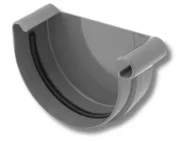
Brackets, connectors, corners, end caps and pipe clips are checked. Cracks, bends and signs of component movement are important. The protective surface and areas of corrosion should also be inspected. Repair depends on the material and the system. Using an unsuitable adhesive or sealant may make later proper replacement of the joint more difficult.
Gutters work under the influence of temperature. This applies to both plastics and metal, although the range of changes differs. Sliding connections must not be blocked arbitrarily. The fixing rules specified by the manufacturer must be maintained. Details differ between systems, so installation clearances should not be transferred from one set of instructions to another.
Do mesh guards and baskets solve the leaf problem?
Guards can reduce the amount of larger debris in the system, but they themselves also require inspection. Fine needles, dust and seeds can pass through the mesh or accumulate on the surface of the guard. A blocked basket at the outlet can stop drainage. Such an accessory changes the way the system is maintained, but does not remove the need for cleaning.
The choice is worth basing on the surrounding trees and access to the gutter. In one place, periodic removal of leaves is enough; in another, a well-fitted guard will be useful. It should be checked whether the element restricts performance and whether it can be easily removed. The most important thing is the ability to keep the system clear, not the mere installation of an additional part.
How should you finish preparing gutters for winter?
After cleaning and inspection, identified faults should be rectified and it should be ensured that water drains to the right place. It is worth inspecting the system after the first heavier rain. If water still overflows after cleaning, the diagnosis must be revisited. A mark on the façade may indicate the location of the problem, but does not always show its actual cause.
Before winter, do not attempt to improve gutters by loading them, or later break ice in them with a tool. This can damage the coating, connectors and brackets. In buildings with recurring icing problems, an assessment of the roof and drainage is needed. Vacuuming alone helps maintain cleanliness, but an effective inspection covers the entire system and how it works.
7 branches. Materials closer to your project.

- SEROCK — Dzierżenin 34 E
- BŁONIE — ul. Sochaczewska 138A
- RADOM — ul. Grobickiego 8
- ŁÓDŹ — Natolin 8
- OLSZTYN — Barczewo, ul. Prosta 9
- WROCŁAW — ul. Jerzmanowska 10C
- GORZÓW WLKP. — ul. Zielona 33/34