Mineral wool in panels
How to choose an insulated wall panel with a mineral wool core for the actual building conditions?
In brief
The best panel with mineral wool is one that meets the requirements of the specific wall. For one building, fire resistance will be most important. For another, heating, appearance or the weight of the elements matter. Choosing the thickness alone does not settle the matter. You need to compare the whole panel, its fixing and the application conditions specified for the selected variant. Start with the building’s function, the internal temperature and the nature of the work. A dry warehouse is assessed differently from a room that is regularly washed. Record the wall dimensions, openings and the expected panel layout. Determine whether the partition has fire and acoustic requirements. Only this information forms the basis for selection.
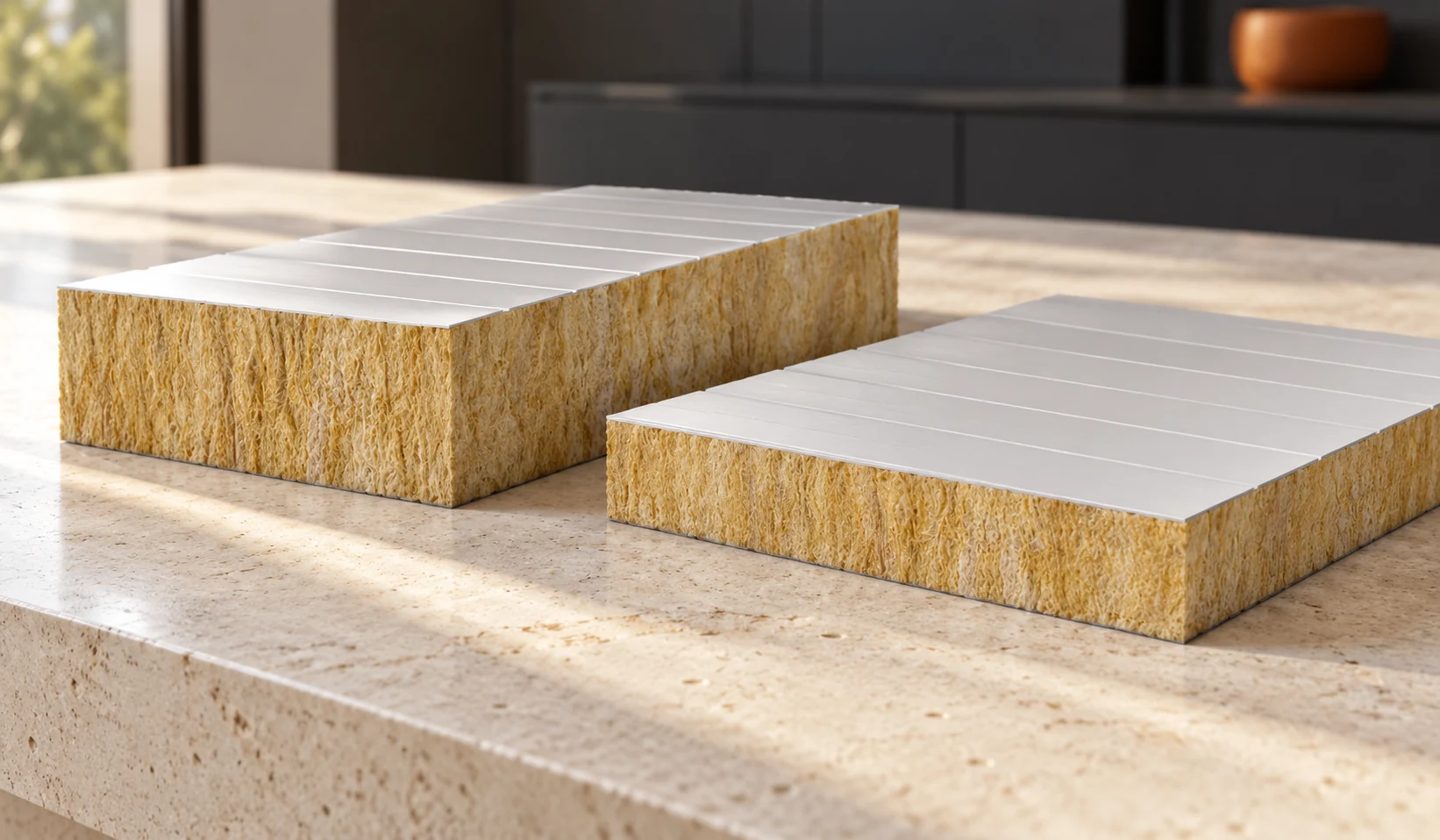
How to describe the task before you choose a product?
For small repetitive pavilions, it is not worth automatically copying a single specification. A building heated all year round has different needs from a seasonal one. A wall at a fire separation boundary may require a different solution from ordinary back-of-house cladding. The differences should be identified before comparing prices per metre.
How to compare thickness with insulation performance?
The U-value describes heat transfer through the element under consideration. A lower value means less flow at the same temperature difference. Thickness alone does not guarantee an identical U-value. The core, the geometry of the joint and the method of calculating the parameter all matter. Values from different tables should not be mixed.
In an example family of panels with concealed fixing, thicknesses of 80, 100 and 120 mm have U-values of 0.56, 0.44 and 0.37 W/(m²·K) respectively. These are data for specific variants. They are not a sufficiency threshold for every building. The required result for the whole wall should be checked together with joints, openings and thermal bridges.
In this example, changing from 100 to 120 mm lowers the U-value from 0.44 to 0.37, i.e. by approximately 16%. This difference relates to heat transfer through the compared area under the same conditions. It is not a promise of a 16% reduction in overall bills. A building also loses heat through the roof, floor, windows and doors, and ventilation.
What do you need to know about fire?
A mineral wool core alone does not allow a fire reaction class to be assigned to the entire panel. The finished product may have a reaction-to-fire class of A2-s1,d0. Fire resistance of the assembly, such as EI, is a separate matter. The result applies to a specific arrangement with fixings, supports and joints. Panel dimensions may also be relevant.
If NPD appears in the table, it does not mean a confirmed class of zero or any arbitrary resistance. The property has not been declared in that entry. Where a class is required, the appropriate documentation must be obtained and the scope of application checked. A similar thickness of another panel does not justify transferring the result.

Is concealed fixing always more advantageous?
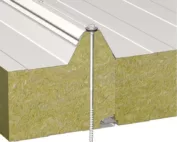
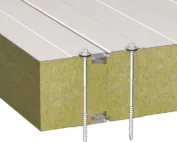
Concealed fixing can give a calmer façade appearance. However, it affects the joint geometry and installation conditions. It is not automatically stronger or warmer. The parameters of both specific variants must be compared. In a small building, a simple layout of visible fasteners can also look good.
The tolerances of the structure and the ability to press the joint correctly are important. At openings and corners, the detail is often more demanding than in the middle of the field. It is worth looking at a sample of joined panels and the façade termination. The small joint cross-section alone does not show the effect on the whole building.
How should weight and sound be taken into account?
For the mentioned family with 0.5/0.6 mm facings, the weights are 18.2, 20.3 and 22.4 kg per linear metre with a 1000 mm module. In this case, a linear metre corresponds to a square metre. With a different width, such an equivalence would be incorrect. Weight affects the structure, transport and lifting.
For acoustics, a distinction must be made between sound insulation and absorption within the interior. A full steel surface does not act like exposed mineral wool. If the problem is reverberation in a hall, increasing the core thickness alone may not be enough. The required effect must be assessed for the entire partition, doors and other openings.
How do you turn the comparison into a practical decision?
Prepare a short table of candidates with U-value, weight, classes, length range and fixing type. Add the coating on both sides. Exclude variants that do not meet the requirements before comparing price. It is not worth paying for an unnecessary feature, but savings must not come from omitting a parameter needed in the project.
Include flashings, fixings and the delivery method in the final quote. Check the possibility of later replacing a single panel. Keep the documentation of the selected layout. A well-described decision facilitates material acceptance and reduces the risk of accidental substitution with a product of similar appearance.
What else is worth asking about
Will the thickest panel be the best for every building?
No. Thickness affects several properties, but it does not replace an assessment of the whole panel. The requirements of the wall, the fixings and the operating conditions are important.
Can weight in kg/mb be compared with kg/m²?
Only after taking the usable width into account. With a 1 m module, the values are numerically the same. With a different module, they have to be recalculated.
7 branches. Materials closer to your project.

- SEROCK — Dzierżenin 34 E
- BŁONIE — ul. Sochaczewska 138A
- RADOM — ul. Grobickiego 8
- ŁÓDŹ — Natolin 8
- OLSZTYN — Barczewo, ul. Prosta 9
- WROCŁAW — ul. Jerzmanowska 10C
- GORZÓW WLKP. — ul. Zielona 33/34