Mineral wool in panels
In which buildings does a wall with mineral wool offer a particular benefit?
In brief
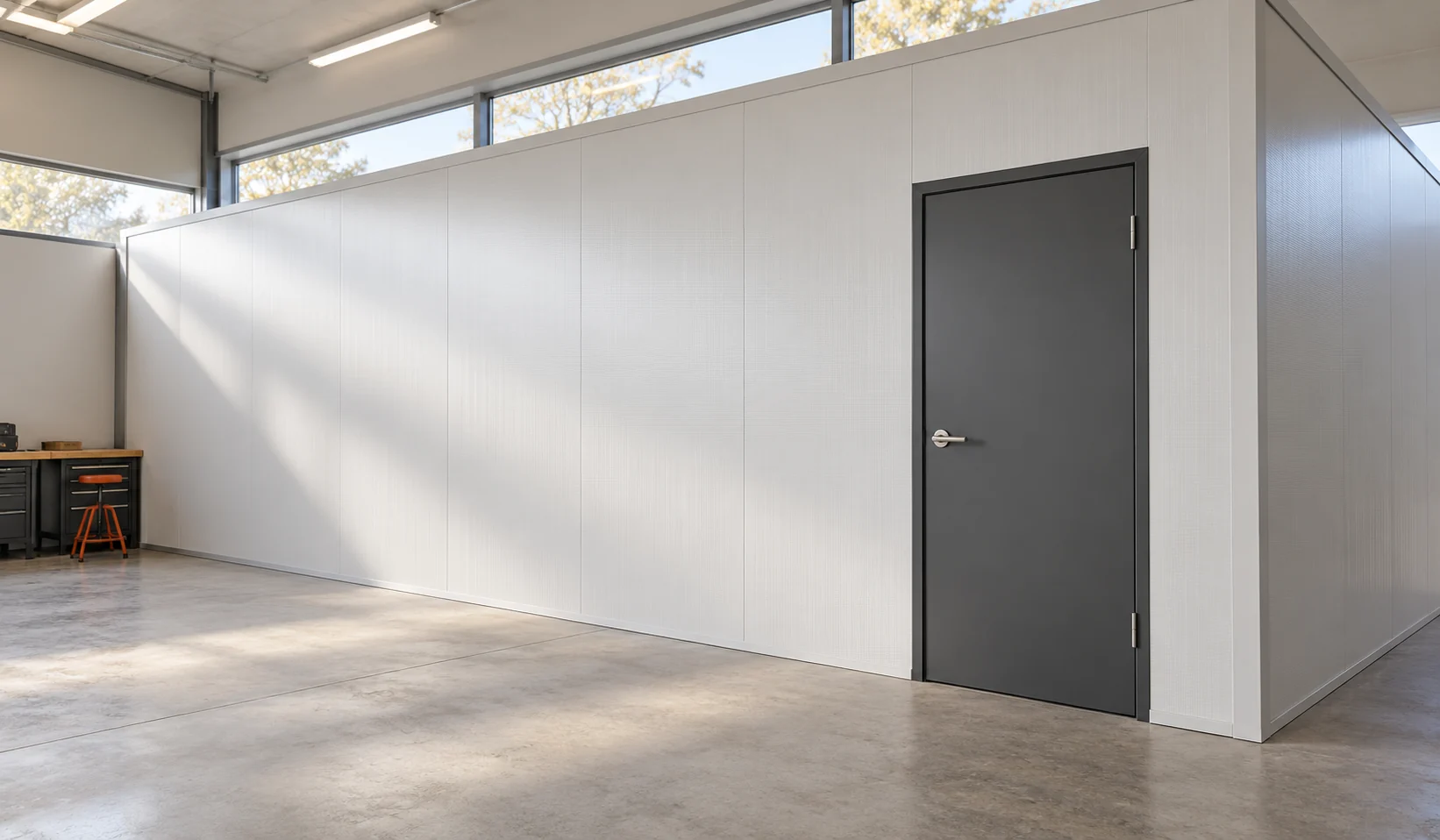
Panels with mineral wool are often considered where fire requirements matter. Their use does not, however, end with a large hall. They can also form the walls of back-of-house areas or a small service building. Suitability is determined by the verified wall assembly, not by the mere presence of mineral wool in the core. It is worth taking openings and joints into account from the outset. Ready-made panels with mineral wool can have a favourable reaction-to-fire class. An example is A2-s1,d0 for a specific product. However, this does not automatically mean any given wall resistance. The latter property relates to the behaviour of the complete wall assembly during testing and is described by separate criteria.
Why does mineral wool appear in demanding wall assemblies?
When selecting, it is necessary to establish what the project requires. Is it the material’s reaction, airtightness and fire insulation, or also other functions? Only then is the solution chosen. The general term “fire wall” is not sufficient to order a panel. The exact class and the conditions for achieving it are needed.
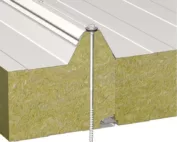
In the catalogue of one family, the 80 mm thickness with concealed fixing has a rating designated NPD. The thicker variant may have a classification, but its conditions must be confirmed. The family name alone is not sufficient.
Where in a hall might such a wall be needed?
The panels may be considered as external cladding or internal compartmentation. In a hall, different zones may have different operating conditions and requirements. The technical back room, the warehouse and the staff area need not be solved identically. The selection should follow from the function and the documentation of the entire facility.
A single panel class cannot be assigned to any wall height. Spans, panel orientation and fixings matter. A gate or door opening may require additional structure. Compartmentation does not work correctly if gaps at the roof or at installations remain accidentally closed with material without the appropriate application.
Is the solution suitable for a public building?
In a building accessible to users, durability, hygiene, acoustics and appearance also count. A panel with mineral wool can be part of an appropriate solution, but it does not replace the assessment of all requirements. The method of interior finishing and the surface’s resistance to typical damage must be taken into account.
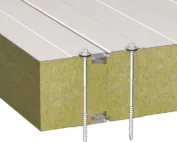
In a small service pavilion, a calm façade and easy cleaning may be important. Concealed fixing helps to reduce the visibility of fasteners. This does not automatically mean better fire performance. These features must be checked separately. A change of variant solely for aesthetics should not be made without comparing the documentation again.
What significance do doors and service penetrations have?
A wall is a continuous system only when its interruptions are correctly resolved. Doors, windows and service penetrations have their own requirements. A panel of the appropriate class will not rectify a non-compliant service penetration. Likewise, thin-gauge flashing is not a standalone fire seal.
All openings should be collated at the design stage. Cutting later can interfere with loadbearing capacity and classification. Additional equipment should have support provided for. The cladding should not be loaded by a casually fixed shelving unit or heavy fittings. The function of the wall and the function of the structure supporting equipment must remain clearly defined.

What do the operating temperature and humidity change?
A mineral wool panel provides thermal insulation, but its U-value depends on the specific variant. A heated building requires assessment of losses through the entire envelope. Junctions with the roof, base and joinery may influence the effect more than a small difference in core thickness. Airtightness is a separate detailing task.
In a wet room, water access to the core must be limited and the internal coating selected accordingly. Regular cleaning, chemicals and elevated humidity may require a different solution from a dry back-of-house area. It should not be assumed that every mineral wool panel is suitable for every technology. Service requirements must be described before purchase.
How can the solution be assessed before implementation?
Collate the class required in the design, the wall plan and the schedule of openings. Then check the scope of application for the specific panel. It should cover the selected installation method and dimensions. Include the entire subframe, fixings and termination details in the quote. Purchasing the panels alone does not yet create a finished partition.
At handover, it is worth inspecting the work in stages. Once joints are covered, their compliance is harder to assess. Keep photographs and documents for the components used in the system. Across a series of similar buildings, this helps maintain a repeatable standard. However, every change of material or opening must be assessed for its impact on the required properties.
What else is worth asking about
Does a mineral wool panel always create a fire compartment wall?
No. A suitable design and a verified system covering the panels, structure, connections and openings are required.
Can penetrations be cut arbitrarily later?
No. A new opening can affect the load-bearing capacity and resistance of the partition. Its position, framing and sealing must be agreed.
7 branches. Materials closer to your project.

- SEROCK — Dzierżenin 34 E
- BŁONIE — ul. Sochaczewska 138A
- RADOM — ul. Grobickiego 8
- ŁÓDŹ — Natolin 8
- OLSZTYN — Barczewo, ul. Prosta 9
- WROCŁAW — ul. Jerzmanowska 10C
- GORZÓW WLKP. — ul. Zielona 33/34