PIR insulation
Why is the loft hot despite insulation? PIR, cellulose and fibres
At a glance
A hot loft does not in itself prove that the wrong material was chosen. PIR boards, cellulose and wood fibre reduce heat flow, but they do so in different constructions. It is worth checking solar gains, air exchange and the heat capacity of the whole building element before deciding to replace the insulation. PIR boards are rigid products with a defined thickness and facing. Cellulose can be blown into prepared cavities. An underfilled cavity and a gap between boards are different installation faults. The inspection should match the way the given layer was laid. At the outset it is necessary to establish how the thermal insulation was installed and where its boundary runs.
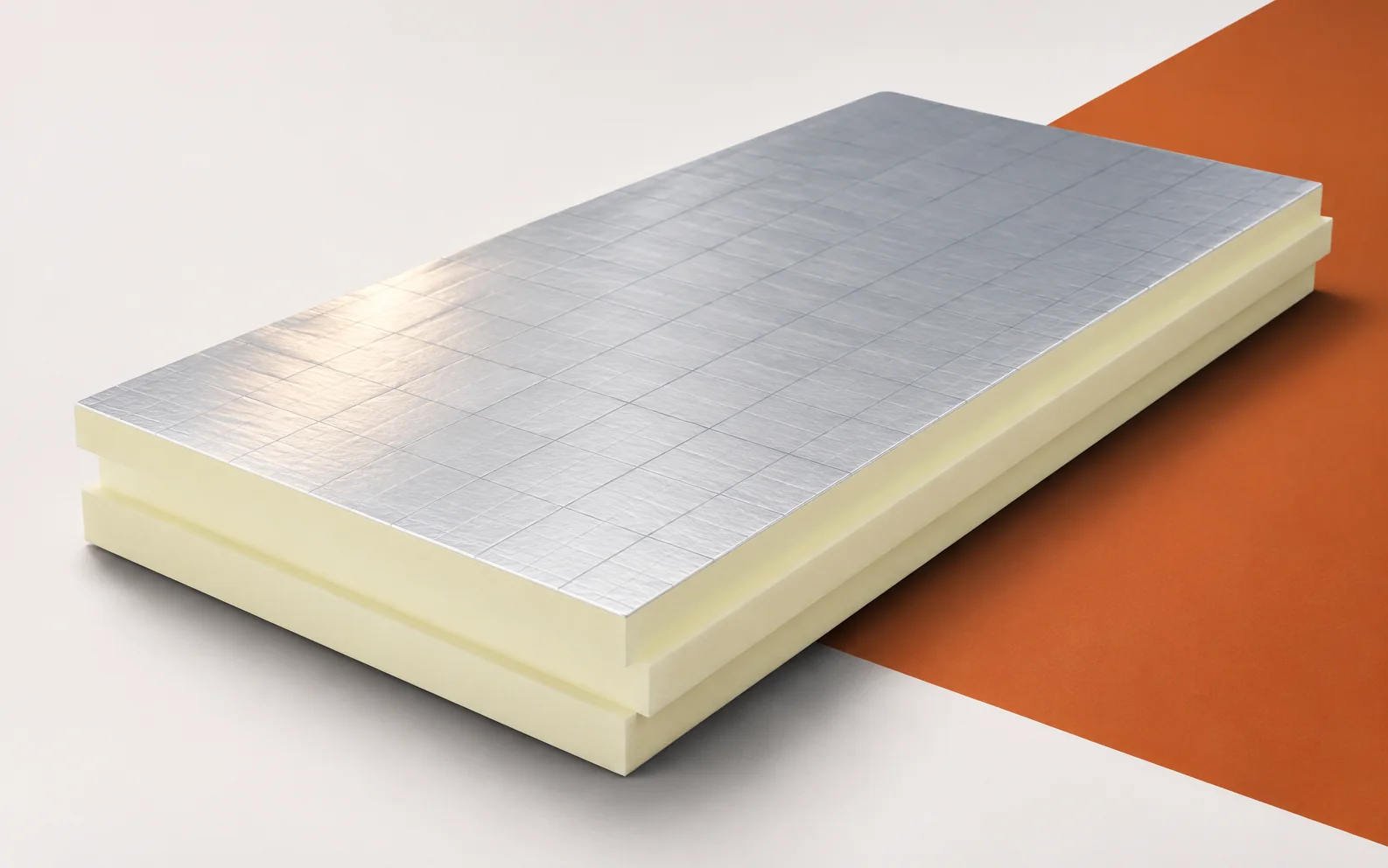
Different forms of the material
An empty space in the compartment may have a different cause than an ill-fitting board cut. It is worth inspecting the areas around obstacles and at the ends, since continuity is harder to maintain there. Information about the type of insulation alone does not describe the quality of installation. The assessment should therefore be linked to the specific technology and the available evidence of execution.
What determines summer comfort
A high temperature in the attic despite insulation does not result directly from the material’s lambda value. Summer comfort is also determined by the heat capacity of the layers, glazing, shading and air exchange. When the temperature peak occurs in the afternoon, it is necessary to check how much heat a sunlit window brings in before attributing it to the building element.
An air temperature reading alone does not indicate the roof’s share in heat gains. Temperature observation should cover several periods of the day and the outdoor conditions. A room can heat up through windows, appliances and the building element at the same time. A delay in temperature change does not by itself prove the contribution of one material. It is also worth checking what happens after sunset. Without information on the removal of stored heat, it is difficult to assess whether a greater mass of layers will improve the expected comfort.
Where a small thickness is useful
The advantage of PIR often relates to space. Well-chosen polyurethane insulation allows a high thermal resistance to be achieved with a small thickness. A narrow space can justify choosing a material with low lambda.
This does not automatically mean a better result for every summer comfort analysis. If there is not enough space in the cross-section, PIR can resolve a thickness constraint. That is a specific advantage, but it concerns a different criterion from overall summer temperature. A fibrous material can make good use of a deep cavity when it is correctly installed. The comparison should keep the same function and conditions of use. Otherwise the result mixes the advantage of a material with the advantage of a different cross-section.
Shared partition and moisture flow
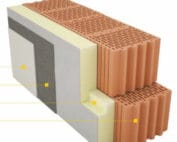
PIR and fibrous insulation can be combined in one designed cross-section, but the layer sequence must follow from a moisture analysis, not from ease of installation. Accidental trapping of moisture in the timber or sheathing is a design error, not a defect of the material. Wet insulation can indicate a leak or moisture transport from the interior — a lead for further inspection.
Different causes require checking layers other than the insulation core itself. Moisture appearing after rain suggests the need to check protection against precipitation. Moisture associated with the cold season may also require analysis of vapour transport and leaks. However, these are not ready-made diagnoses without inspection. It is worth establishing the location and the path by which water enters before replacing the insulation. The new material should go into a repaired system, otherwise it may be exposed to the same problem.
Acoustics and fire protection
The raw material alone does not determine how PIR, cellulose or wood fibre behave in fire. The reaction to fire is read from the document for the specific product, and fire resistance is determined for the entire building element, not for its infill. Heavy rain on the roof slope is not a measurement of thermal insulation performance, so it does not replace inspection.
The acoustic problem must be assessed separately, taking into account the roof covering and the interior finish. If the complaint concerns noise, it is worth checking the construction and fixing of the finish. The same thermal material can perform in different acoustic systems. Changing from fibrous insulation to a rigid board requires an assessment of whether it removes a needed infill function. This does not mean that PIR is inherently unsuitable. It means that the thermal task must be separated from the method of reducing sound in the finished roof.
Selection suited to the task, not to a slogan
The starting point is to establish what effect is to be achieved, not to choose a material. During the inspection, the available section height, the expected insulation performance and the way the rooms are used must therefore be recorded. If overheating comes from the glazing, replacing fibrous insulation with PIR does not close off this gain path, which is why both issues are considered separately.
First of all, it is worth establishing the share of the individual heat sources. The scope of the repair should follow from the share of the identified causes. If the largest solar gain passes through the glazing, its shading can be assessed first. If deficiencies in the thermal insulation have been found, they need to be made good using a suitable method. Such a separation allows PIR or fibrous insulation to be used where they bring a real improvement. Replacing the entire technology is not a necessary answer to every hot day.
An example that brings order to the comparison
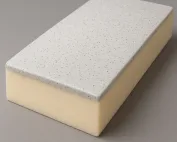
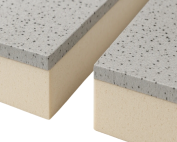
The calculation shows that the layer alone, with the assumed density of 160 kg/m³, specific heat capacity of 2100 J/(kg·K) and thickness of 160 mm, has an area heat capacity of approximately 53.76 kJ/(m²·K), and with an area of 50 m² approximately 2688 kJ/K. This is a characteristic of the assumed layer, not the room temperature nor a guaranteed delay time for heating; assessing summer conditions requires the entire section as well as a balance of gains and heat removal. Polyurethane boards come in various designs, so a comparison with fibrous insulation requires specifying the core and the facing. Polyurethane insulation in a factory-made board is not the same as spray application, and the term polyurethane foam does not describe the parameters of the finished roof — a description of the form of the material and the place of application is needed.
7 branches. Materials closer to your project.

- SEROCK — Dzierżenin 34 E
- BŁONIE — ul. Sochaczewska 138A
- RADOM — ul. Grobickiego 8
- ŁÓDŹ — Natolin 8
- OLSZTYN — Barczewo, ul. Prosta 9
- WROCŁAW — ul. Jerzmanowska 10C
- GORZÓW WLKP. — ul. Zielona 33/34