PIR insulation
Why does Powerdeck F have a different lambda value from other PIR boards?
At a glance
In Recticel Powerdeck F, lambda is a property assigned to a specific product, not to the entire group of materials referred to as PIR. Recticel Powerdeck F has a PIR core faced on both sides with a mineralised glass fleece and is intended for flat roofs with a suitably selected covering. This fleece is not packaging or a decorative layer, but a surface that interacts with the covering in the roof assembly. Therefore, the Powerdeck F facing is selected to match the materials in contact in the adopted assembly, and not merely on the basis of a matching chemical name.
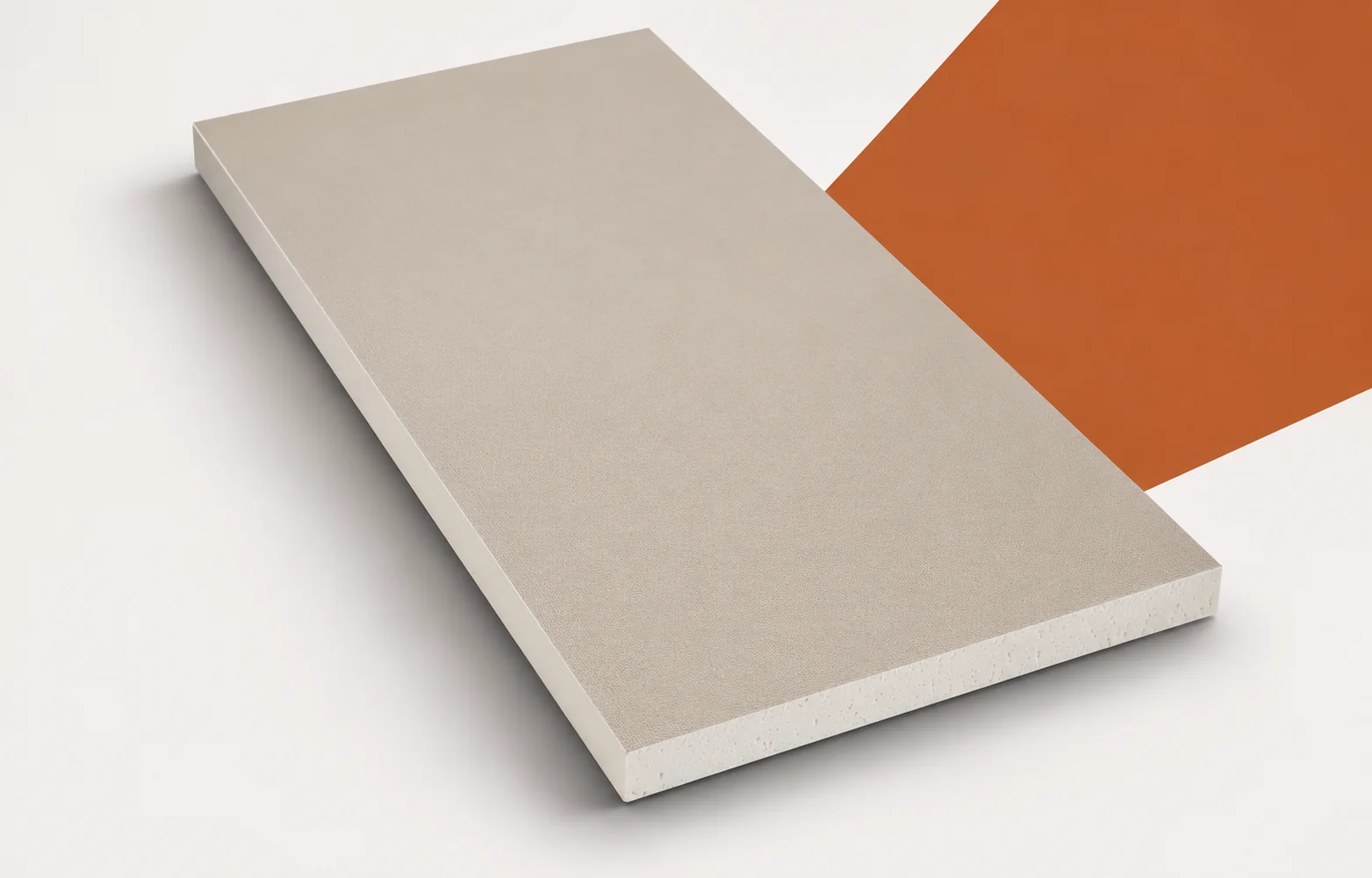
Product construction explains its application
When inspecting an existing roof, it is worth separating two things: the appearance of the core alone does not identify all the properties of the product, but it does not determine whether the mineralised glass fleece of Powerdeck F is compatible with the membrane that has been laid on it. The check should therefore cover the type of facing, the covering actually used and the documentation of their mutual compatibility, compared with the documentation or the condition before the change. Only information compiled in this way makes it possible to indicate whether the source of the problem is the product itself or the connection with the membrane.
How to read thermal parameters
The value of 0.026 W/(m·K) is the declared lambda assigned exclusively to the Powerdeck F board. The thermal resistance of a layer of a given thickness is calculated using precisely this figure, and not the lambda of another PIR product. Therefore, when checking the construction of an existing roof, first establish which board is actually present in the assembly, and only then insert its parameter into the calculation.
For Powerdeck F, the declared lambda is 0.026 W/(m·K), and it is precisely this value that is inserted into the calculation of the resistance of a layer of a specific thickness. Using a lambda of 0.022 from another product would give an incorrect result for this board, even though both figures relate to materials with a PIR core. The thickness of Powerdeck F is therefore determined using its own lambda, and not the general name of the group. When assessing the promise of savings, the design resistance, the available height of the layers and the calculation of the full roof cross-section are needed.
The letter F in the name Powerdeck F should not be read as a fire reaction class. The relevant information is found in the parameter table and the application documentation. For the specified thicknesses, class E appears, and the B-s2,d0 assessment relates to the corresponding final assembly. The trade name and the technical classification are different pieces of information. Confusing them can lead to assessing the material on the basis of an incorrect designation.
Leak, vapour or airtightness failure
The choice of adhesive determines compatibility with the mineralised glass fleece of Powerdeck F in the specific combination with a glued or self-adhesive membrane and the fastening system. The name polyurethane or bitumen adhesive alone does not confirm this compatibility. When assessing an existing covering, check whether the installer actually joined these very materials before you consider the joint to be the cause of the defect.
When moisture appears in an existing roof, first check whether the glued or self-adhesive membrane was matched to the mineralised fleece in the specific material assembly. The chemical name of the adhesive alone, or the phrase “polyurethane foam”, does not explain the cause until you confirm that the membrane and the bonding material are compatible with that fleece. The diagnosis should establish whether the system selection, the substrate preparation or the installation conditions failed, and only on that basis allow the joining method and the inspection of the joint before the details are covered to be planned.
Edge profiles and joint continuity
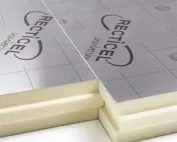
Powerdeck F is available with straight edges or in a rebated shiplap variant, and the availability of format and thickness must be confirmed for the variant being ordered. When diagnosing a local discontinuity in the insulation in an existing roof, establish which edge variant was actually used, because the method of assessing the joint and the scope of the repair depend on it.
A local discontinuity may result from the geometry of the edges, so establish whether straight edges or a rebate are provided for the Powerdeck F variant being ordered. The cutting plan and the number of boards are agreed before ordering, because a change of format or edge profile affects the offcuts and the actual surface coverage. When assessing this detail, gather the format from the order, the way the elements are brought together and the support at the end of the field, so as to separate the effect of the joint itself from the behaviour of the whole building envelope.
How to understand hardness and fire class
The Powerdeck F data sheet states a CS(10/Y)120 declaration, and reaction to fire E is given for thicknesses from 40 mm; class B-s2,d0, however, relates to the proper end use. These statements must be read together with the thickness and the assembly to which they refer, because the trade name alone does not replace the technical classification.
In the Powerdeck F product data sheet, read the CS120 declaration and the conditions of class E from 40 mm and relate them to the actual substrate and fixing. The end-use classification is not permission for arbitrary use, because changing the covering or the method of fixing may go beyond the assessed assembly. In the event of a discrepancy, establish the board thickness, the complete layer build-up and the documentation corresponding to the actual fixing, instead of relying on a general assurance about the quality of the board.
What to gather before an assessment or repair
Purchasing Powerdeck F requires agreeing not only the thickness but also the method of forming the joints. The quotation should include substrate preparation, the required layers and details, because the price of the board alone does not yet describe a completed roof assembly.
With the term “polyurethane insulation”, what decides the matter is what the quotation covers beyond the board itself: substrate preparation and the way the insulation is connected to the adopted waterproofing system. Only a bill of quantities covering the boards, connecting materials, work on the substrate and details around the perimeter of the covering allows the cost and completeness of the offer to be assessed, because a favourable board price does not include priming, bonding or the making of flashings. Listing these items leads to a completed, sealed covering with specified requirements.
7 branches. Materials closer to your project.

- SEROCK — Dzierżenin 34 E
- BŁONIE — ul. Sochaczewska 138A
- RADOM — ul. Grobickiego 8
- ŁÓDŹ — Natolin 8
- OLSZTYN — Barczewo, ul. Prosta 9
- WROCŁAW — ul. Jerzmanowska 10C
- GORZÓW WLKP. — ul. Zielona 33/34