Mineral wool in panels
Can condensation form on an insulated wall panel?
In brief
Water can appear on an insulated panel even though the panel itself does not leak. This happens when water vapour meets a sufficiently cool surface. The problem often concentrates at joints, the plinth or a window. To resolve it, the temperature and humidity must be assessed, along with the airtightness of the details. An additional layer of foil alone does not guarantee improvement. Air contains water vapour. On cooling to a certain temperature, condensation can occur. The higher the humidity at the same indoor temperature, the more easily condensate forms on cool spots. This does not mean that the steel cladding produces water. It is a surface on which the phenomenon occurs.
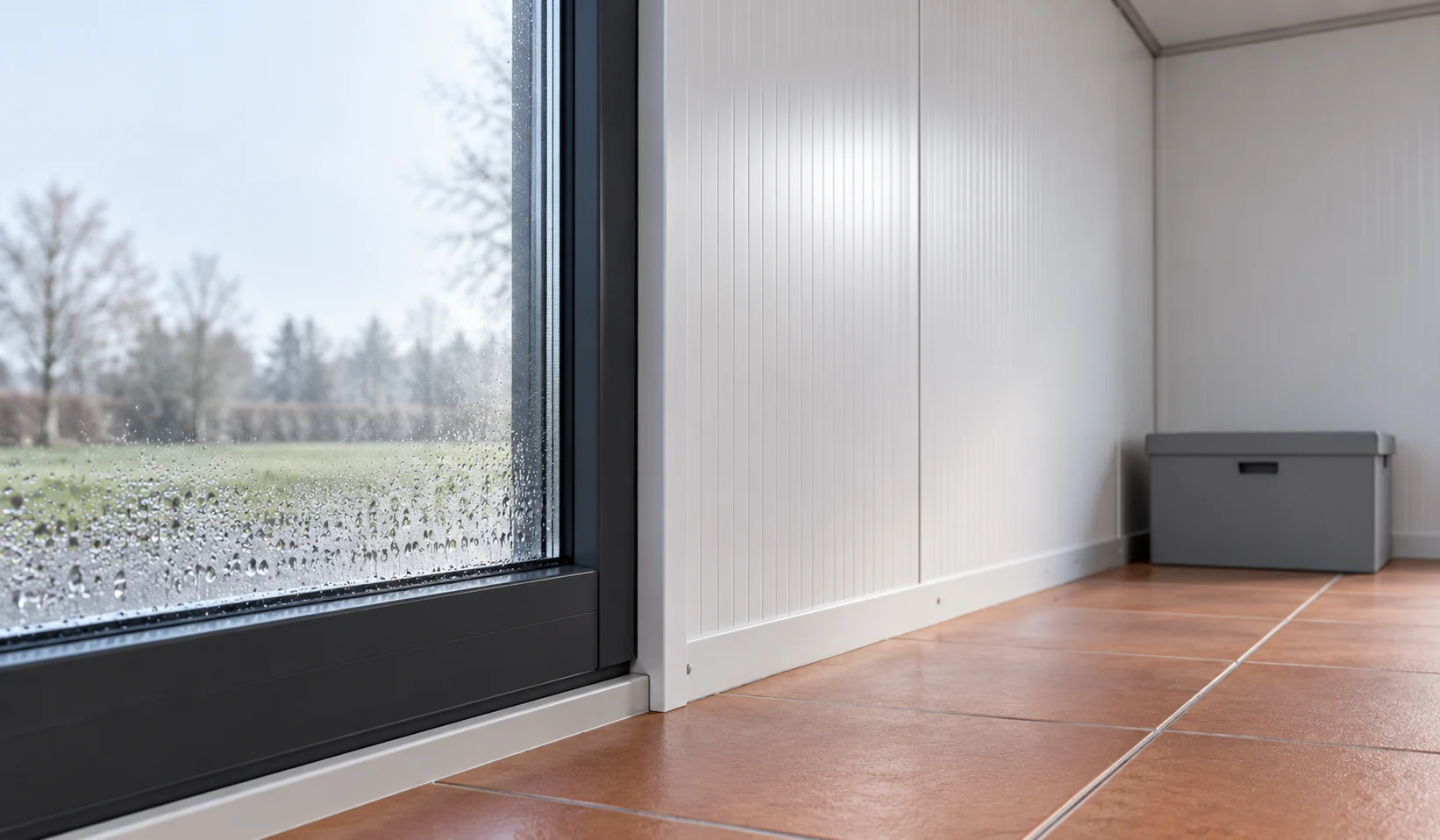
When does condensate form on a surface?
In a small back room, people, washing, wet items or a technical process can be sources of vapour. In a seasonal pavilion, interruptions in heating also matter. It is worth observing when moisture appears. In the morning, after the building has cooled down, the situation may look different from after a full day of stable heating.
Why does the problem concentrate at details?
Connections to the plinth, roof and joinery may have different thermal conditions from the middle of the panel. Steel structural elements can form thermal bridges. If the local temperature drops, condensation may start precisely there. A good U-value of the panel alone does not describe every corner of the finished building.
Air tightness is also worth checking. Humid air moving through a leak can reach the cooler part of the connection. This transport differs from diffusion through the layers alone. That is why continuity of sealing on the interior side is important. Accidental covering of the gap from the outside does not always remove the cause.
What role do steel claddings and seals play?
The full steel surface strongly restricts the passage of vapour through the panel field itself. The entire wall, however, contains joints and openings. These require a proper solution. One should not speak of the airtightness of the assembly on the basis of a single undamaged section of sheet metal.
The seal at the support, the tape in the joint and the external flashing can perform different functions. They are not freely interchangeable. The material must be matched to the location and the operating conditions. If the design specifies a particular sealing line, its continuity must be maintained at the window, the corner and the service penetration.
How to distinguish condensation from rainwater?
Record the dependence on weather and on how the building is used. A leak may intensify during rain from a particular direction. Condensation may appear without precipitation, after the surface has cooled. These are helpful observations, but not full proof. Water trapped in the layers can reveal itself with a delay.
Check the temperature and humidity at several times of day. Inspect the external flashings and the interior at the same location. In a difficult case, a thermal and moisture assessment and an airtightness assessment of the detail are needed. It is not worth starting by sealing the joints with mastic. This can impede drainage or trap moisture inside.

Will a thicker panel solve the problem?
Better insulation of the wall field can raise the surface temperature on the inside. However, it will not repair every thermal bridge or leaky joint. If humidity is excessive, improved ventilation or a reduction of the vapour source may be needed. The choice of thickness should be part of an assessment of the whole system.
Additional insulation from the inside requires particular care. It can change the temperature of the existing cladding and the drying conditions. Do not add foil or boards without checking the layers. Two airtight materials on either side of an incidental void do not automatically make a good solution.
How can moisture recurrence be prevented?
Maintain the intended ventilation and do not obstruct its openings. Pay attention to the method of heating and the bringing in of wet materials. After intensive washing, drying of the room appropriate to its function is needed. Regularly inspect the joints and signs of corrosion. Condensate remaining on the surface for a long time can worsen the conditions of use.
After the repair, observe the wall under conditions similar to those before. One dry afternoon does not confirm that the problem is solved. In several similar pavilions, comparing the way they are used may indicate a difference. Sometimes the cause lies in the detail, and at other times in the indoor humidity. An effective improvement addresses the identified mechanism.
It is worth keeping the measurement results and photographs. They will allow an assessment of whether the change in ventilation or the repair of the joint brought a lasting effect during the cold period.
What else is worth asking about
Does water on the cladding always mean a defective panel?
No. It may result from condensation, a leaky detail or a leak. The cause must be identified before assessing the product itself.
Does an airtight wall replace ventilation?
No. Airtightness limits uncontrolled flow, while ventilation is intended to provide planned air exchange and moisture removal.
7 branches. Materials closer to your project.

- SEROCK — Dzierżenin 34 E
- BŁONIE — ul. Sochaczewska 138A
- RADOM — ul. Grobickiego 8
- ŁÓDŹ — Natolin 8
- OLSZTYN — Barczewo, ul. Prosta 9
- WROCŁAW — ul. Jerzmanowska 10C
- GORZÓW WLKP. — ul. Zielona 33/34