Panels in use
When does composite cladding work in a livestock building?
In brief
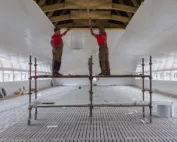
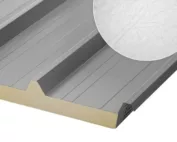
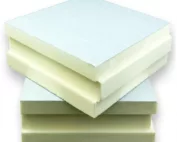
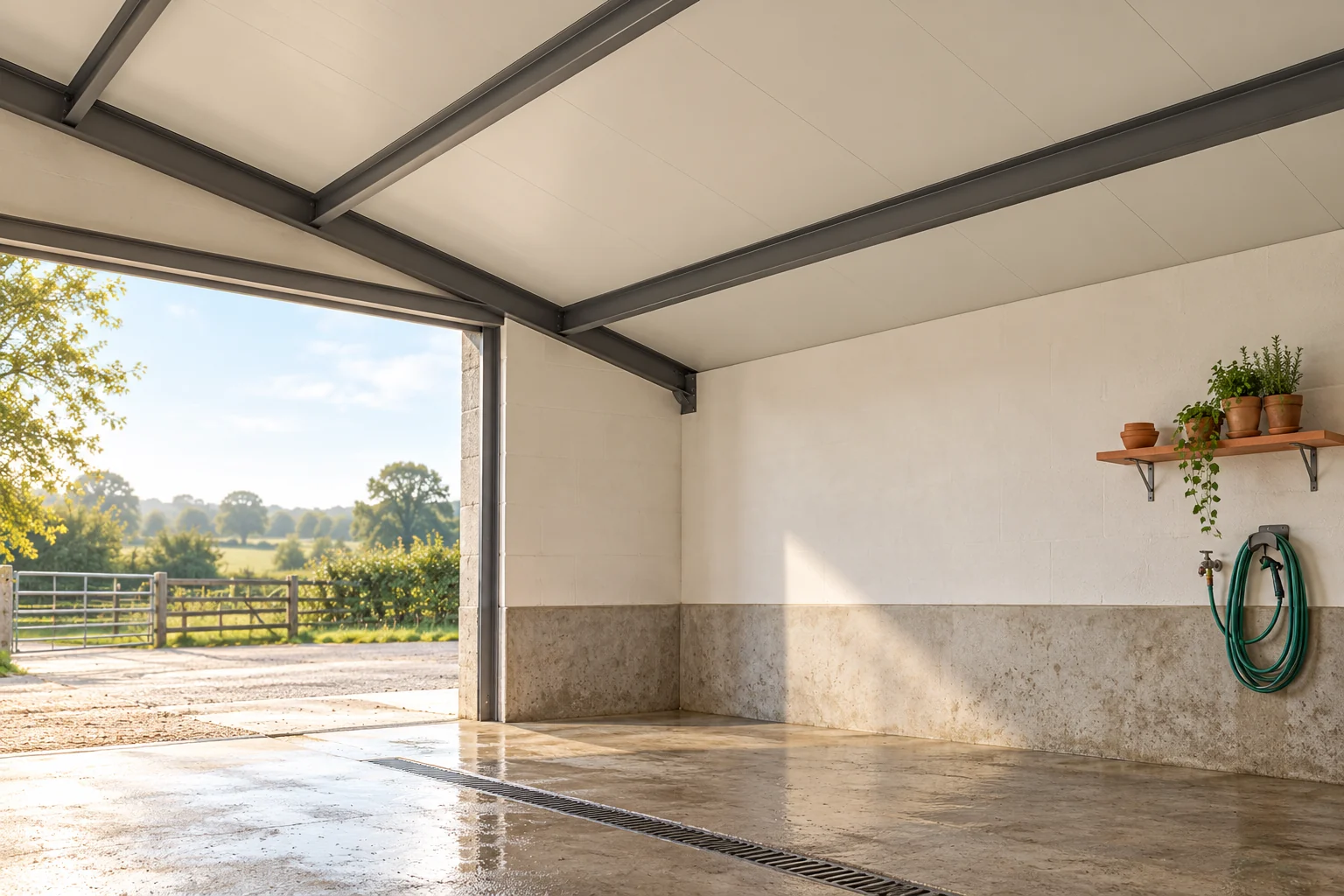
In a cowshed, pigsty or poultry house, the inner roof surface operates in a demanding environment. Moisture, deposits and compounds produced during rearing act on it. One solution is a panel with composite cladding on the inside. This does not mean full resistance to every substance. The conditions of use must be matched to the specific building. An example roof panel has a profiled steel outer cladding, a PUR or PIR core and a flat inner cladding. The latter is made of polyester resin reinforced with glass fibre. The fibre reinforces a thin surface layer. It is not a mineral wool core.
What is such a panel made of?
This distinction matters for assessing the properties. Such a panel should not be attributed with the characteristics of a mineral wool core panel. Also, the paint coating on steel is not the same solution as a separate composite cladding. The cross-section of the product should be clearly described.
Why does the livestock environment require a separate assessment?
The interior may have high humidity, variable temperature and limited drying capacity. The ammonia concentration, exposure time and deposited dirt matter. Conditions are not the same in every building. The method of ventilation and cleaning changes the surface load.
A general phrase “for agriculture” is not enough. Describe the type of husbandry, temperature, humidity and the agents used. Ask for confirmation of suitability for this set of conditions. Resistance to one compound does not mean resistance to the entire mixture or to any concentration.
Does composite eliminate the problem of corrosion of the entire roof?
The internal composite surface limits the proportion of exposed steel in this part of the building envelope. The roof still contains external steel sheet, fasteners and flashings. These elements must also correspond to the environment. An exposed fastener or a poorly protected edge can remain a weak point.
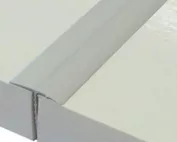
At the junction of wall and roof, the ingress of humid air into the gaps must be limited. The tightness of the panels does not replace ventilation of the room. It also does not solve the problem of leakage from outside. The assessment concerns the complete enclosure, not only the visible ceiling.
How to select thickness and thermal parameters?
In a specific family of roof PIR panels with this facing in thicknesses of 60, 100 and 160 mm, the Uc values are 0.35, 0.22 and 0.14 W/(m²·K) respectively. The values describe the specified variants. They are not a general table for all panels with a plastic core.
Selection depends on the required temperature and moisture balance. Joints, flashings and connections to the structure are also important. A thicker panel can reduce losses through its surface, but it will not remedy a thermal bridge or an airtightness failure at a junction. The entire building envelope must be checked.

What should be established before regular washing?
Match the chemistry to the facing and seals. Check the permitted concentration, temperature and rinsing method. A product used on the floor need not be suitable for the ceiling. Do not assume unlimited pressure-washer resistance without limits on jet strength and distance.
Remove deposits in a way that does not scratch the surface or force water into the joints. Plan access for roof inspection from inside. At the point of damage, also check the condition of the core and the edges. A minor scratch is not assessed in the same way as delamination.
What documents and details are needed for installation?
Check the load-bearing capacity of the exact panel with composite facing. Do not transfer tables from the steel variant with the same core. Weight, structural behaviour and permissible spacings may differ. The instructions also specify transport, lifting, cutting and making connections.
Separate the material’s reaction to fire from the fire resistance of the roof and its behaviour under external fire. The presence of glass fibre does not automatically confer non-combustibility. The required classifications must relate to the complete solution under project-specific conditions.
When is it worth comparing this variant with steel cladding?
A comparison is justified where internal conditions require particular surface protection. Include the cost of the panel, accessories, cleaning and inspections. Also ask about repair and replacement of a single element. The lowest purchase price does not describe the entire service life.
In a well-ventilated warehouse with a mild environment, a properly selected steel facing may be sufficient. In an aggressive interior, broader provisions are needed. Do not choose the material solely by the building name. The actual conditions at its surface matter.
What else is worth asking about
Does a glass-fibre facing mean a mineral wool core?
No. In the described solution, the fibre reinforces the resin that forms the inner lining. The core is foam. These are two different layers with different functions.
Is it permissible to state that such a panel is fully resistant to ammonia?
Without specifying the conditions, that would be too broad a statement. Suitability must be confirmed for the concentration, temperature, humidity and cleaning method. The fixings and sealing require a separate assessment.
7 branches. Materials closer to your project.

- SEROCK — Dzierżenin 34 E
- BŁONIE — ul. Sochaczewska 138A
- RADOM — ul. Grobickiego 8
- ŁÓDŹ — Natolin 8
- OLSZTYN — Barczewo, ul. Prosta 9
- WROCŁAW — ul. Jerzmanowska 10C
- GORZÓW WLKP. — ul. Zielona 33/34