Sheet metal roofing
How to compare T18 and T35, sheet thickness and the cost of fleece?
In brief
T18 and T35 describe different profile heights, but they are not enough to select a covering. You need to check the drawing, steel thickness, supports and the intended use of the sheet. The price also depends on the coating and the coverage. Fleece can help limit condensation dripping, but it needs to dry out. It does not replace insulation or a tight roof. The profile affects stiffness and how the sheet performs. A taller trapezoidal profile may offer different possibilities under the same material conditions. However, this does not mean that every T35 is automatically suitable for any support spacing. Data for the specific product and loads are required.
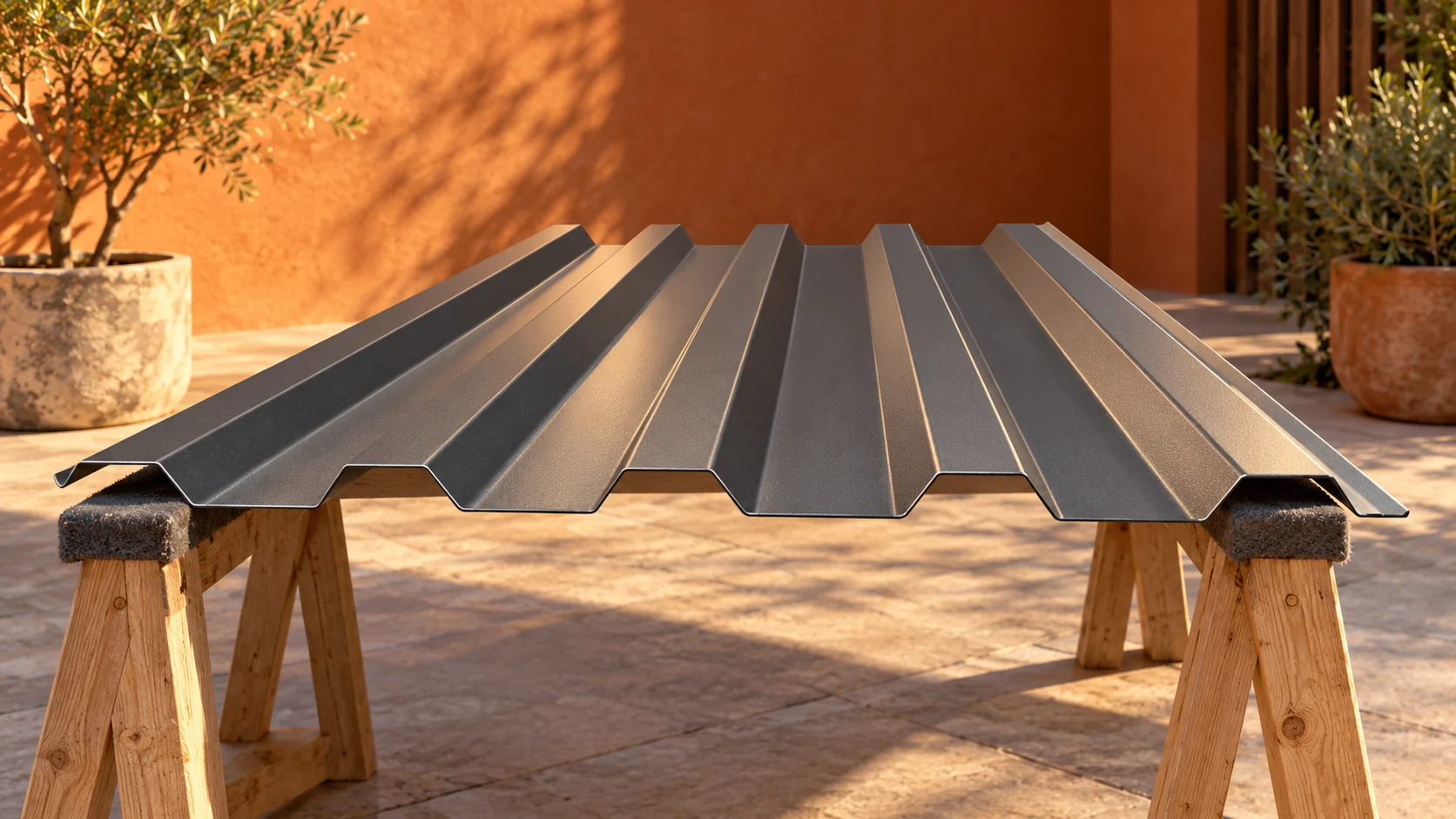
What does the trapezoidal height really change?
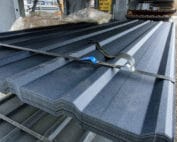
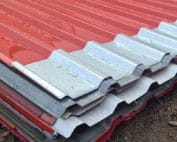
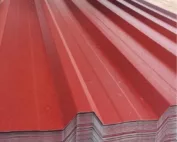
The T18 designation also does not describe one common drawing for all offers. The widths of the flanges, the division and the covering module may differ. Sheets with a similar number should not be combined by accidental matching. Before purchase, check the profile and whether it is a roof or façade variant.
How to compare two actual coverage dimensions?
An example roof profile with a height of 18 mm has a covering width of 1100 mm and an overall width of 1137 mm. Another roof trapezoidal steel sheet with a height of 35 mm has a covering width of 1035 mm with an overall width of 1082 mm. These are the data of two specific geometries. They do not constitute universal dimensions for every T18 and T35.
With a sheet length of 4 m, they give 4.40 and 4.14 m² of covering respectively. Therefore, the same number of sheets cannot be treated as an equal roof area. The full strips of the roof slope and the final cuts must be calculated. A different module can change the quantity of material purchased.
How to choose the steel thickness?
Thickness is one of the parameters alongside the steel grade and geometry. The load-bearing table must correspond to the sheet offered. The purlin spacing from a thicker covering or one with a different profile should not be copied. Snow loads, wind loads and deflection criteria require verification for the building.
Compare the thickness of the metal substrate in accordance with the product description. The coating is not additional steel. A very similar appearance of two sheets does not prove the same load-bearing capacity. In the offer, it is worth recording the full specification so that a later delivery is not based on the trapezoidal number alone.
What function does the fleece on the underside serve?
The anti-condensation layer can temporarily retain condensed water. It is a buffer that needs conditions to dry out. It does not constitute waterproofing that repairs a leak through the overlap. Nor is it full thermal insulation. Its role is different from roof insulation.
In an unheated building, adequate air exchange must be ensured and sources of moisture limited. If more water condenses than the layer can release, adding felt alone will not solve the problem. Details at the eaves and overlaps must be executed in accordance with the instructions for the given material.

What makes up the price of a finished roof covering?
Calculate the steel sheet according to the effective coverage and cutting plan. Add flashings, fasteners, sealants and drainage. Include any felt, transport and installation. The price per total metre may appear lower than the price per coverage metre, although it relates to the same sheet.
Assume, for example, 120 m² of purchased covering at €9.72 net. The sheet metal costs €1,166.40 net. If the surcharge in the example is €1.85/m², that adds a further €222.00. These are assumed figures for comparison, not a current price list. The remaining items still have to be added separately.
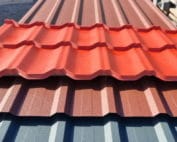
The coating also affects the price. It should match the environment, not just the desired colour. A comparison of cheaper galvanised steel with coated sheet in matt does not show only the cost of the T18 or T35 profile.
How do you check the pitch and lengths?
The minimum slope depends on the profile, the joint arrangement and the instructions. It cannot be read solely from the designation T18 or T35. Transverse connections and obstacles on the roof slope may increase the requirements. The whole roof must be considered, not just a smooth sheet.
A long element reduces the number of joints but complicates transport and handling. It also requires proper accommodation of thermal movement. The maximum production length is not the span between supports. The cutting plan should take into account the geometry, logistics and the permitted detail solution.
How do you make the decision for a small building?
Choose the variant that meets the loads and roof conditions. Then compare the full cost and appearance. In a small pavilion, flashings may occupy a significant part of the visible surface. Agree the colour and type of coating for the entire set, not just the sheets themselves.
On acceptance, check the profile, thickness, surface condition and conformity of the accessories. After installation, remove swarf. The felt and coating require proper use and inspections. A good choice of T18 or T35 is part of a coherent roof, not just the purchase of material with a higher number.
What else is worth asking about
Does T35 always allow a wider support spacing than T18?
The possibility must be checked in the data for the specific sheet. Thickness, steel, geometry and loads matter. The profile number alone does not give a universal spacing.
Does the fleece surcharge eliminate the need for ventilation?
No. The layer must release retained water. Without drying conditions it will not be an effective moisture buffer.
7 branches. Materials closer to your project.

- SEROCK — Dzierżenin 34 E
- BŁONIE — ul. Sochaczewska 138A
- RADOM — ul. Grobickiego 8
- ŁÓDŹ — Natolin 8
- OLSZTYN — Barczewo, ul. Prosta 9
- WROCŁAW — ul. Jerzmanowska 10C
- GORZÓW WLKP. — ul. Zielona 33/34