Metal sheet coverings
How do you match roof sheet thickness to the profile and supports?
In brief
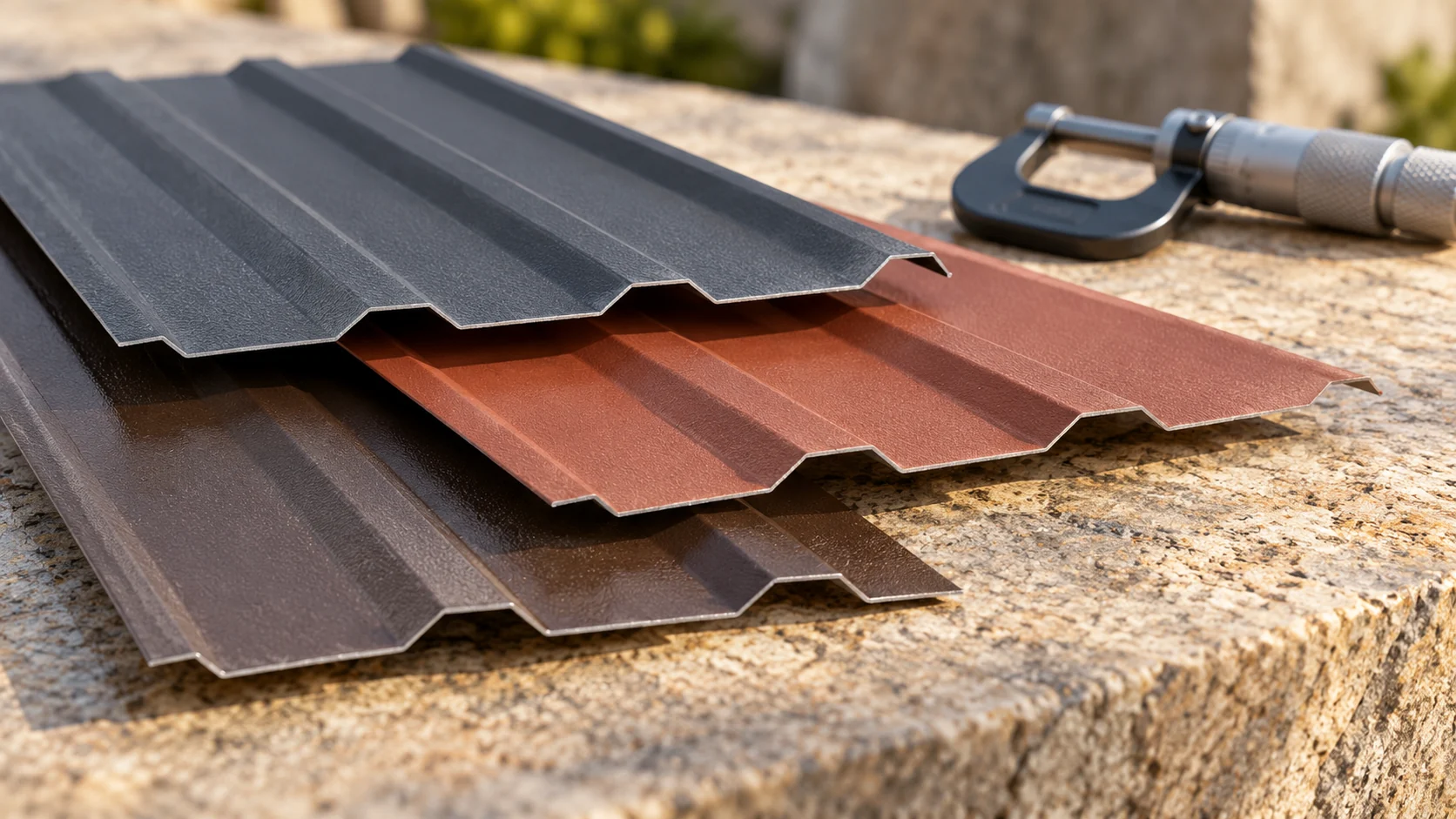
There is no single sheet thickness suitable for every roof. The same sheet can perform differently with a different support spacing and load. The height and geometry of the profile are also important. When ordering, a distinction must be made between the steel and the protective layers. The choice is based on the data for the specific product and structure, not just on the price of the sheet. Check whether the specification refers to the nominal steel thickness and how the coatings are described. Metallic and organic protections are not the same as the steel core of the sheet. A total measurement with a micrometer does not always correspond to the value that should be used to verify load-bearing capacity.
What does the thickness stated in the offer mean?
In the order, record the product designation, thickness, tolerances and type of coating. The phrase “thick sheet” does not provide a basis for comparison. A similar surface appearance does not allow all variants to be distinguished. The documents and the identification of the delivered batch are important.
A check measurement should be carried out with the correct tool and at the appropriate point on the sample. A reading at a bend or damaged edge may be misleading. Any discrepancy should be clarified before installing the entire batch.
Why is the profile height equally important?
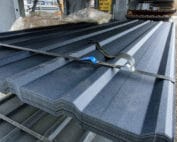
The profiling gives the thin sheet its rigidity. T18 and T35 profiles of the same steel thickness do not perform identically. They also differ in rib spacing and cover width. Roof suitability cannot be determined from the number of millimetres of steel alone.
Different geometries occur under a single height designation. The correct table for the specific section is needed for calculations. Do not transfer spans from a similarly named profile. Even a small change in shape can matter for how the sheet performs.
How does the support spacing change the requirements?
The steel sheet transfers loads between supports. A greater distance can increase deflection and load-bearing requirements. The number of spans and the bearing width are also significant. A table for a continuous system is not automatically suitable for a single span.
It is worth comparing a variant with thicker sheet and a variant with a modified support layout. Each requires calculations and a full quote. An additional purlin has its own cost and method of fixing. The lowest price for the covering does not always mean the cheapest correct roof.
What loads must be taken into account?
In addition to self-weight, snow and wind act. Location, building height and adjacent roof slopes influence the assessment. Near a higher wall, a different snow pattern may occur than in the middle of an open roof. At the edges, wind suction can be important.
Adding equipment or installation panels requires a separate check. Do not assume that a reserve of sheet thickness solves the whole problem. Loads must be transferred through the fixings and structure to the foundations. The cladding alone is not a universal place for suspending loads.

What does a comparison of 0.5 and 0.7 mm show?
With the same geometry and material, increasing the steel thickness from 0.5 to 0.7 mm means about 40% more mass of the steel alone. However, it does not automatically mean exactly 40% greater permissible span. The relationship between load-bearing capacity and deflection is more complex.
A thicker sheet may be less susceptible to accidental deformation, but still requires proper transport. Its mass affects handling and structural load. Also check the permissible production lengths. Not every combination of profile and thickness has the same range.
Can a coating replace a greater steel thickness?
The coating protects the surface from environmental conditions. Its type is selected according to exposure and the required appearance. It does not replace the correct load-bearing cross-section. On the other hand, suitably thick steel will not remedy poorly selected protection in an aggressive environment.
Check both sides of the sheet. The underside may be affected by condensation and contaminants from the interior. Anti-condensation fleece has a separate function and requires drying out. It does not increase load-bearing capacity as an additional layer of steel would.
How can the choice be confirmed before ordering?
Provide the designer or the person selecting the covering with the geometry, support spacing and loads. Identification of the exact profile is needed. The check should cover the ultimate limit state and permissible deflections. The fixings must also match the layout.
On acceptance, compare the markings with the order and inspect the condition of the sheets. Do not choose thickness based on pressing your hand on a sample. A short piece behaves differently from a long run between supports. A “by feel” test does not replace technical data.
What else is worth asking about
Is 0.5 mm steel sheet always sufficient for a small roof?
A small area alone does not decide. What matters is the profile, span, supports, fixings and loads. A roof over a small shelter can also be heavily loaded by wind or snow.
Can a thicker sheet be supported less frequently without calculations?
No. Changing the thickness may improve some parameters, but the permissible arrangement must be verified. A table or calculation is needed for the specific profile, material and scheme.
7 branches. Materials closer to your project.

- SEROCK — Dzierżenin 34 E
- BŁONIE — ul. Sochaczewska 138A
- RADOM — ul. Grobickiego 8
- ŁÓDŹ — Natolin 8
- OLSZTYN — Barczewo, ul. Prosta 9
- WROCŁAW — ul. Jerzmanowska 10C
- GORZÓW WLKP. — ul. Zielona 33/34