EPS and thermal insulation
How should thermal insulation and foundation waterproofing be separated?
At a glance
EPS at the foundation reduces heat loss. A watertight waterproofing layer protects the masonry against water. These layers work alongside each other, and neither takes over all of the other’s tasks. A good detail also takes into account the adhesive, protection during backfilling and the connection to the wall and floor. Buying a board described as a foundation board does not by itself solve the moisture problem. An EPS board reduces heat flow thanks to its structure. A waterproofing coating or membrane forms a watertight barrier against water. In a typical external solution, the waterproofing is applied to the prepared masonry, and the thermal insulation sits in front of it. A protective or drainage layer may follow. The exact arrangement depends on the design.
What is each layer responsible for?
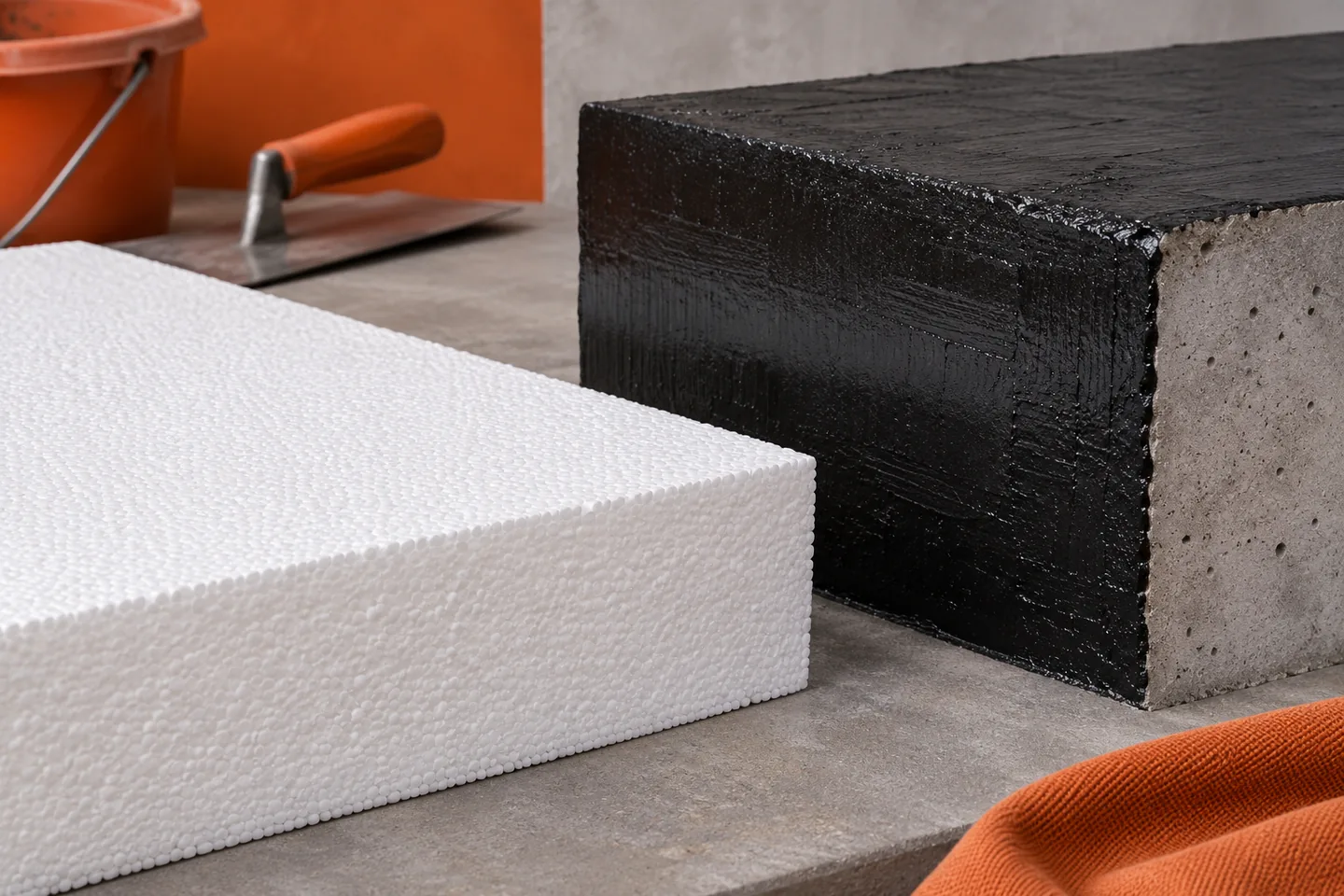
The joint between two polystyrene boards is not a watertight waterproofing connection. This also applies to rebated edges. The rebate makes it easier to achieve continuity of the thermal insulation, but it does not replace sealing at a corner or a pipe penetration. During inspection, the continuity of the thermal insulation and the tightness of the layer protecting the wall must therefore be assessed separately.
First, the water conditions must be established
Damp ground after rain, periodically backed-up water and constant water pressure are different service conditions. The choice of foundation protection should follow from an investigation of the subsoil and the groundwater level. The lie of the land, the permeability of the backfill and the way rainwater is drained also matter. A solution from the neighbouring house does not have to suit our plot.
Drainage can be part of the design if water discharge and the possibility of maintenance are ensured. It should not be assumed that the pipe alone at the footing will always dry out the foundation. When the outlet is blocked or there is nowhere to direct the water, the drainage will not fulfil its function. Waterproofing is selected for the actual conditions, including the less favourable ones.
Which EPS parameters matter?
For the zone near the ground, a board is chosen whose application is confirmed in the documentation. The λD coefficient describes heat conduction. A lower value allows a higher thermal resistance at the same thickness. The WL(T) parameter indicates water absorption in a long-term immersion test. It is also worth checking behaviour under pressure and the requirements relating to frost.
The designation CS(10)100 refers to the compressive stress at 10% deformation, not to a safe pressure sustained over several decades. Reading the EPS number alone is not enough. Density can be an auxiliary characteristic of the material, but it does not replace the declaration of properties. The colour of the board also does not prove its water resistance or its suitability for permanent immersion.
Connections are just as important as the surface
Vertical waterproofing must be properly connected to the horizontal waterproofing and to the seals at service penetrations. The greatest attention is paid to corners, the junction between the wall and the footing, and the termination at the plinth. It is not enough to carefully coat the middle section of the wall if water can bypass the coating at its lower or upper edge.
Thermal insulation works in a similar way. The insulation of the foundation wall should connect with the insulation of the floor and the façade according to the designed detail. The Uc value relates to the entire building element, not to a single EPS board. A cold strip near the floor may result from a gap in the insulation or a thermal bridge at the junction, even though the middle section of the wall has been thickly insulated.
Adhesive and backfill must not damage the protection
The adhesive must be compatible with both the EPS and the specific waterproofing. Not every bituminous product is suitable for direct contact with polystyrene. Solvents can damage the boards. The required drying time of the coating must also be observed. Bonding the insulation onto a fresh, not yet ready layer makes it difficult to assess its tightness and adhesion.
Below ground level, no random penetrations of the waterproofing with insulation fixings are made. The method of fixing results from the system solution. Before backfilling, the coating, the joints and the boards must be accepted. The backfill and its compaction must not cut through the layers or displace the thermal insulation. The protection is selected according to the type of soil and the expected loads.
How can the completeness of the solution be checked?
It is worth having a single section drawing in the documentation showing all layers and their terminations. It should include the ground level, plinth, footing, floor and service penetrations. Product data sheets and confirmation that the adhesive is compatible with the substrate are also needed. Photographs taken before backfilling help later to reconstruct the arrangement and determine the cause of any dampness.
The best check is to ask separately about water and about heat. Which layer retains water? Which layer limits heat loss? Where do both end? If the answer to everything is a single polystyrene board, the description is incomplete. The right EPS is part of the foundation solution, but its effectiveness also depends on the other layers.
EPS materials for different zones of the building are produced by, among others, Austrotherm, Polstyr, Dom-Styr and Ekobud. Selecting a specific grade requires checking its documentation.
7 branches. Materials closer to your project.

- SEROCK — Dzierżenin 34 E
- BŁONIE — ul. Sochaczewska 138A
- RADOM — ul. Grobickiego 8
- ŁÓDŹ — Natolin 8
- OLSZTYN — Barczewo, ul. Prosta 9
- WROCŁAW — ul. Jerzmanowska 10C
- GORZÓW WLKP. — ul. Zielona 33/34