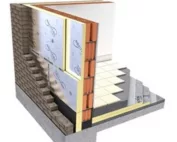
PIR insulation
Does Eurothane G replace the vapour control layer for the entire wall?
At a glance
Eurothane G does not make the entire wall a vapour control layer, because its gas-tight facings act only on the surface of the boards, while the building element also has joints, openings and points where services pass through. Airtightness must therefore be ensured at each of these points, not only by bonding the panels. Recticel Eurothane G is a PIR board faced on both sides with a gas-tight facing and with 12.5 mm plasterboard, intended for suitable internal insulation applications. The masonry beneath it requires preparation in line with the condition of the substrate and the requirements of the new construction, not merely an assessment of the surface appearance.
From the name to the actual board
The factory-bonded composite of layers in Eurothane G does not relieve you of the need to identify the substrate to which the board is to be fixed. The inspection should cover the masonry, the function of the room and the points of connection with adjacent partitions, and the result should be compared with the documentation or with the condition before the change. This determines how well the composite matches the existing partition and the way the interior is used.
How to read thermal parameters
In Eurothane G, the lambda value of 0.022 W/(m·K) describes the PIR component. The plasterboard facing has a different thermal resistance: its thickness must not be added to the core and divided by the same lambda. When assessing the wall, use the composite data or consider both layers separately.
When comparing Eurothane G variants, the same parameters must be compared: the total thickness of the composite and the thickness of the insulating PIR part. The lambda value of 0.022 W/(m·K) applies only to the PIR core, without the gypsum facing, so treating gypsum and foam equally would overstate the thermal resistance of the whole system. Before assessing savings, establish the parameters of the PIR part, the share of the gypsum facing and the specific resistance for the given variant — this will translate into the actual loss of room space.
In Eurothane G, the chamfering of the gypsum edge is not a tongue and groove of the PIR part. Both layers must be examined separately to understand how the joint is made. Finished jointing of the visible surface does not prove that the core has been correctly brought together. In the documentation or installation photos, it is worth looking for both pieces of information. This helps distinguish a finishing problem from a discontinuity in the hidden insulation layer.
Leak, vapour or airtightness defect
After adding Eurothane G from the inside, the masonry works under different thermal conditions than before. Gas-tight facings therefore require checking whether the joints remain continuous across the entire partition and whether the wall retains its ability to dry out.
First establish where water is entering the building envelope and whether the masonry can dry outwards before the wall is closed with Eurothane G boards. A dry and even plasterboard surface does not prove that the source of dampness has ceased. Combine traces of leaks, room ventilation and the junction of the insulation with the floor and ceiling with the history of when the problem appeared — only this allows the action of water to be separated from the properties of the linings.
Edge profiles and joint continuity
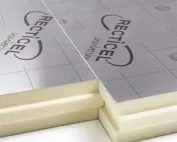
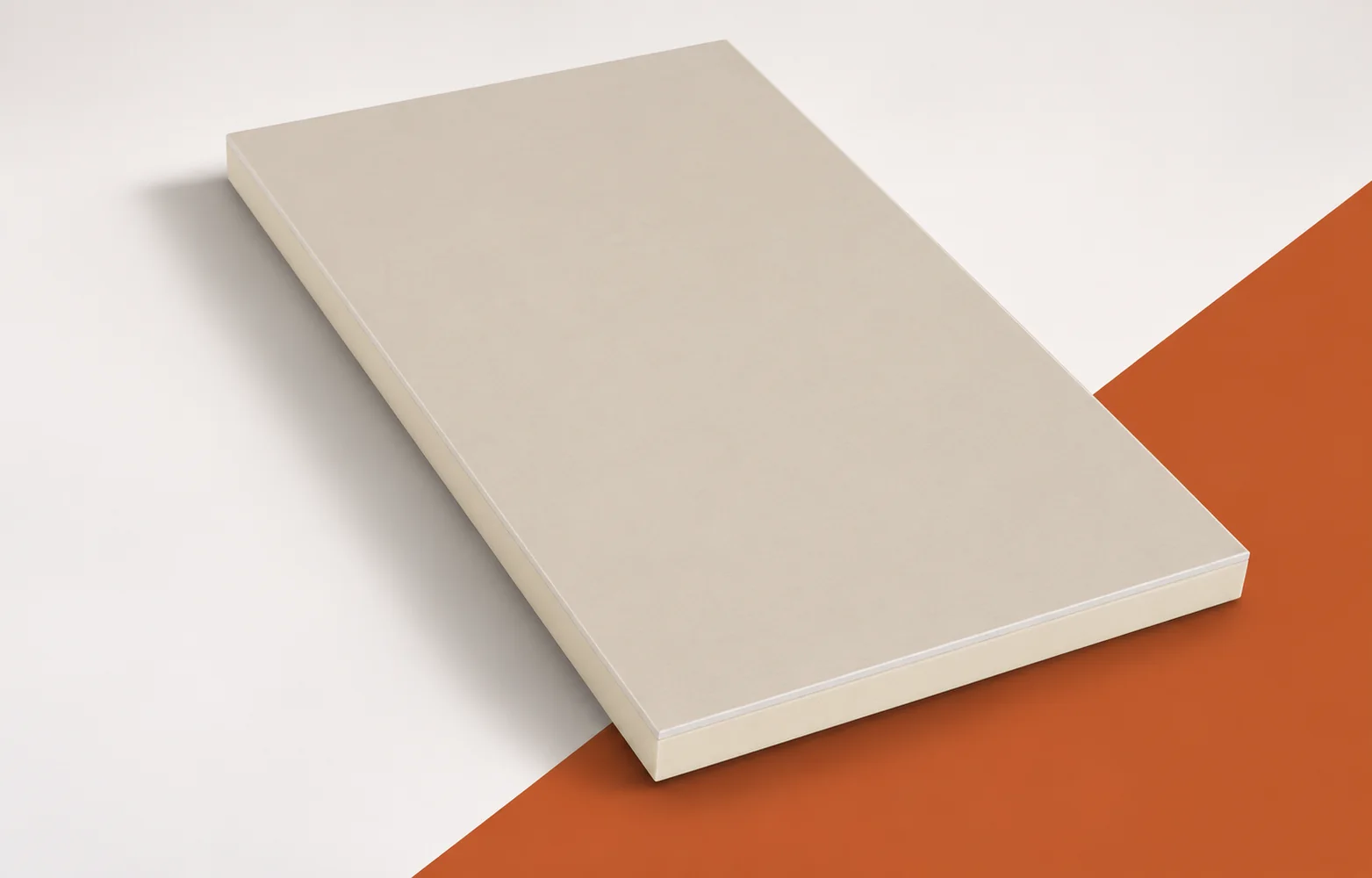
The Eurothane G board measures 2600 × 1200 mm. Its PIR core ends with straight edges, while the longer sides of the plasterboard facing are chamfered, which entails the execution of joints.
At a local discontinuity, compare the chamfered long plasterboard edges with the straight edge of the PIR core. The plaster joint and the insulation junction form a single connection, and careful finishing of the surface does not confirm that the core has been brought fully home. For the 2600 × 1200 mm panels, establish the position of the joints, how the insulating part is brought together and the route of services at cut locations — this shows whether the polyurethane insulation forms a continuous layer.
The limits of conclusions drawn from the product data sheet
In the Eurothane G datasheet, the B-s1,d0 classification refers to the specified end use. It therefore does not establish that the PIR core alone is non-combustible, nor does it make the entire building envelope automatically fire-resistant.
Class B-s1,d0 relates to reaction to fire in a specific end use, not to the load-bearing capacity of the composite facing. Heavy fixings passing through the Eurothane G board must transfer the load through the construction to a suitable substrate, not rely on the reaction-to-fire test result. The documentation should then specify the type of anchors, the installation route and the conditions of use of the composite in the given interior.
What to gather before assessment or repair
In the Eurothane G offer, the thickness of the PIR part and the full scope of finishing works must be found. Fixing materials, the method of forming joints and solutions at reveals remain to be agreed.
Compare the quotation with the specific wall build-up in which Eurothane G is only one element. Check whether substrate preparation, fixing of the boards, finishing of reveals, the perimeter of the construction and the relocation of services are included. At openings, many short ends arise, and repairing the masonry is often a separate item. Compare variants only after checking jointing, perimeter connections and the rerouting of existing service points — without this, the assessment of the completeness of the quotations is incomplete.
7 branches. Materials closer to your project.

- SEROCK — Dzierżenin 34 E
- BŁONIE — ul. Sochaczewska 138A
- RADOM — ul. Grobickiego 8
- ŁÓDŹ — Natolin 8
- OLSZTYN — Barczewo, ul. Prosta 9
- WROCŁAW — ul. Jerzmanowska 10C
- GORZÓW WLKP. — ul. Zielona 33/34