Installation and details
Choosing a roofer for the whole job, from covering to details
In brief
First, check how the roofer intends to resolve the specific roof details, not just the price per square metre. During the conversation, ask for a description of the substrate preparation, the fixing method for the covering and the sequence of work that will later be covered up. Note whether the contractor clearly separates material supply from labour and how they document any changes after uncovering the layers. Photos of valleys, eaves and chimneys give good insight, not only a view of the finished slope. On this basis it is easier to judge whether the offer matches the real conditions of your roof.
How can you verify experience with the chosen roofing?
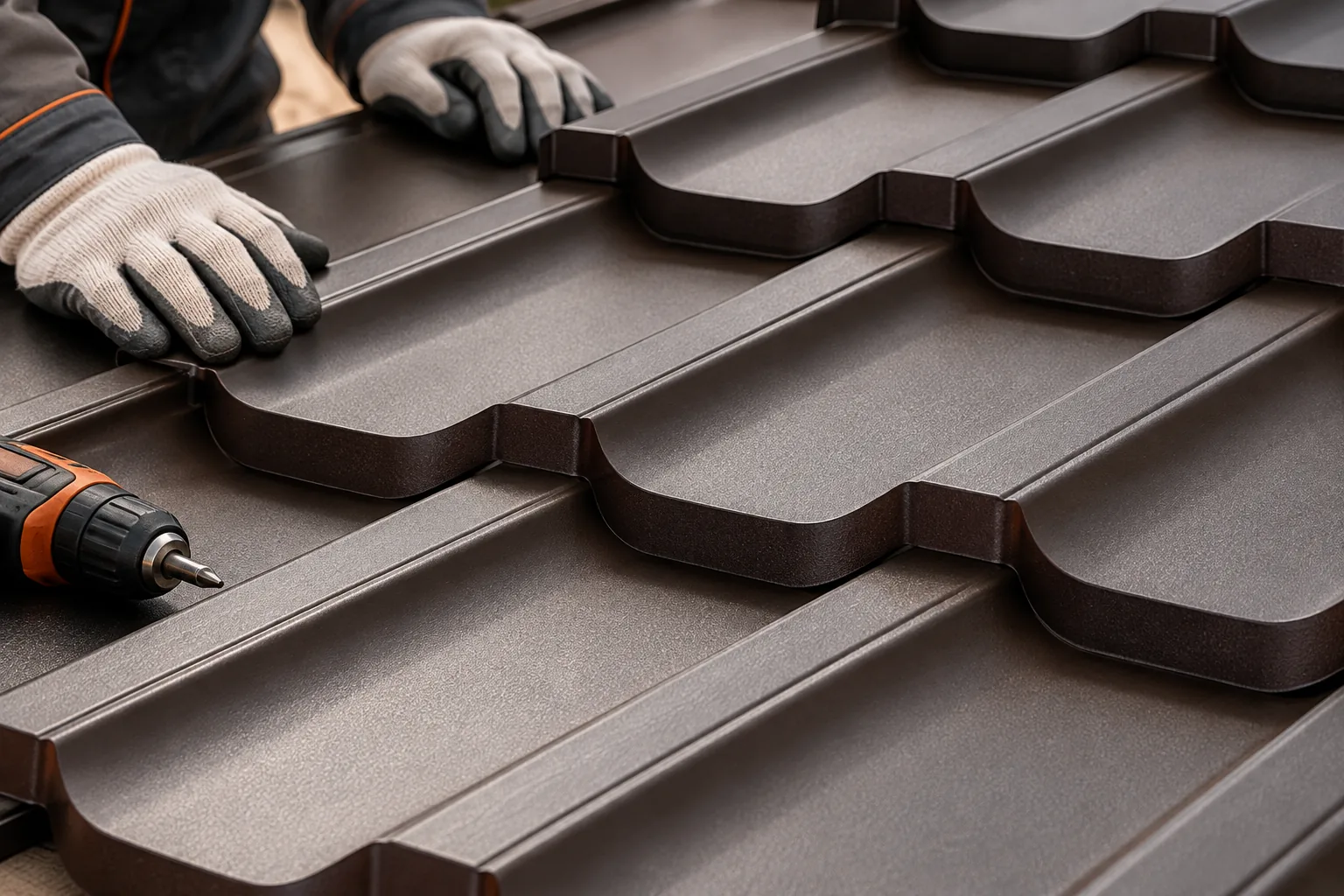
It is worth asking about projects with similar material and roof geometry. Installing modular tile-effect metal roofing, long trapezoidal steel sheet and sandwich panels requires different organisational skills. A photo of the finished structure does not show everything. Photographs of roof valleys, eaves, chimney and layers before covering provide more information.
If there is an opportunity to view a completed project, pay attention to straightness, flashings and the tidiness of details. However, the entire workmanship should not be assessed solely from the pavement. References regarding deadlines, communication and rectification of defects are also important. It is good to ask whether the works presented were carried out by the same team that is to come to the new site.
What to ask during the roof inspection?
The contractor should establish the condition of the structure, the layers under the covering and the method of drainage. In the case of renovation, it is worth discussing the need for exploratory openings. Without checking hidden elements, the scope of all works cannot be responsibly confirmed. A good answer may include conditions and the scope of further inspection, rather than a promise of a fixed price without viewing the substrate.
Ask about installation in accordance with the instructions of the selected product, the method of cutting and the organisation of roof penetrations. It is also worth raising the subject of ventilation and the connection of the underlay with the eaves. If every doubt is to be resolved with silicone, a more detailed explanation is needed. Details should have a well-thought-out geometry and a path for water drainage.
What should the scope of the quote include?
The quote should separate substrate preparation, laying of the covering, flashings, gutters and other accessories. In the case of renovation, dismantling, protection of the building and waste management are added. It is worth specifying who supplies the material and checks its quantity. Comparing several prices only makes sense when they all relate to a similar scope.
The rules for settling additional works revealed after the roof has been opened must also be established. These may concern damaged battens, timber or damp insulation. It should not be assumed that every surprise means a contractor error. It is important that the method of documenting and agreeing changes is clear before the start, and not only at the final invoice.

How to assess organisation and work safety?
Before installation, it is worth discussing access to the building, unloading and the storage location. The team should know how to protect long sheets from deformation and moisture. Covering the house after dismantling the old covering is also important. The schedule must take into account the weather and the restrictions on the use of sealing materials.
The contractor organises safe work at height and protection of the surrounding area. Scaffolding or proper equipment should not be treated as unnecessary decoration in the cost estimate. It is also worth checking whether the team has insurance appropriate to the work being carried out. The scope and conditions of the policy are more important than the mere assurance that the company is insured.
How should handover and responsibility for corrections be established?
A staged acceptance of elements that will later be covered is useful. This applies among other things to the substrate, membrane, seals and insulation. Photos help to document the solution, but they do not replace a technical assessment. For more difficult roofs, the participation of a supervising person can be agreed, who will check that the execution complies with the design.
Finally, a list of any defects and a deadline for their removal should be drawn up. A distinction must be made between responsibility for the material and responsibility for the execution. It is good to keep product documents, agreements with the team and the acceptance report. In the event of a problem, it is then easier to establish what the defect concerns and who should initiate its inspection.
What signals should prompt caution?
A lack of inspection, an unclear price scope or a refusal to specify a particular material model can be worrying. A promise of identical installation for every steel sheet works in a similar way. A universal batten spacing and a single number of screws for any roof ignore differences in profiles and loads. It is worth asking for substantive justification instead of judging the confidence of the statements.
The best choice does not have to mean the most expensive quote. What counts is a team that understands the task, can price it and clearly describes the limitations. Reliable agreements make the work easier for both sides. They also allow contractors to be compared on the basis of how they solve real roof problems, rather than on declarations of many years of experience alone.
7 branches. Materials closer to your project.

- SEROCK — Dzierżenin 34 E
- BŁONIE — ul. Sochaczewska 138A
- RADOM — ul. Grobickiego 8
- ŁÓDŹ — Natolin 8
- OLSZTYN — Barczewo, ul. Prosta 9
- WROCŁAW — ul. Jerzmanowska 10C
- GORZÓW WLKP. — ul. Zielona 33/34