Polystyrene and thermal insulation
EPS or XPS with high groundwater? What to check?
At a glance
With high groundwater, the insulation is not chosen solely on the basis of the price of EPS and XPS. First, the water conditions must be established and a watertight protection of the structure must be designed. Only then are specific boards compared, along with their water absorption and behaviour under load. The material name alone does not confirm suitability for permanent contact with water. Water may appear at the foundation seasonally or persist for a long time. It may also accumulate locally after heavy rainfall. For the design, what matters is the level, the duration of exposure and any pressure exerted on the building element. A single inspection of a dry excavation in summer does not give a complete picture of the conditions that will occur during the use of the house.
What does a high water level mean?
A geotechnical investigation and a watertightness protection design come before the choice of thermal insulation. If water exerts pressure, the structure and the tightness of the joints must also be taken into account. No type of insulation board will on its own solve a leak through a working joint, an unprotected service penetration or an incorrect connection between the wall and the substrate.
How do EPS and XPS differ?
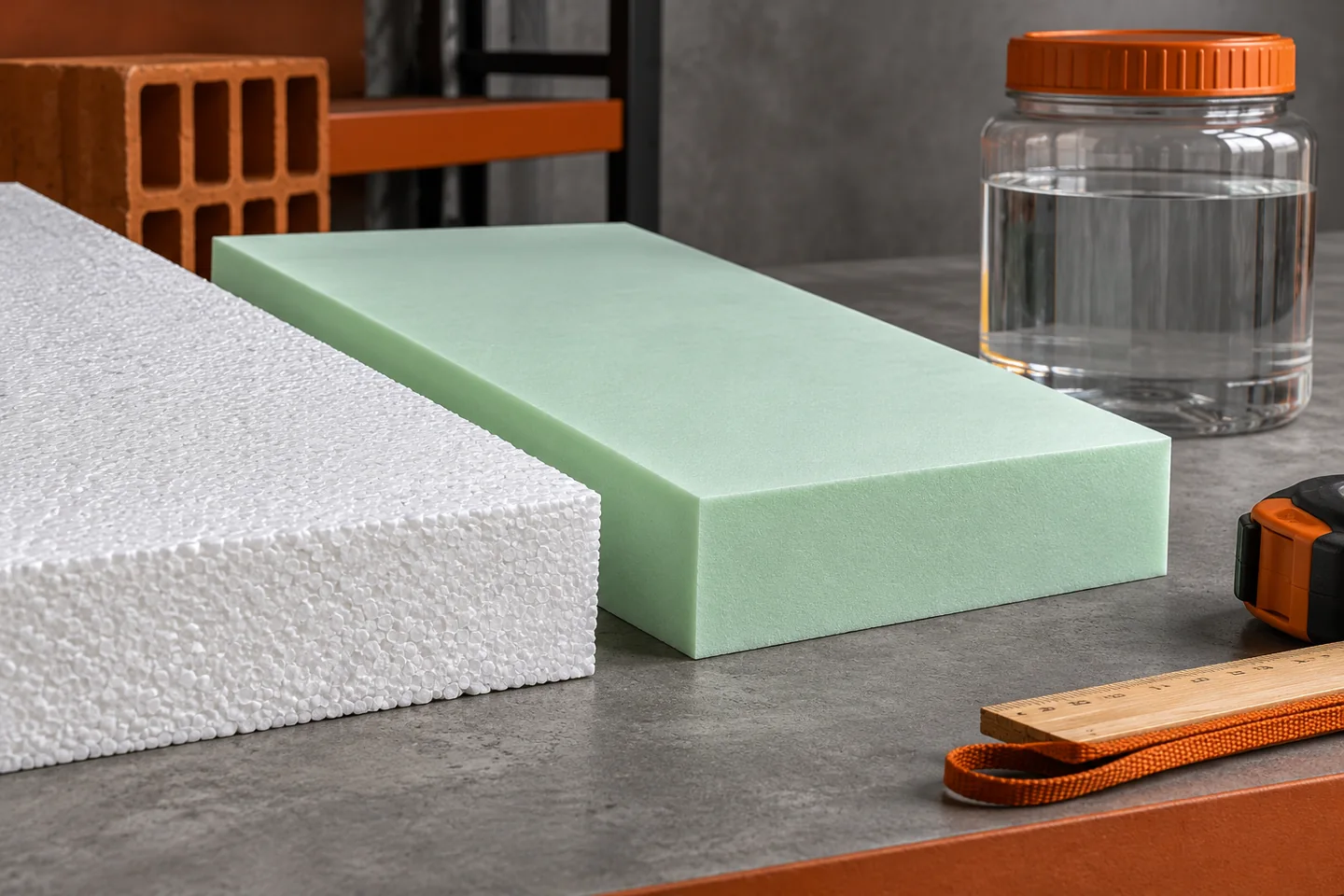
EPS is expanded polystyrene, whose structure is made up of fused expanded granules. XPS is extruded polystyrene. The differences in technology translate into the structure and the available performance properties. However, this does not mean that all boards in one group are identical. There are numerous variants with different parameters and intended applications.
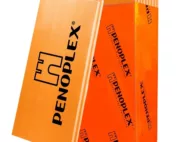
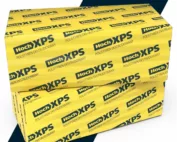
In zones exposed to water, special EPS variants and suitable XPS boards are considered. The parameters of the best product should not be transferred to the entire category. Colour is also not decisive. Coloured EPS is available on the market, so a blue board cannot be identified as XPS on the basis of appearance alone.
Which data should be compared where water is present?
The basis is a clear suitability for the given conditions. The water absorption under long-term immersion and, where required, under diffusion must be read. In the frost zone, behaviour after freeze-thaw cycles is also significant. The absence of a declaration of a given parameter is not proof that the material achieved a zero or the best possible result.
The WL(T) value describes the result of a specific test. It does not constitute an independent approval for many years of immersion. The limitations on depth, method of fixing and covering of the boards must be checked. When the data sheet speaks of damp ground or periodic water, this cannot be taken as consent for every foundation below groundwater level.
Why is strength also important?
The thermal insulation must retain its shape under compressive loads. This applies to backfill, protective layers and, in particular, insulation beneath a loaded structure. The CS(10) parameter allows a specific property to be compared in a test, but 10% deformation is usually not the permissible settlement of the finished building element. Design criteria for long-term performance are required.
The documentation may contain data on creep under compression. If it does not, a safe load must not be calculated by simply dividing the CS class by an arbitrary factor. The designer should base the choice on the data for the specific product and construction. A material for a vertical wall does not thereby automatically become suitable beneath a foundation slab.
How can the continuity of the layers be maintained?
The waterproofing should form a continuous barrier in accordance with the design. Thermal insulation reduces heat losses and may perform a protective role, but its joints are not seals. Service penetrations, corners and the base termination require their own details. Milled edges improve the fit of the boards, but they do not replace a tight membrane or coating.
Before backfilling, the compatibility of the adhesive with both layers must be checked. Not every adhesive is suitable for every surface of XPS, EPS and waterproofing. Equally important is avoiding unforeseen punctures. A drainage layer can only drain water away if the entire system has a functioning outlet. It does not remove the need to check the water conditions.
When can a purchasing decision be made?
Only after comparing the technical data and limitations can costs be compared. Lambda is responsible for heat conduction, whereas Uc describes the entire building component. Thickness results from the thermal balance and the geometry of the joints. In difficult conditions, paying extra for a suitable product may be justified, but it will not replace a correct design and careful workmanship.
A practical order should include the type of board, the parameters, the thickness and the intended place of use. It is worth keeping written confirmation of suitability when the conditions go beyond the standard description. If two offers have only similar colours and a general name such as foundation, there is not yet any basis for a reliable comparison of their use.
Among EPS manufacturers are Austrotherm, Swisspor, Dom-Styr and Polstyr. The comparison with XPS should be carried out on the basis of the documentation for specific boards.
7 branches. Materials closer to your project.

- SEROCK — Dzierżenin 34 E
- BŁONIE — ul. Sochaczewska 138A
- RADOM — ul. Grobickiego 8
- ŁÓDŹ — Natolin 8
- OLSZTYN — Barczewo, ul. Prosta 9
- WROCŁAW — ul. Jerzmanowska 10C
- GORZÓW WLKP. — ul. Zielona 33/34