Polystyrene and thermal insulation
Does a dimpled membrane replace waterproofing alongside EPS insulation?
At a glance
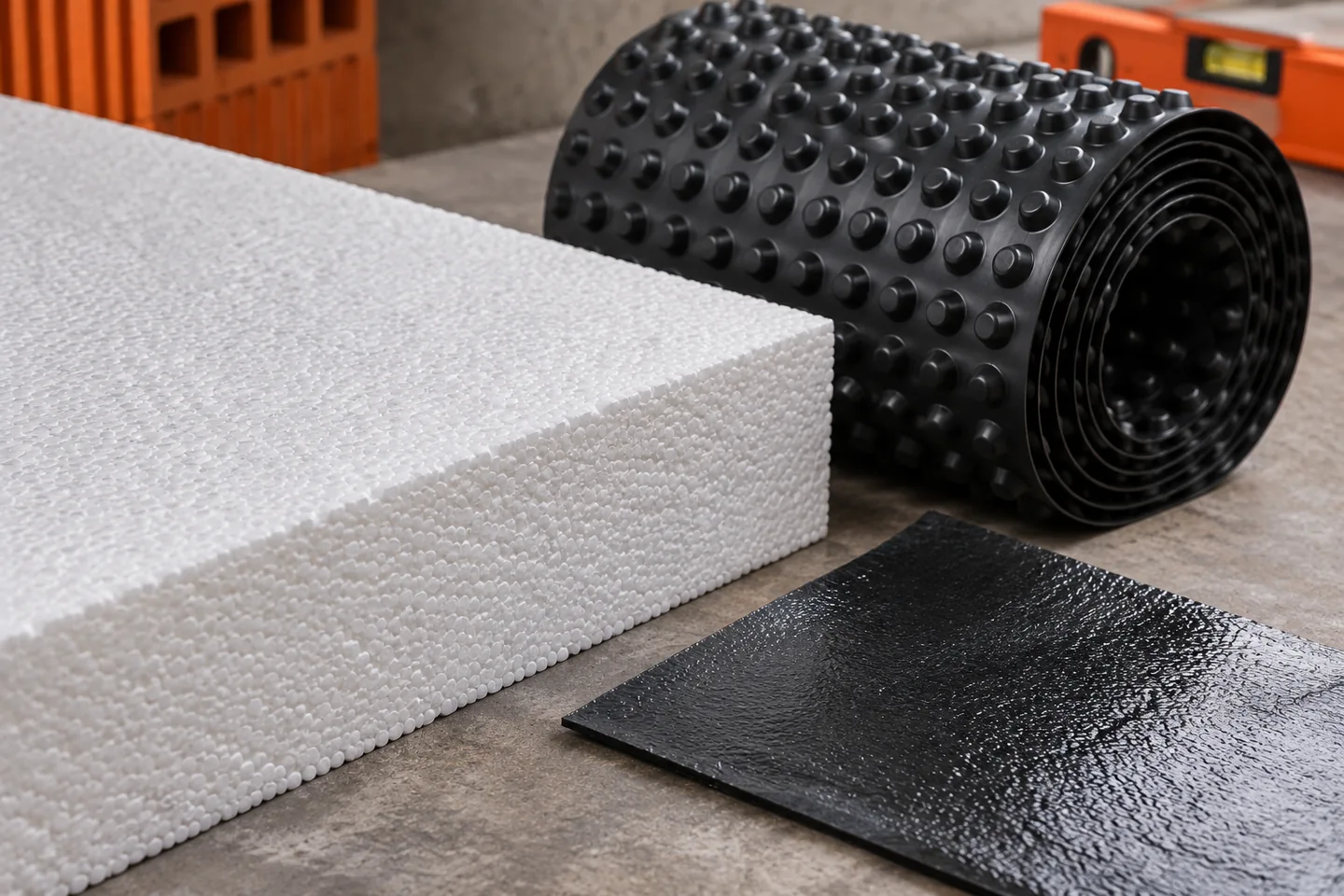
A dimpled membrane does not by definition replace foundation waterproofing. Depending on the product and the system, it may protect layers or take part in draining water. The tightness of the wall is ensured by separately designed protection. The type of membrane, the direction of installation, the termination at the top and the drainage outlet at the bottom must be checked. The dimples alone do not solve the water problem. The term dimpled membrane covers products with different functions. These may be simple embossed membranes or elements with a filter layer intended for specific drainage systems. They differ in resistance to pressure, method of joining and installation. They should not be treated as one interchangeable category merely because the surface has similar embossing.
What lies behind the colloquial name?
First of all, the product’s intended purpose must be read. The protective, drainage and water-resistant layers have different tasks. If the membrane is to protect the EPS during backfilling, that does not yet mean it seals a cracked wall. The choice should be part of the description of the entire foundation. The absence of such a description often leads to the layers being reversed or the terminations being omitted.
Why does the wall need separate protection?
Water can reach the wall through the ground, gaps and construction joints. Waterproofing must form a continuous barrier together with corners and pipe penetrations. A loosely laid protective layer on top of the polystyrene does not automatically ensure that all these places are sealed. The connection between the vertical and horizontal protection at the foundation and floor is particularly important.
EPS is not waterproofing either. Even a board with limited water absorption has joints and ends. The WL(T) parameter describes water uptake in a test of the material, not the tightness of the whole wall. If the design requires protection against water pressure, it cannot be replaced by a combination of polystyrene and a random foil simply because both products are moisture-resistant.
In which direction should the dimples face?
There is no single correct answer for all products and assemblies. The direction depends on what the membrane protects, what it is in contact with and how it is to drain water. A product with a geotextile may have different requirements from a simple protective layer. The detail and instructions of the specific manufacturer should be followed, rather than relying on the appearance of a neighbouring site.
The point load of the dimples can be significant for the surface of the thermal insulation or a fresh coating. The compatibility of the layers and the permissible loads must therefore be checked. The CS(10) class of the board alone does not describe all the effects of contact with the membrane’s protrusions. If the instructions specify a smooth protective layer or a different assembly, it should not be simplified on one’s own initiative.
Where will the collected water flow?
The layer referred to as the drainage layer must be given a path for drainage. Without it, water can collect at the lower edge of the foundation. The connection to the designed drainage system, its patency and its maintainability must be checked. Laying the membrane alone does not turn impermeable ground into an efficient system for draining precipitation.
At the top, a termination is needed to limit soil and contaminants getting behind the protective layer. The drainage layer should not be filled with random backfill that will silt up the flow space. The height of the termination must be coordinated with the plinth and the final ground level. If the surface is later raised, a previously correct detail may cease to work as intended.
How do you fix it without unnecessary penetrations?
The fixing of the membrane must correspond to its instructions and to the foundation design. The waterproofing layer below ground must not be accidentally punctured in order to hold the protective layer in place quickly. The fixing location, the method of joining the sheets and the treatment of corners must be determined. Punctures made before backfilling may become invisible but will still remain a path for leakage.
The EPS boards should be stable and properly fitted before the protective layer is installed. Backfilling is carried out so that it does not displace the layers or tear them. Sharp waste and large fragments of rubble are not without effect on the insulation. Even a robust membrane has defined limits of strength. Acceptance before covering is far simpler than subsequently searching for damage underground.
What should be included in the order?
In addition to the type of EPS, the function of the membrane and its required properties must be specified. It is worth attaching a foundation cross-section showing the waterproofing, adhesive, protective layer and drainage. This way, the supplier will not select a product solely on the basis of the phrase “foundation foil”. The necessary accessories and terminations should be counted together with the main materials.
When renovating, the cause of the dampness is established first. Adding a membrane over existing EPS does not necessarily improve the tightness of the wall. Sometimes it is necessary to repair the coating, the joint or the drainage of water from the surface. A good solution clearly indicates which layer seals, which insulates and which protects or drains water.
EPS for construction is offered by, among others, Polstyr, Austrotherm, Sonarol and Justyr. The choice of EPS does not replace the separate selection of waterproofing and foundation protection.
7 branches. Materials closer to your project.

- SEROCK — Dzierżenin 34 E
- BŁONIE — ul. Sochaczewska 138A
- RADOM — ul. Grobickiego 8
- ŁÓDŹ — Natolin 8
- OLSZTYN — Barczewo, ul. Prosta 9
- WROCŁAW — ul. Jerzmanowska 10C
- GORZÓW WLKP. — ul. Zielona 33/34