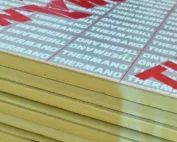
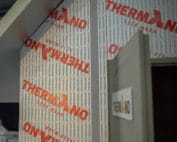
PIR insulation
The green facing on Thermano GK-H2: what moisture resistance means
At a glance
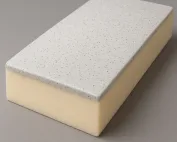
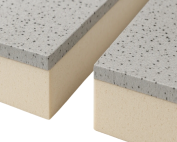
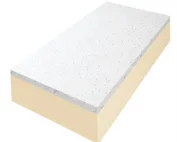
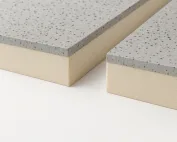
Thermano GK-H2 combines a PIR core with gas-tight facings and a green 12.5 mm gypsum plasterboard with reduced water absorption. The stated thickness refers to the plasterboard, not to the entire composite. The variant with a white facing, Thermano GK-A, is intended for typical dry rooms. Choosing H2 does not, however, create a standalone waterproofing system and does not solve ventilation, protection of areas exposed to water or the tightness of joints. Before renovating, the conditions of use and the cause of any dampness in the wall must be established. Below, we separate the functions of the gypsum facing, the PIR core and the protective layers so that the choice of composite follows from the actual cross-section.
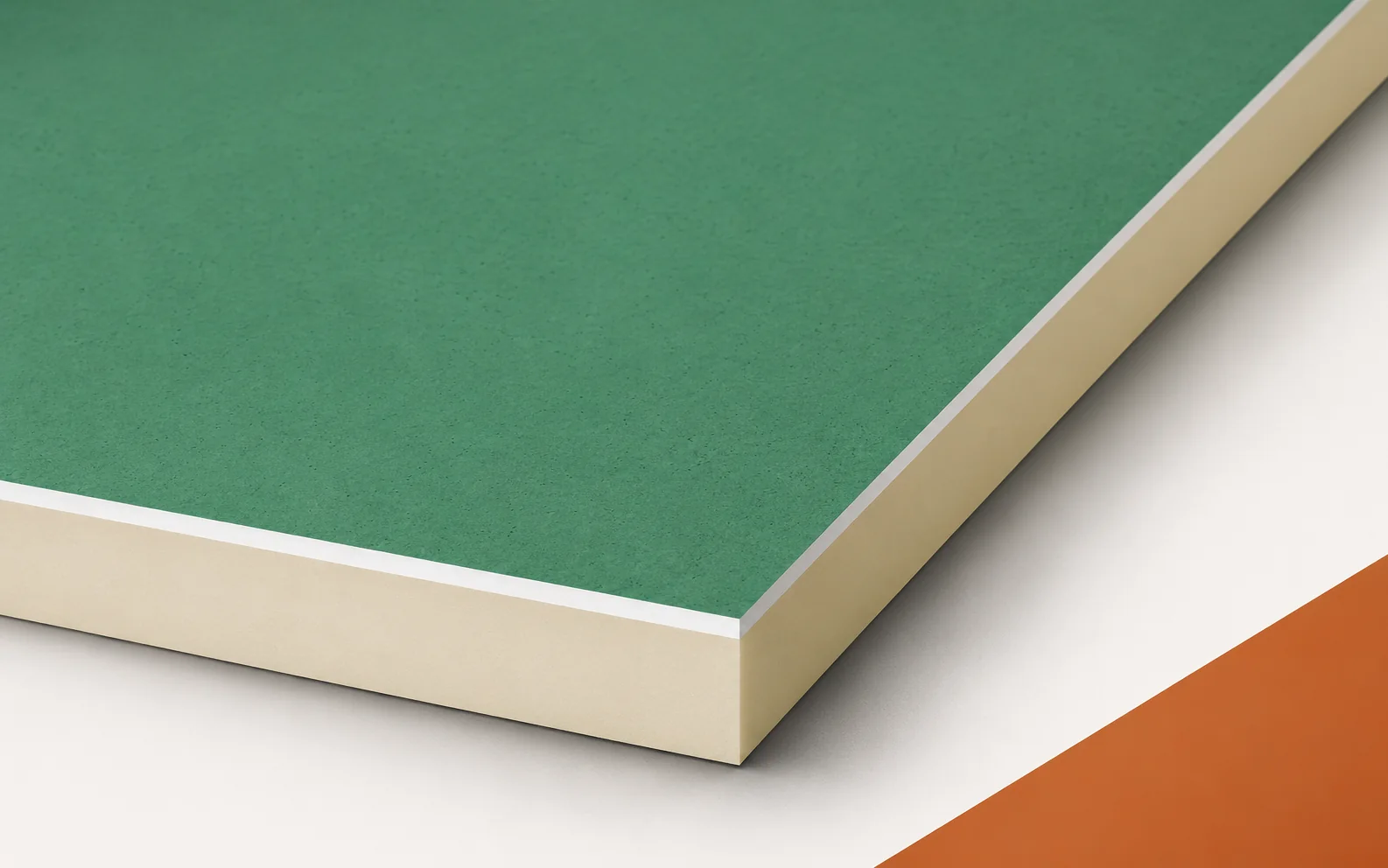
The product’s construction explains its application
Increased moisture resistance of the facing does not mean protection against water, and the colour of the board does not describe the entire protection system. During the inspection, compare the function of the room, the extent of contact with moisture and the planned finishing layers with the documentation or with the condition before the change.
What lambda alone does not say
The thermal resistance of Thermano GK is assigned to a specific composite, not to the PIR core alone. The manufacturer ties the value to the total thickness of the product, so when comparing variants it is necessary to establish which layer arrangement and which thickness correspond to the declaration.
Compare two composites with different total thickness and different thermal resistance on the same basis. The R value applies to the finished Thermano GK variant with its actual layer distribution; the number from the offer alone does not describe the conditions of use. Total thickness does not say how much space the insulating core occupies, so relate the loss of room area to the thermal benefit of the specific board. To assess savings, the distribution of thickness between the gypsum board and PIR and the resistance indicated for the ordered composite are needed.
The H2 designation in Thermano GK-H2 is easily confused with a declaration of full watertightness. In fact, it refers to the type of gypsum facing with increased moisture resistance. Joints, corners and penetrations are still part of the surface solution. It is therefore worth asking separately about the board variant and about the protection of the wet area. A single material designation does not describe both of these tasks at the same time.
Moisture must be identified, not merely covered up
H2 denotes a facing variant with reduced water absorption, not waterproofing of the wet area. The green face of Thermano GK-H2 alone therefore does not close the path of water. In a partition insulated from the inside, the moisture conditions, the PIR lamination on both sides and the continuity of the joints must be checked separately.
With moisture in a room with Thermano GK-H2, first establish whether water is passing through a joint or an installation penetration, or whether it has another source. The green H2 facing does not constitute the waterproofing of a wet area, so the cause may lie outside the board. Compare the scope of sealing of corners, penetrations and surfaces in contact with water with the history of the problem — this will allow you to distinguish the property of the facing from the performance of the entire partition.
Where problems at the junction come from
The dimensions of 1200 × 2600 mm and the BASIC edge define the grid of the Thermano GK layout, which must be related to openings and junctions with adjacent partitions. The documentation should show where the joints fall relative to doors and installations before the scope of the repair is determined.
Plan the wall with the door and electrical points using the 1200 × 2600 mm panels before cutting the elements and closing the joints, taking into account the position of the sockets and openings. Moving a socket after the facing has been closed requires cutting the layer, which makes it difficult to assess its continuity. Before bonding the elements, gather the position of the boxes, the width of the strips at the door frame and the method of finishing the sides of the structure.
Limits of the conclusions from the product data sheet
The B-s1,d0 class for Thermano GK-A and GK-H2 applies from the gypsum plasterboard side and only under the conditions given in the product classification. When assessing an existing partition, check from which side the reaction to fire is counted and whether the layer arrangement corresponds to the classified one. The class alone does not determine the behaviour of the entire partition.
The classification of Thermano GK is read from the indicated side of the gypsum plasterboard, so at service penetrations check the layer arrangement instead of transferring the result to any direction of fire exposure. Reversing the direction does not entitle you to repeat the same declaration. Where there is a discrepancy, the conditions of use, the joint detail and independent requirements for the entire partition are needed, rather than a general assurance about the quality of the board.
What to gather before assessment or repair
When ordering Thermano GK, decide on the facing variant — GK-A or GK-H2 — as well as the total thickness and the scope of finishing. Also determine the fixings for equipment and the service penetrations, because these elements belong to the scope of works and not to the board itself.
Before comparing costs, establish whether the quotation covers finishing the perimeter of the boards and preparing the locations for future fixings. The price of the panels alone does not determine whether the scope is complete, because a similar amount can conceal a different way of preparing and finishing the joints. Compare it with the type of facing, the number of panels, the execution of the joints and the agreed points for heavy fixings.
7 branches. Materials closer to your project.

- SEROCK — Dzierżenin 34 E
- BŁONIE — ul. Sochaczewska 138A
- RADOM — ul. Grobickiego 8
- ŁÓDŹ — Natolin 8
- OLSZTYN — Barczewo, ul. Prosta 9
- WROCŁAW — ul. Jerzmanowska 10C
- GORZÓW WLKP. — ul. Zielona 33/34