Roof and energy
Does a photovoltaic roof protect the house even when it is not producing electricity?
In brief
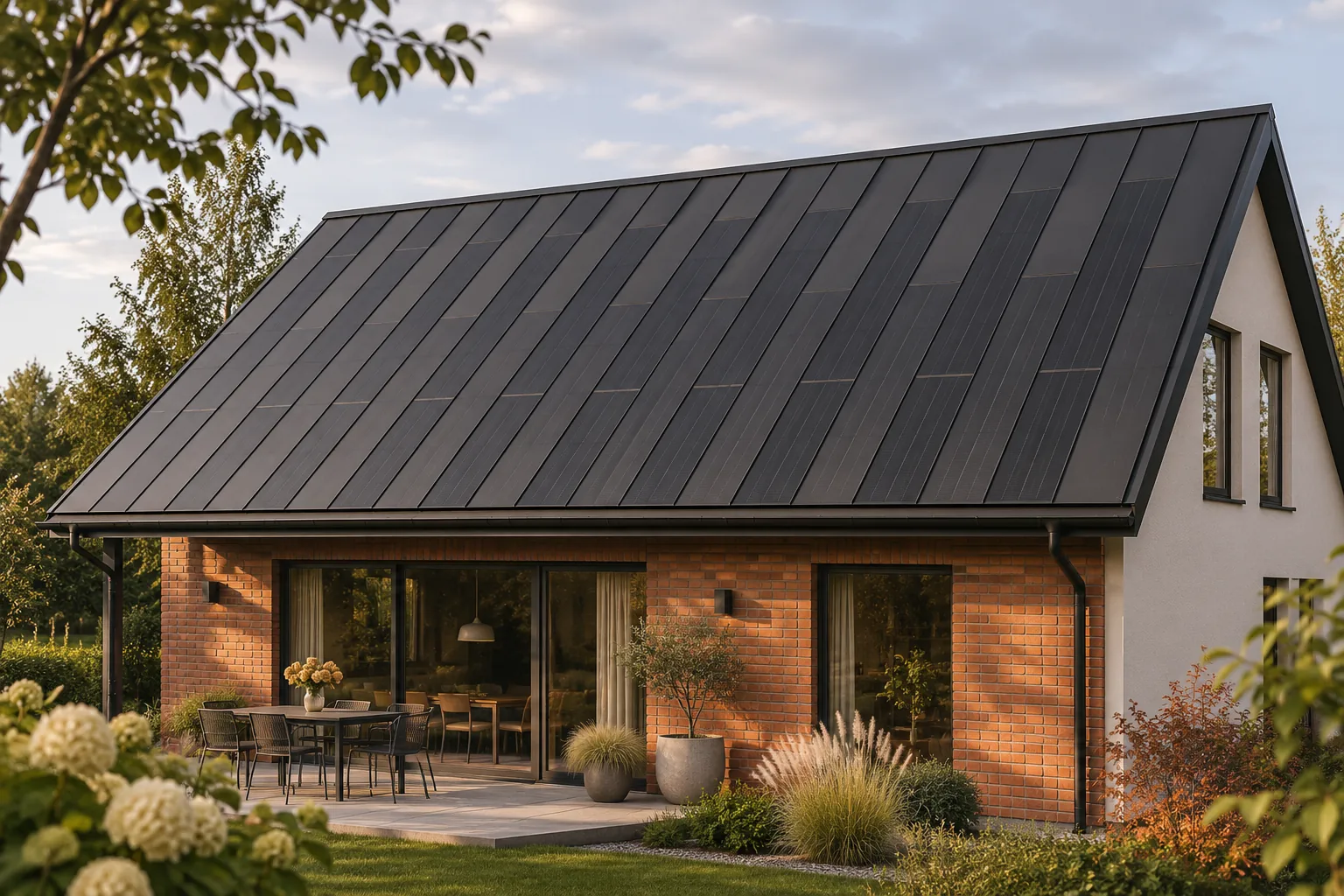
A roof integrated with photovoltaics has two tasks. It shields the building from the weather and converts light into electrical energy. Night, cloud cover or inverter shutdown limit the second function, but in themselves do not take away its weathertightness. This is an important difference between an electrical fault and damage to the covering. When buying, both areas of responsibility and the method of repair must be checked. When the inverter stops working, the steel covering element does not disappear or change shape. It still drains water in accordance with the roof slope. Flashings at the chimney, ridge and eaves work in the same way. The condition is correct installation and the absence of mechanical damage. Electricity production is not needed to maintain this function.
What remains after the installation is switched off?
In an integrated solution, the active layer is part of the planned roof covering. There is no need to lay a second, complete roof beneath the installation on a separate frame at this point. However, the layers required by the design remain underneath. They may be responsible for moisture drainage, ventilation and additional protection against water.
Which fault affects only the energy?
A break in communication with the app does not necessarily mean there is no production. A faulty inverter, on the other hand, can stop energy export even though the roof is intact. An electrician identifies these cases from device messages and measurements. A zero reading on the phone alone does not allow the tightness or the condition of the connections to be assessed.
For the owner, it is practically important to separate the reports. In a message to the service team, it should be stated whether the problem is an alarm, a drop in yield, visible damage or a leak. A well-described symptom shortens diagnosis. It is not advisable to open enclosures or disconnect cables under the covering yourself.
It is also worth keeping the meter reading or the history of messages. This helps to determine whether the outage affected only the data presentation, one circuit or the entire installation.
When is a roofer also needed?
A crack, deformation of the edge, a leaking flashing or an element displaced by wind can affect the building’s protection. In such a case, correct energy production does not confirm that the roof is sound. The cells can continue to work even though water penetrates through a poorly made connection next to the active field.
If part of the integrated covering is damaged, the service team should assess both functions. An electrical repair must not impair water drainage, and a sheet metal repair must not damage the cable insulation. That is precisely why it is better to establish a joint reporting procedure before acceptance, while the contractors are still on site.
Can the roof be left unconnected?
The covering can be installed earlier than the commissioning of the electrical part if the organisation of works and the system documentation provide for this. This does not mean that the cable ends may be left unprotected. Illuminated photovoltaic elements can generate voltage even before the inverter starts normal operation.
The phasing plan should specify who protects the circuits, who inspects the roof and when the final acceptance takes place. The owner also needs to know whether the period between installation and commissioning affects the warranty. These arrangements allow the building to be used safely and avoid misunderstandings in the event of a delayed grid connection.
What documents confirm both functions?
For the roof section, documents relating to the product, the conditions of use and the installation method are required. For the electrical section, these are supplemented by a circuit diagram, circuit labelling, the results of the required measurements and the equipment instructions. A single datasheet with the module output does not describe the entire building envelope or the quality of the flashings installed.
Also ask for the warranty terms covering the roof covering, the active elements and the workmanship. Check who pays for access to the damaged location and for reinstallation. A long power-output warranty is not automatically a promise that every detail is watertight. Each of these areas should have a clearly identified party responsible.
Why does this feature matter when choosing?
The greatest benefit of integration arises when you design a single well-organised roof from the outset. Active and inactive areas form a shared composition, and the weatherproofing layer is not a random addition to the modules. Cable routing, window placement and service access can be resolved in advance.
However, do not judge the system solely from a photograph of the finished roof slope. Ask what will happen if an individual element fails and how the building will be protected during replacement. A good photovoltaic roof should be repairable both as an installation and as a roof covering. That is a more useful criterion than record output alone.
Examples of companies and brands in roof-integrated photovoltaics are Solarstone, ML System, Wienerberger Wevolt, Electrotile, SunRoof, MDM NT (MyRoof), 3S Swiss Solar Solutions, SoliTek, SolRoof and Nelskamp.
7 branches. Materials closer to your project.

- SEROCK — Dzierżenin 34 E
- BŁONIE — ul. Sochaczewska 138A
- RADOM — ul. Grobickiego 8
- ŁÓDŹ — Natolin 8
- OLSZTYN — Barczewo, ul. Prosta 9
- WROCŁAW — ul. Jerzmanowska 10C
- GORZÓW WLKP. — ul. Zielona 33/34