Sheet metal flashings
Leaking roof valleys: blockage, insufficient overlap or too little drainage space?
In brief
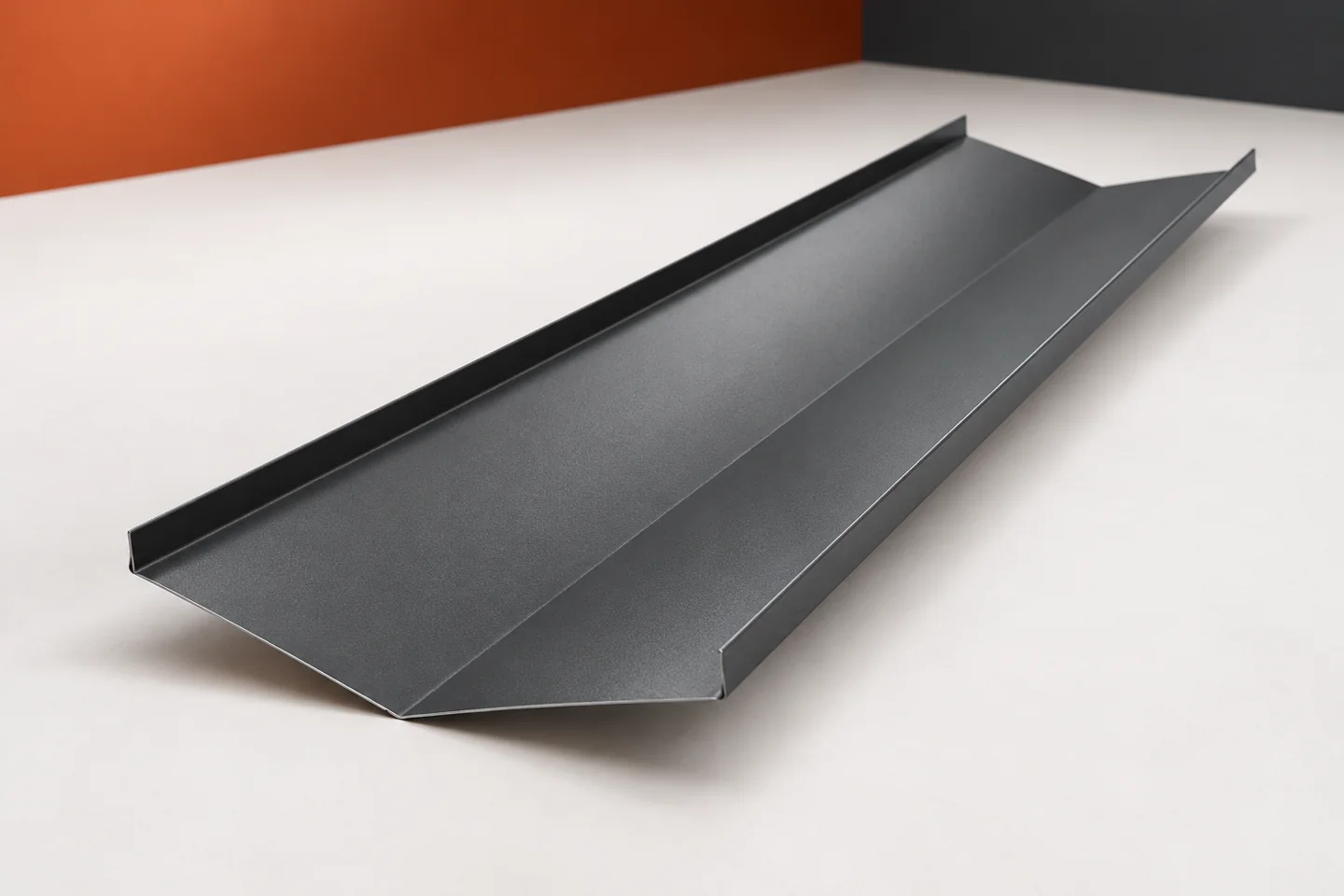
A roof valley collects water from the adjacent roof slopes. That is why a small error in this area can become more apparent than on a straight section of roof. A roof valley needs an unobstructed drainage path and correct connections. If damp patches appear, it is worth checking both the sheet metal itself and the arrangement of the covering at its sides. Replacing the sealant will not help when the real problem is a blockage or an incorrect cross-section. During the inspection, it is necessary to establish from which parts of the roof water reaches the given valley. Changes in roof slope, dormers and outlets from higher sections are important. A large roof does not always have a single simple drainage layout. The concentration of water at a specific point requires assessment of the entire junction.
Start with the valley run
A visible leak at the lower end of the roof valley may originate higher up. Water can travel beneath the covering or along the underlay. Inspection should therefore not stop at the point of the stain. The joints along the section feeding this zone need to be examined.
Leaves can change drainage conditions
Accumulated debris narrows the available path for water. Its presence also makes it difficult to assess the sheet and the edges of the covering. Cleaning the roof valley is therefore part of the diagnosis. It should be carried out in a way that does not scratch the surface or disturb the fixing of adjacent elements.
If the blockage recurs, it is worth considering its cause. It may be a local depression, a protruding detail or the way the roof slope is finished. Periodically removing leaves alone will not correct faulty geometry. The roof valley should maintain the designed drainage path at the joints as well.
Covering edges on both sides
Sheets terminating at the roof valley must leave the intended space for water. Pushing the covering in too deep can restrict it. However, the channel should not be widened independently without checking the fixing arrangement. A solution in accordance with the profile and the roof documentation is required.
Seals at the edges are selected according to the height of the profiles and the method of installation. The detail for a popular tile-effect metal roofing differs from that for standing seam. A roof valley intended for one system may have clips that the other system does not use. The name of the element does not determine compatibility.
Connections in line with the direction of flow
Successive sections of the roof valley sheet require correct positioning and fixing. The lap, its support and any sealing must be checked. The dimensions of the joint depend on the specific solution. Applying a single lap dimension to all roofs can lead to error.
Bent ends and points where water meets a barrier are concerning. The method of fixing the flashing is also important. Holes should not be added in the drainage path merely to press down a protruding section. The cause of its incorrect position must be identified first.

Condition of the material under the sediment
After cleaning, scratches, discolouration and corrosion can be assessed. Swarf left during installation can rust on the coating surface. Abrasion of the sheet or a damaged hole require separate assessment. Contamination must be distinguished from loss of protection of the steel core.
Galvanised, aluzinc and coated sheets are used in various roof flashings. The valley material should match the service conditions and the recommendations for the covering. A coloured finish tidies the appearance of the narrow strip between the slopes. However, it does not replace correct coating selection and maintenance.
The lower outlet is also part of the roof valley
At the eaves, the valley passes water on. The relationship with the gutter and the gutter apron must therefore be checked. If the outlet directs the flow past the gutter, the problem may be visible on the façade. In that case, repairing only the joint in the upper part of the roof will not change the behaviour of the lower end.
Barge boards, ridge tiles and chimney flashings affect other zones of the roof slope. Starter profiles may occur at the eaves of certain coverings. During the inspection, it is worth noting which elements actually connect to the valley. This helps avoid repairing the entire assembly without identifying the cause.
Standard or bespoke solution?
With an unusual intersection of roof slopes, a standard profile may need to be replaced by a different cross-section. Bespoke flashings allow the geometry to be adapted to the location. However, the design must account for the drainage area and the method of connection. Increasing the width of the sheet strip alone is not a complete solution.
Measurements of both slopes and documentation of their terminations are needed to prepare the repair. It is also worth describing the course of the leak and the precipitation conditions. After the work is completed, the water path, the connections and the cleanliness of the surface are checked. The valley must drain water efficiently without creating hidden paths beneath the covering.
Questions and answers
Can every valley be repaired by widening the gap between the sheets?
No. The profile, fixings and system requirements must be taken into account. Simply cutting the covering can compromise the correct detail.
Is the valley gutter the same element as the eaves flashing?
No. The valley gutter collects water between the roof slopes. The eaves flashing directs it into the gutter at the eaves. Their connection must maintain continuous drainage.
7 branches. Materials closer to your project.

- SEROCK — Dzierżenin 34 E
- BŁONIE — ul. Sochaczewska 138A
- RADOM — ul. Grobickiego 8
- ŁÓDŹ — Natolin 8
- OLSZTYN — Barczewo, ul. Prosta 9
- WROCŁAW — ul. Jerzmanowska 10C
- GORZÓW WLKP. — ul. Zielona 33/34