Costs and formalities
How to decide on a roof covering for your home
In brief
In Poland, the choice of roof covering should be based on matching the roof shape, pitch and structural load capacity, not on the material’s appearance alone. The client should check the design and local rules on the building’s appearance, which may specify roof angle, covering type or colour. Then compare the roof pitch with the requirements of the specific system, because the material name alone is not enough — two types of metal roof tile can have different lap rules and different permissible roof geometry. Leave the design of the roof build-up to the designer.
What limits the choice right from the start?
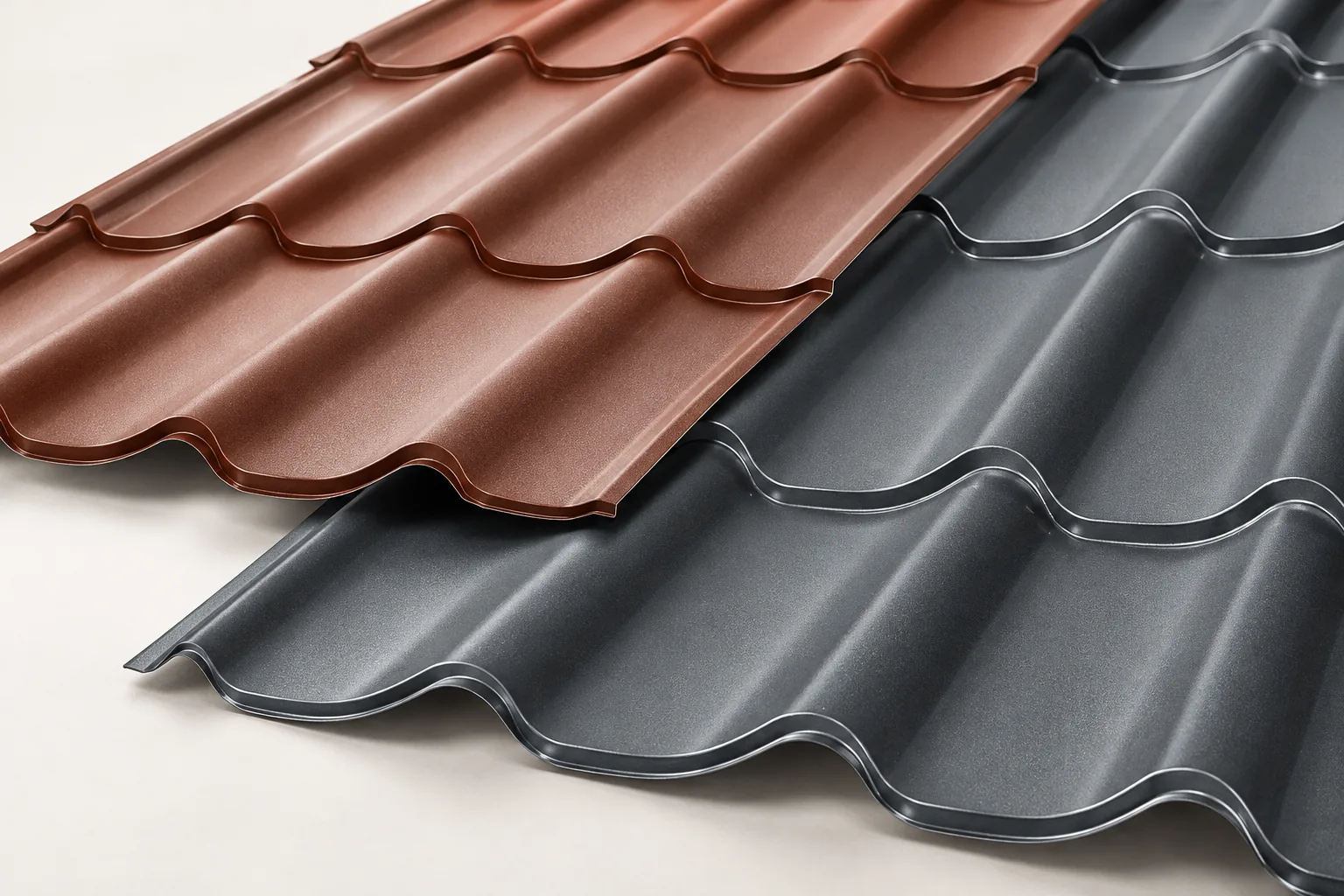
Check the design and local regulations on the building’s appearance. They may specify the roof pitch, the type of covering or its colour. Then compare the roof slope with the requirements of the specific system. The material name alone is not enough. Two tile-effect metal roofings may have different rules for forming laps and different permissible roof geometry.
When renovating, the roof structure must be assessed. A lightweight covering reduces the dead load but does not remove snow and wind loads. The structural engineer should also take into account the planned windows, services and insulation. Replacing a heavy material with steel sheet does not repair weakened connections or damaged sections of timber.
Pay attention to the adjacent roof slopes and the surroundings of the house. Nearby tall trees make it harder to keep clean, and strong wind exposure affects the fixing. Coastal or industrial conditions may require a suitable coating. The same model in a quiet residential area and in an aggressive environment does not have to carry the same warranty conditions.
When should you choose cut tile-effect metal roofing?
Sheets ordered to length suit simple roof slopes well. They reduce the number of transverse joints and allow a large area to be covered efficiently. However, they require precise measurement. An error in length or an incorrectly identified roof shape can mean cutting, extra waste and the cost of re-transport.
Access to the construction site also matters. Long sheets must be transported, unloaded and safely brought onto the roof. They must not be dragged over one another or lifted in a way that causes them to buckle. When choosing this option, discuss the permissible length of the elements and the handling plan with the team. Convenience of purchase does not replace good logistics.
Where does modular tile-effect metal roofing work well?
Smaller panels make transport and work on extensive roofs easier. They allow installation in shorter sections. They can also make it easier to replace a damaged element, although access depends on the arrangement of laps and fixings. Modularity does not mean that every panel can be removed without touching adjacent sections of the covering.
On roof slopes with roof valleys and dormers, the laying direction and the possibility of using offcuts are important. The rhythm of the profiles and correct support must be maintained. When comparing costs, check the coverage area of the panel. The price per piece looks attractive only until it turns out that the compared elements are of different sizes.

Is trapezoidal steel sheet suitable for a house?
Trapezoidal steel sheet may suit a simple, economical building form. Profiles T18 and T35 differ in appearance and geometry. A higher rib can be useful structurally, but it does not by itself determine the permissible support spacing. Data are needed for the specific steel thickness, profile orientation and structural scheme.
In a house with a usable attic, all roof layers must be designed. A single metal sheet is not thermal insulation. A fleece limiting condensation drip does not replace it either. Acoustic comfort is determined by, among other things, the insulation, airtightness and construction of the assembly. Do not judge the sound of rain solely on a loose sheet.
How to compare steel sheet with other roof coverings?
Ceramic and concrete tiles have a different mass and a different method of fixing than metal sheet. They may require appropriate preparation of the structure. Bituminous shingles need a suitable substrate and a ventilation solution. So do not compare only the price of the surface material. The required layers and labour must be added to each variant.
In sandwich panels, the metal facing is bonded to the insulating core. This is a different system, often used in commercial buildings. It should not be treated as ordinary metal sheet with added insulation. Selection covers joints, fire resistance of the assembly and support conditions. In a house, the decision must be linked to the whole design.
How to narrow the choice down to two solutions?
First, rule out materials that do not match the pitch, structure and requirements of the building. From the remaining ones, choose two variants and request full specifications. Compare the coverage width, type of coating, flashings, transport and installation. Ask for colour samples, because a small image on a screen does not show the actual texture or the way light is reflected.
Finally, check the possibility of maintenance and later changes. The installation of photovoltaics, access to the chimney or replacement of a section of roof may be important. A covering works best when its requirements are known to the team and taken into account in the design. Appearance remains important, but it should result from a technically correct choice.
7 branches. Materials closer to your project.

- SEROCK — Dzierżenin 34 E
- BŁONIE — ul. Sochaczewska 138A
- RADOM — ul. Grobickiego 8
- ŁÓDŹ — Natolin 8
- OLSZTYN — Barczewo, ul. Prosta 9
- WROCŁAW — ul. Jerzmanowska 10C
- GORZÓW WLKP. — ul. Zielona 33/34