Insulation materials
What role does the aluminium facing play in internal insulation?
In brief
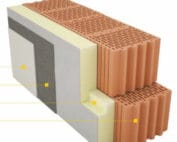
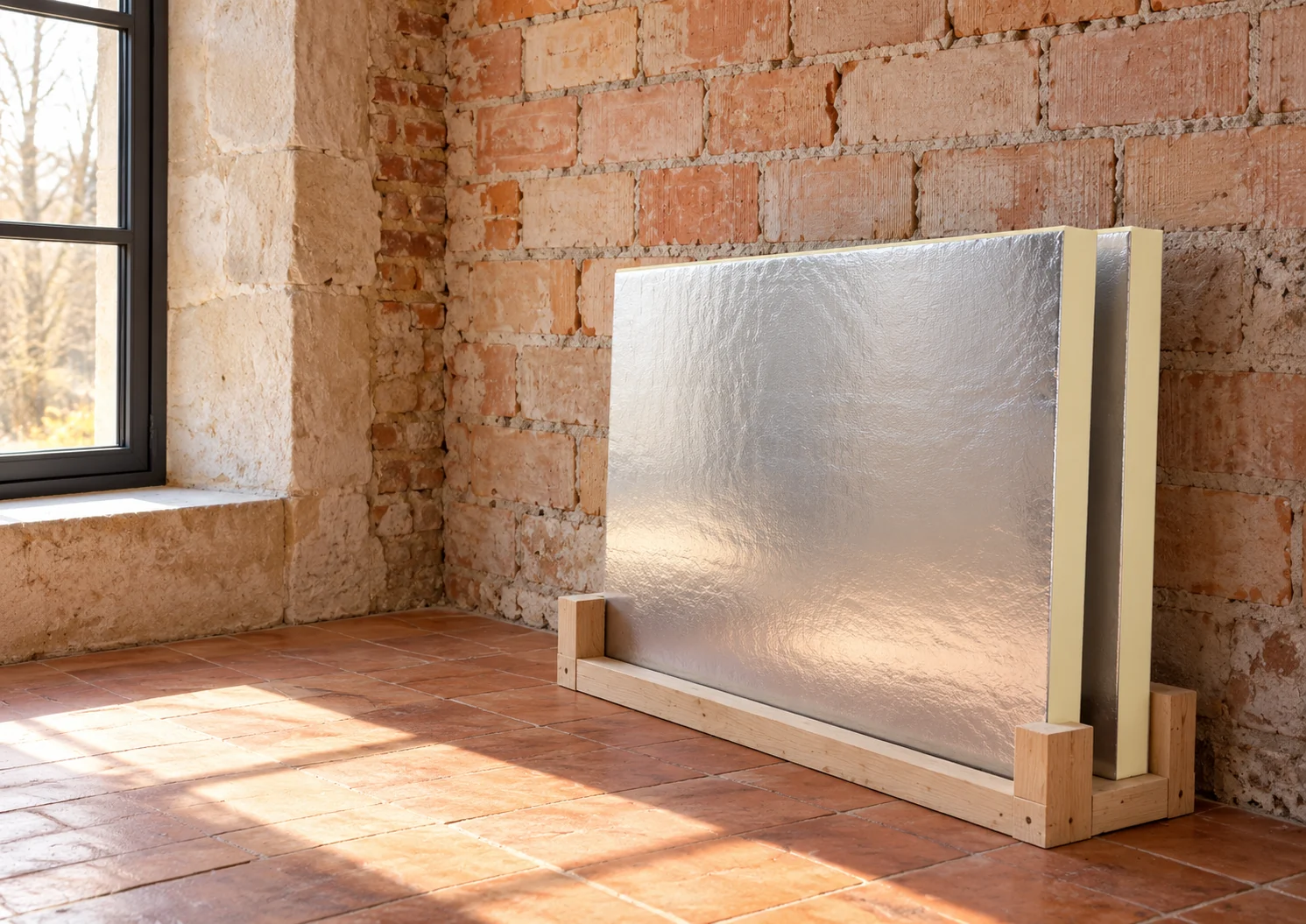
Foil-faced PIR board can reduce the thickness of insulation required. Its facing also affects water vapour transmission. This matters for internal insulation, but it does not automatically permit any wall build-up. An assessment of the masonry, moisture and continuity of seals is needed. Simply bonding the boards does not close the matter. The new layer restricts heat flow from the interior to the existing wall. The room surface may become warmer, and the masonry behind the insulation cooler. Drying conditions and the temperature distribution change. Internal insulation therefore requires assessment of the whole system. It is not merely transferring an external wall solution to the other side.
What does insulation on the room side change?
First, leaks must be removed and rising damp identified. A damp wall should not be sealed with a vapour-tight layer in the hope that the problem will disappear. Thermal insulation does not replace repair of the roof, flashings or ground-level protection. The condition of the existing wall determines the further procedure.
How does the aluminium facing work?
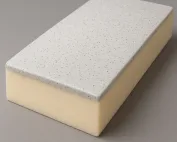
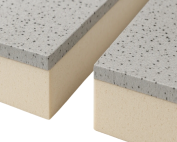
Certain PIR boards use facings containing aluminium. These have a high diffusion resistance. They can restrict the passage of vapour through the board surface, but data for the specific product is required. Not every silver material should be regarded as a layer with identical properties.
Joints are equally important. Even a tight surface will not ensure continuity if a gap is left open at the floor. Air can carry moisture behind the insulation. The solution requires compatible materials for connections and designed terminations. A shiny foil alone does not constitute a complete detail.
How much heat will a thin board retain?
For an example PIR with a foil facing and λ 0.022 W/(m·K), a 60 mm layer has a calculated R of approximately 2.73 m²·K/W. A 100 mm layer gives approximately 4.55. These are the insulation resistances. The U-value of the entire wall also depends on the masonry, plasters, surface resistances and appropriate corrections.
A large additional resistance should not be added merely because the foil is reflective. The reflection effect requires a specific arrangement with an air space. Foil in direct contact with the next layer does not act as an arbitrarily assumed “additional insulation thickness”. The actual cross-section is needed for the calculation.
How should the substrate be prepared and what is the sequence of works?
Work begins with inspection and assessment of the load-bearing capacity of the surface. Loose plaster, salt contamination and traces of leaks require identification. After removing the causes of moisture, the fixing method is selected in accordance with the chosen system. Not every foam or adhesive is suitable for every facing. It must also be established whether voids behind the board are permissible.
Next, details at the reveals, ceiling and transverse walls are prepared. Once the insulation is installed, the required seals and the finishing layer are applied. The exact sequence follows from the system solution. It should not be replaced by a universal recipe made up of random products.

Why are reveals and services particularly important?
Insulating a large area while leaving a cold reveal can shift the problem to a narrow strip at the window. Connections to the ceiling behave similarly. Surface temperatures and continuity of insulation must be assessed. Sometimes site conditions limit the thickness, but such a difficulty requires a detail solution.
Electrical boxes and cables can interrupt the airtight layer. Their routing should be determined before installing the boards. An installation layer can be helpful if provided for in the system. Do not drill arbitrary holes later without checking the consequences. Every penetration should have appropriate finishing and sealing.
What should be checked before closing the wall?
Check the continuity of insulation, the connections and the condition of the cladding. Verify the details at all boundaries of the area. It is good practice to document concealed locations. The later finished surface will not show whether a gap or damaged membrane was left behind it. The finish must also meet user and fire requirements.
After renovation, monitor humidity and ventilation operation. A tighter enclosure does not remove vapour from the room. A change of use, for example drying laundry, can significantly change the conditions. The insulated wall remains part of a building whose heating and air exchange must work together.
If a composite board with gypsum cladding is used, check the thickness of each layer. For example, 12.5 mm of gypsum is not additional PIR thickness. This distinction matters when calculating insulation, reveal depth and choosing the method of fixing equipment.
What else is worth asking about
Does a membrane allow moisture analysis to be omitted?
No. It limits a specific mode of vapour transport, but it does not eliminate leaks or decide the drying out of the masonry. An assessment of the specific building component is needed.
Can PIR be left as an exposed room finish?
This should not be assumed. The method of covering and the permitted application must be checked for the product and the entire system, taking fire requirements into account.
7 branches. Materials closer to your project.

- SEROCK — Dzierżenin 34 E
- BŁONIE — ul. Sochaczewska 138A
- RADOM — ul. Grobickiego 8
- ŁÓDŹ — Natolin 8
- OLSZTYN — Barczewo, ul. Prosta 9
- WROCŁAW — ul. Jerzmanowska 10C
- GORZÓW WLKP. — ul. Zielona 33/34