Metal sheet roofing
Where does T7 perform best and how do you calculate its coverage?
In brief
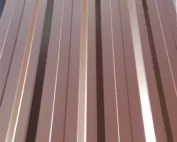
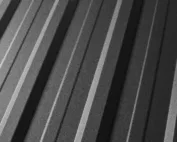
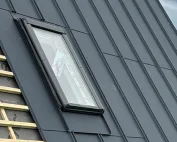
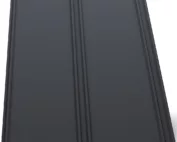
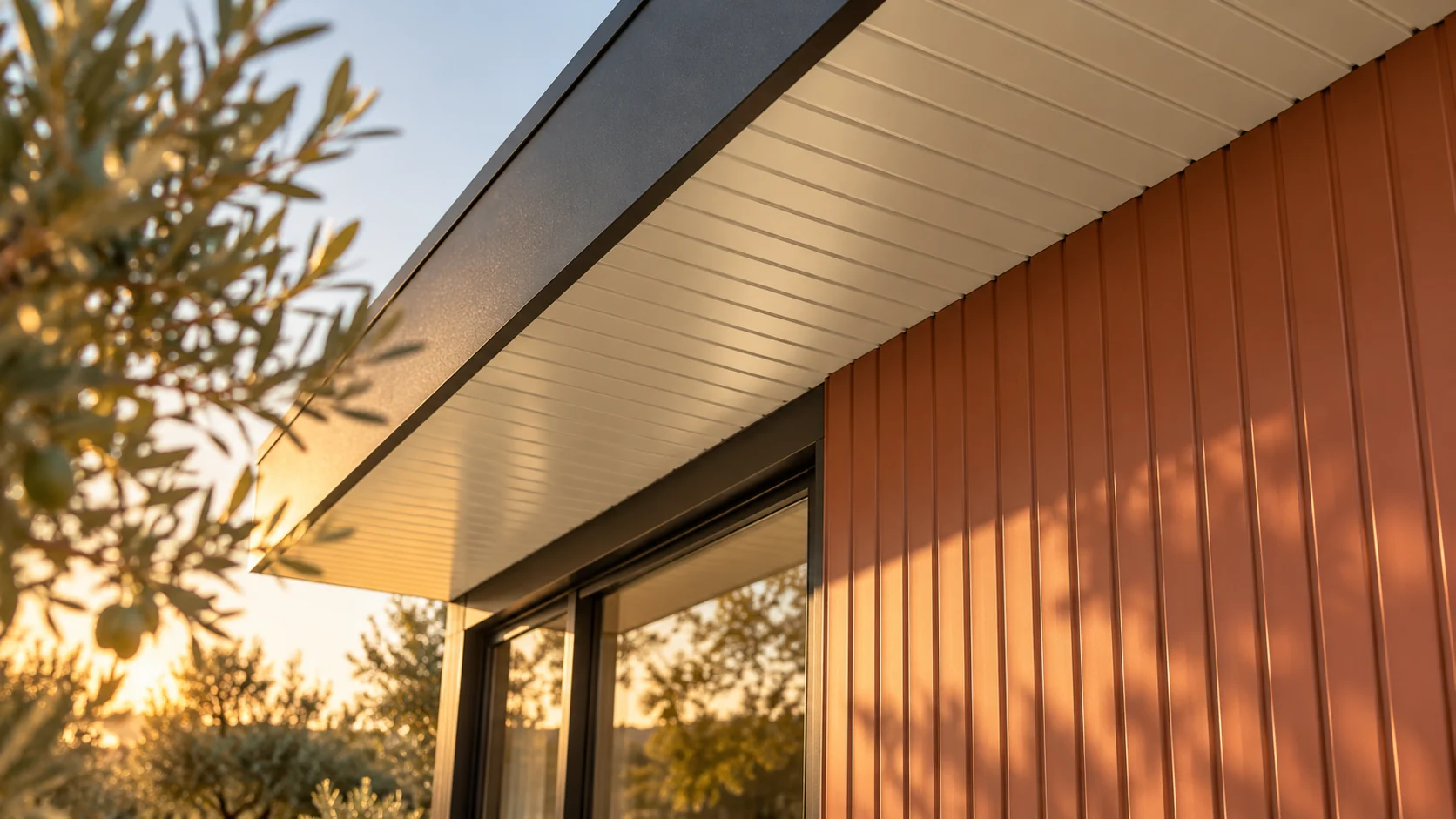
T7 is a low profile that can look good on soffits and small cladding. Its advantage is the subtle surface pattern. However, it should not be treated like a taller trapezoidal roof sheet. The choice depends on the intended use of the specific variant, the support and the dimensions of the area. Calculations must use the coverage width, not the full sheet width. For example, a sheet with a 7 mm profile has an overall width of 1195 mm and an effective width of 1155 mm. This means that after joining adjacent strips you will not get the full 1195 mm from each piece. The usable dimension takes account of the joint geometry. Another T7 variant may have different values.
What dimensions show the difference between the sheet and the coverage?
If the soffit strip is 8 m long, dividing by 1.155 m gives approximately 6.93. With this laying direction, seven sheets are needed across the width of the field. The total coverage will be 8.085 m. The remaining 85 mm must be accounted for at the finish. Only after the flashings are determined is it known how to execute the last element.
Why is the low profile suitable for small areas?
A small profile gives a calm pattern. It harmonises well with a straight eaves edge and small details. On large flat areas, however, irregularities are easier to notice. Low-profile sheet should not be chosen on price alone if a perfectly smooth appearance is expected on a high façade.
The result is influenced by sheet length, steel thickness and preparation of the substructure. Visible waviness may change with lighting and temperature. It is worth viewing a larger sample or a section made in a similar arrangement. A small piece held in the hand does not show the behaviour of a long strip fixed to a building.
Can T7 be used on a roof?
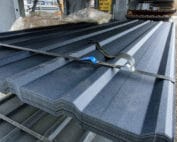
The cited example is a wall and soffit profile. It should not be assigned roof application merely by changing its position. Covering a roof slope requires a product with the appropriate purpose, permissible pitch and load-bearing capacity. A height of 7 mm is not a standalone criterion for tightness.
If a small canopy is similar in colour to the soffit, two different profiles can be used. Their junction must be finished correctly. Such a choice is often more logical than forcing one material onto all surfaces. It must also be remembered that a roof performs differently under snow and wind suction than a sheltered soffit underside.
How do you maintain ventilation at the soffit?
The soffit is part of the roof finish but may also lie in the path of ventilating air. The design should specify the required openings or slots. A full sheet without perforation does not replace a ventilation element. On the other hand, drilling arbitrary holes can impair appearance and edge protection.
The method of protection against insects and contamination must be agreed. Perimeter flashings should match the profile and leave the specified clearances. Do not fill every gap with foam simply because it is visible. Some openings have a specific purpose. Closing them may change the humidity conditions under the covering.
Suitably selected finishing profiles, for example with a cross-section similar to the letter J or L, are used to close the perimeter. Their dimensions must match the actual sheet and support. It is not enough to choose an element with a similar colour.

What should be considered for support and installation?
The support spacing results from the chosen solution and the loads. The low dead weight of the sheet metal does not mean that the effect of wind can be ignored. The fasteners and the material they penetrate are also important. Fixing to timber and to thin steel profiles requires appropriate selection.
The sheet should not be stressed in order to hide an uneven substructure. Before installation, check the plane and the eaves line. Flashings must provide a durable closure of the edges. A well-prepared substrate reduces the number of later corrections. In a series of similar buildings, it is worth checking every eaves rather than assuming identical dimensions.
How to prepare a complete order?
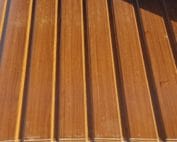
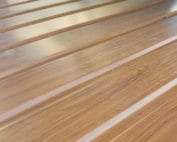
Provide the exact variant, thickness, colour, coating and visible side. Record the lengths and number of pieces. List perimeter flashings, ventilation elements and fastenings separately. If the coating is to imitate wood or have a directional texture, the direction of the pattern must be taken into account. Reversing the strip may be noticeable.
On delivery, protect the sheets from bending and from moisture trapped in the pack. Remove the protective film within the period specified for the material. After cutting, collect the swarf thoroughly. Clean the finished surface using a method suited to the coating. T7 can be easy to maintain if the details do not create places where dirt and water accumulate.
What else is worth asking about?
Is seven millimetres the thickness of the steel?
No. It is the profile height in the example discussed. The thickness of the steel sheet is specified separately in the specification.
Is it enough to order just the sheet metal for the soffit?
No. Provision must be made for support, fixings, flashings and a ventilation solution. The list depends on the layout of the entire roof.
7 branches. Materials closer to your project.

- SEROCK — Dzierżenin 34 E
- BŁONIE — ul. Sochaczewska 138A
- RADOM — ul. Grobickiego 8
- ŁÓDŹ — Natolin 8
- OLSZTYN — Barczewo, ul. Prosta 9
- WROCŁAW — ul. Jerzmanowska 10C
- GORZÓW WLKP. — ul. Zielona 33/34