Metal roofing
What is tile-effect metal roofing made of and what does each layer do?
In brief
Tile-effect metal roofing is a profiled sheet, not a set of separate tiles. Its strength and appearance come from the combination of steel, surface protection and geometry. Each part has a different job. It is worth distinguishing them before comparing offers. That way colour and warranty length will not overshadow the parameters that matter for a particular roof. In popular steel tile-effect metal roofing, the basis is a thin steel core. It is this that works with the pressings to carry loads. Steel thickness is described separately from profile height and the thickness of protective layers. These values should not be added together and presented as the thickness of the structural material.
What forms the basis of the sheet?
Many variants are made from 0.5 mm steel, but this is not a full description of the product. Grade, tolerances and cross-sectional shape also matter. Two sheets of the same thickness can have different cover widths and support requirements. Selection requires reading the specification of the specific covering.
Why is metallic protection used?
Steel needs protection against corrosion. One element of the protection is a metallic coating. Its type and quantity should follow from the material documentation. It should not be equated with the visible paint. These are different layers, although both affect how the covering behaves in an outdoor environment.
Cut edges, scratches and places where moisture lingers for a long time require particular attention. Good protection does not give resistance to any method of cutting. Tools that generate high temperature and hot swarf can damage the surface. After the work, metal particles must be removed, including those lying further from the place where the hole was made.
What is the role of the coating visible from outside?
The organic finish gives colour and texture and also contributes to protecting the sheet. Variants differ in resistance to weather, radiation and damage. The thickness given in micrometres is one piece of information. On its own it is not enough to create a durability ranking.
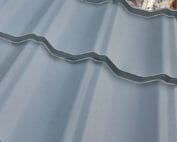
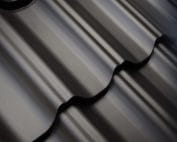
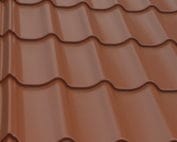
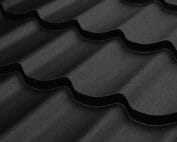
A matt and a glossy surface in the same colour can look different. On flat tile-effect metal roofing the difference is particularly visible in low light. The backing coat has its own task and does not always match the aesthetics of the outer side. If a section underneath is to remain visible, this must be taken into account when choosing.
Why are pressings more than decoration?
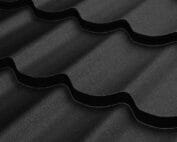
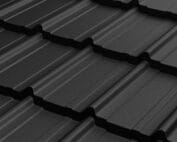
Profiling changes the rigidity of a thin sheet and creates a path for water drainage. The longitudinal waves and transverse steps affect the layout of the covering. The batten spacing must correspond to the given system. It cannot be assumed solely from the appearance of another tile-effect metal roofing on a neighbouring house.
In a typical flat module, the coverage area is 320 mm long and 1210 mm wide. The visible height of the transverse rib may be 35 mm, and the fine surface profile 3 mm. These are different dimensions describing different features. Neither of them denotes the steel thickness. This distinction helps you read product data sheets without confusion.

How do the sheets form a watertight covering?
The elements are joined according to the shape of their edges and the direction of water runoff. The overlaps take up part of the material. Therefore the total area is greater than the coverage area. A correct joint requires the proper slope and fixing. Additional sealant should not replace the required overlap.
The tightness of the entire roof also depends on the flashings at edges and penetrations. The covering does not work in isolation from ventilation and the layers beneath it. Above a heated attic, a solution for insulation and vapour flow control is needed. The steel sheet alone does not constitute a complete thermal barrier.
The transport film has a different purpose than the protective coating. It protects the surface during handling but is not the intended layer of the covering. Its removal deadline must be checked at delivery.
How can the material be assessed before purchase?
Check the thickness and grade of steel, the type of protection, the coating, the coverage dimensions and the permissible application. Examine a sample in daylight. Check the availability of compatible flashings and how subsequent repairs are carried out. Read the warranty conditions together with the requirements for installation and care.
On delivery, pay attention to edges, scratches and deformation. Do not assess only the top sheet in the pack. Also establish the storage conditions until installation. Moisture trapped between the sheets can damage the surface. Proper handling of the material begins before it is laid on the roof.
Your own specification should remain with the building documentation. In the event of an extension after several years, it will make it easier to select a covering with a compatible profile and finish.
What else is worth asking about
Is tile-effect metal roofing an insulating material?
The sheet alone does not provide roof insulation. Suitable insulation layers and a solution for their tightness and ventilation are needed.
Does the wave height tell you anything about the sheet thickness?
No. The profile can be several tens of millimetres high while the steel is a fraction of a millimetre. These parameters describe completely different characteristics.
7 branches. Materials closer to your project.

- SEROCK — Dzierżenin 34 E
- BŁONIE — ul. Sochaczewska 138A
- RADOM — ul. Grobickiego 8
- ŁÓDŹ — Natolin 8
- OLSZTYN — Barczewo, ul. Prosta 9
- WROCŁAW — ul. Jerzmanowska 10C
- GORZÓW WLKP. — ul. Zielona 33/34