Metal roofing
Why do two tile-effect metal roofs have such different prices per square metre?
In brief
The price of tile-effect metal roofing depends on what exactly you are buying. A square metre of the total sheet area gives a different result from a square metre of coverage, and a single module gives yet another. On top of that come the coating, the steel thickness and the roof details. Before you choose the cheapest item, bring the offers down to the same unit and the same scope. A price list may show a price per square metre of sheet, per square metre of coverage or per module. These are not equivalent units. The laps take up part of the material. They therefore affect the quantity of steel sheet you buy, although they do not increase the area of the finished roof. The same problem applies to comparing sheets of different widths.
What area is the price given for?
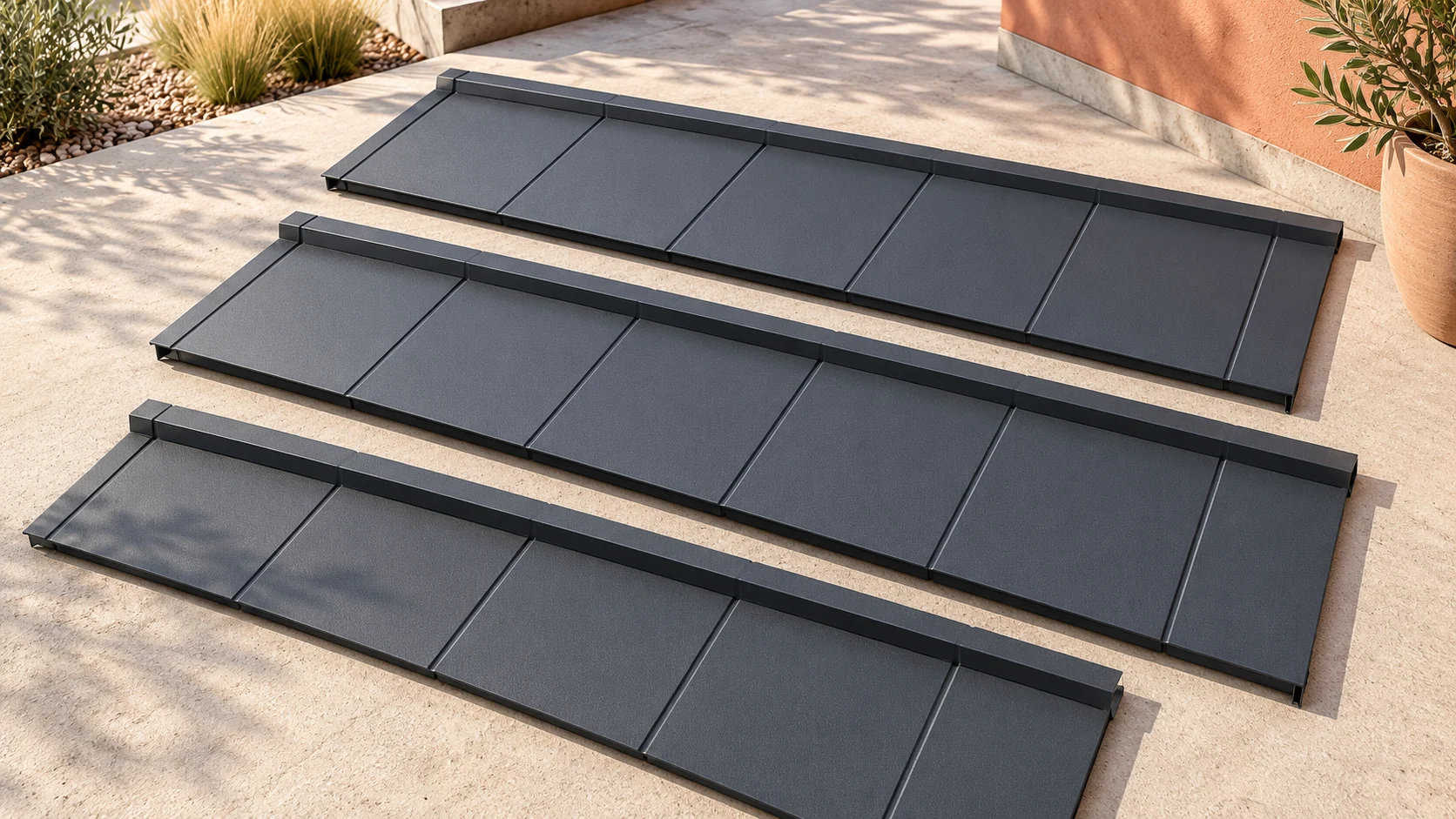
A flat module with cover dimensions of 320 × 1210 mm covers 0.3872 m². At an assumed net price of €5.55 per module, divide 5.55 by 0.3872 to get about €14.33 per square metre of cover, excluding VAT. This example shows how to account for the effective area when converting a unit price. It is not a current offer.
What does the steel and its protection change?
The thickness of the steel core affects the properties of the sheet. The metallic coating and organic finish have different tasks from the steel itself. They should be described separately in the quote. The phrase ‘thick coating’ alone does not explain resistance to corrosion, solar radiation or conditions of use.
It is worth checking whether the selected coating suits the building’s surroundings. A house in a quiet residential area may have different requirements from a property exposed to aggressive pollution. There is no single most expensive coating that is best in every situation. What counts are the declared properties, limitations of use and surface maintenance conditions.
How does the roof shape affect the material cost?
A simple roof slope allows large sheet areas to be used. Roof valleys, dormers and numerous breaks increase the number of cut pieces. With identical floor area, two roofs may require different amounts of material and flashings. Therefore, the price from a simple gable roof should not be transferred to a complex roof shape.
With modules, whole pieces and the row layout must be calculated. With sheets cut to size, the length cutting pattern matters. A cut-off piece cannot always be transferred to another part of the roof. The direction of the profiling and the side of the overlap may rule this out. A reliable comparison requires a laying plan, not just multiplying the area by the rate.
Which extras are easiest to leave out?
The list should include flashings for the eaves, gables, ridge, roof valleys and penetrations. Add to this the fasteners, seals specified in the system and ventilation elements. Roof access and snow guards, if needed, are priced separately. They should not be added as an arbitrary percentage of the sheet value.
In a small building, accessories can make up a noticeable part of the total. Two short slopes still have eaves, gables and a ridge. Reducing the area does not proportionally reduce the length of all edges. For this reason, the price per complete square metre of a small roof is often higher than that of a large, simple field.

How do you compare two quotes using a specific example?
Suppose quote A allows for 90 m² of material at €13.89/m² excluding VAT and quote B for 84 m² at €15.04/m² excluding VAT. The totals are €1250.10 and €1263.36, a difference of just €13.26 despite the different rates. Check both cutting plans before accepting the smaller quantity in this example.
Next, add the accessories, transport and unloading. Establish whether the prices are net or gross and which tax rate applies to each item. Separate material from service. If one offer includes only the covering and the other also includes installation, their final amounts cannot be compared without separating the scope.
What is worth paying extra for, and what should be checked again?
A justified surcharge may relate to a coating selected for the environment, a complete detail or a reduction in difficult cuts. Logistics are also worth considering. Smaller elements can facilitate access on a cramped plot. Long sheets require suitable transport and safe handling without permanent deformation.
It is not worth paying for a feature described only by a marketing slogan. Ask for a measurable parameter and the conditions for achieving it. The final quote should indicate the specific material, quantity, scope of accessories and validity period. This way, a later change to the offer will be visible instead of hiding under a similar item name.
For repeatable buildings, the cost of one complete roof can be compared. A joint purchase reduces part of the transport costs but does not eliminate cuts and accessories on each building. In the comparison, the entire amount should not be divided by the sum of floor areas. The area of the actual slopes is needed.
What else is worth asking about
Does the lowest module price mean the cheapest roof?
No. Modules have different coverage areas. You need to compare the cost of the required number of pieces, the cutting plan and the entire set of accessories.
Can a catalogue price be treated as a final offer?
Not always. You need to check the date, unit, tax and scope. The terms of a specific order may cover different quantities, delivery and discounts.
7 branches. Materials closer to your project.

- SEROCK — Dzierżenin 34 E
- BŁONIE — ul. Sochaczewska 138A
- RADOM — ul. Grobickiego 8
- ŁÓDŹ — Natolin 8
- OLSZTYN — Barczewo, ul. Prosta 9
- WROCŁAW — ul. Jerzmanowska 10C
- GORZÓW WLKP. — ul. Zielona 33/34