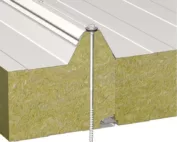
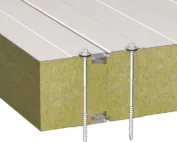
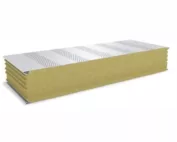
Mineral wool in panels
Will mineral wool panels help reduce noise in a pavilion?
In brief
Mineral wool is often associated with quiet, but a ready-made sandwich panel has steel surfaces. Its sound insulation and its sound absorption are different properties. In a small pavilion, doors, openings and joints also determine the effect. Choosing the core alone is not enough to promise a specific level of quiet. Sound can pass through the wall, the joinery and gaps. It can also travel by flanking paths through the structure and adjacent partitions. If there is a large gate in the wall, its properties will be an important part of the result. A good panel will not automatically compensate for an open vent.

How does sound get into the room?
First, identify the source of the noise. Road traffic, conversation and a machine with a motor each have a different spectrum. A distinction must also be made between noise from outside and noise generated inside. In the first case, the insulation of the envelope matters. In the second, control of reverberation and vibration may also be needed.
The insulation of a wall with a window is not calculated by a simple arithmetic average of decibel values. The scale is logarithmic, and the share of each area requires appropriate calculation. A weaker element can noticeably lower the result for the assembly. It is therefore worth knowing not only the parameter of the window or door but also their share of the total partition area.
How should Rw and spectrum adaptation terms be read?
Rw is the weighted sound reduction index of the element itself. The documentation may also include C and Ctr. These make it easier to relate the result to different noise spectra. It is not worth comparing quotes when one gives only Rw and the other already gives the result with the appropriate correction.
An example wall panel with 120 mm mineral wool and concealed fixing has, in a specific configuration, Rw 32 dB, C = −2 and Ctr = −3 dB. Adding these gives 30 and 29 dB respectively. This is not a promise of such a reduction of every sound in the finished pavilion. The parameter must be related to the complete assembly and the test conditions.
Does a steel panel absorb like exposed mineral wool?
These materials should not be equated. In an ordinary panel, the mineral core is enclosed between facings. Sound in the room meets primarily the steel surface. Full sheet steel does not behave like an open, suitably protected porous layer. The absorption parameter must be checked separately.
A room with hard walls and floor can have pronounced reverberation. Even improved insulation of the envelope does not remove all reflections inside. Properly selected absorptive elements can help. Their use requires consideration of fire conditions, hygiene and the method of fixing.

Will a thicker mineral core always improve the effect?
Improvement cannot be attributed to thickness alone. Facings, joints and the behaviour of the whole element across different frequencies all matter. Results are needed for the variants being compared. Sometimes several thicknesses in a table share the same rating. They should not be credited with extra decibels on the basis of intuition.
Likewise, greater mineral wool density does not provide a universal acoustic conversion factor. The comparison should relate to the complete panel. If the requirement is important for the function of the building, it is worth analysing the full partition with an acoustician. The core name alone is too imprecise a specification.
What can be improved in a small building?
Check the airtightness of the doors and whether the joint seals are compatible with the system. Ventilation openings require solutions that maintain air exchange and reduce noise. They should not simply be blocked up. Equipment that causes vibration may need to be decoupled from the structure, with a solution matched to its operation.
With an internal source, it is worth establishing whether the noise is reflecting off hard surfaces. Changing the layout of equipment and suitable absorptive elements may be more effective than replacing the entire wall. Heavy acoustic panels should not be hung at random on the thin facing of a sandwich panel.
How should the requirement be written into the quote?
Describe the sound source, the expected effect and the arrangement of openings. State the relevant parameter and how it is to be verified. Ask for data corresponding to the thickness and facings of the panel offered. If the result relates to a laboratory element, this should be clear. It is not automatically a result for the whole building.
If necessary, plan a measurement after the building is completed. This will allow the actual conditions and any flanking paths to be assessed. In a small pavilion, a single weak detail can have a large share of the effect. It is therefore worth identifying the main noise paths first, and only then buying a thicker panel.
What else is worth asking about?
Does Rw 32 dB mean a noise reduction of 32 dB in every room?
No. It is a rating for a specific element. The result in a building depends on the spectrum, openings, connections and flanking paths. It requires assessment of the whole solution.
Will exposing the core improve the acoustics of a standard panel?
The panel should not be modified in this way. It compromises its cladding and properties. Dedicated solutions are selected for sound absorption.
7 branches. Materials closer to your project.

- SEROCK — Dzierżenin 34 E
- BŁONIE — ul. Sochaczewska 138A
- RADOM — ul. Grobickiego 8
- ŁÓDŹ — Natolin 8
- OLSZTYN — Barczewo, ul. Prosta 9
- WROCŁAW — ul. Jerzmanowska 10C
- GORZÓW WLKP. — ul. Zielona 33/34