Roof and structure
Which covering best suits your gable roof?
In brief
The best covering for a gable roof depends on the pitch, the building’s purpose and the desired appearance, not on the roof shape alone. On simple slopes, consider cut-to-size or modular metal roof tiles, or trapezoidal sheet, while for buildings with other functions a sandwich roof panel may be worth considering. Before ordering, check the actual slope dimensions, diagonals and eave details, as even a simple roof may have construction deviations. It is also worth settling the sheet plan, window and chimney positions and drainage early to avoid later adjustments.
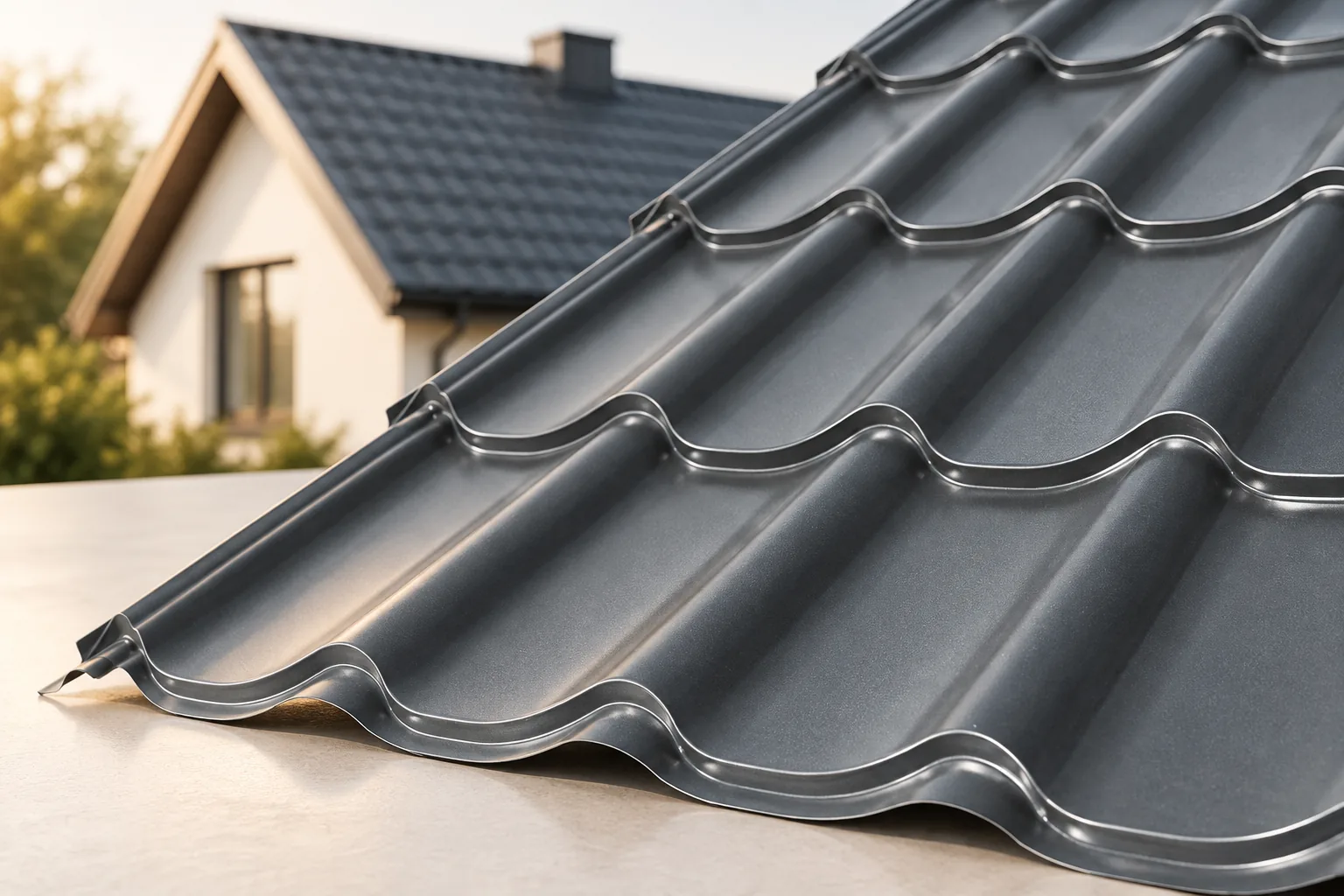
What does simple geometry make easier?
Two regular roof slopes usually require less complicated connections than a roof with numerous roof valleys and dormers. It is easier to prepare a sheet plan and to predict waste. This can reduce material and labour costs. The benefit decreases when many windows, chimneys or other penetrations appear on the slope.
You should not order sheet metal based only on the building length and the angle from the design. A measurement of the actual roof slopes, a check of the diagonals and determination of the eaves details are needed. Even a simple roof can have construction deviations. Detecting them before purchase helps avoid uneven ends or missing pieces.
With simple roof slopes it is also easier to plan drainage and the access route to the chimney. These elements must be taken into account before ordering the material. Adding a window or a device later can change the sheet plan and the scope of flashings. Early agreement on the equipment helps preserve the benefits of a straightforward shape.
When to choose cut-to-size metal roof tiles?
On a long, regular roof slope, sheets can be matched to the planned layout. A smaller number of transverse connections can be an organisational advantage. However, the maximum permitted lengths and transport conditions must be taken into account. A sheet that can be produced is not always convenient to carry onto a specific house.
When ordering, the cover width, the module length and the type of termination at the eaves are important. The first batten spacing may differ from the subsequent ones. All these data must be read for the selected model. Changing the profile after the substructure has been prepared may require its correction.
When does the modular format offer an advantage?
Smaller panels are easier to transport and to pass up onto the roof. They can be convenient where access to the building is limited or when working in stages. They also allow short sections around windows to be handled efficiently. On a very simple roof slope, however, their material advantage is not automatic.
Compare the cost of a complete covering with the cut-to-size version. Use the same thickness and an equivalent coating. Pay attention to the number of elements, the required fastenings and the waste plan. The price of a single panel cannot be compared directly with the price per square metre of a long sheet.

When to consider T18 or T35?
Trapezoidal sheets suit simple building forms and create a linear pattern across the roof slope. They can look good on a house, garage or outbuilding. T18 gives a lower profile, while T35 makes the ribs more pronounced. The technical selection is determined by thickness, geometry, support spacing and loads.
There is no single minimum pitch value for all trapezoidal sheets. Longitudinal joints and seals also matter. At a low pitch, particular attention must be paid to water drainage. The profile designation does not replace the installation instructions or load-bearing calculations.
Is a sandwich roof panel an alternative?
In a workshop, warehouse or suitably designed commercial building, a sandwich panel can combine the covering with an insulating core. It requires its own support and fixing arrangement. The selection covers thermal, fire and acoustic parameters. It is not a simple replacement for metal roof tiles on ready-made battens.
For a house with a usable attic, entire assembly solutions should be compared. Saving on the number of layers alone does not determine comfort. A sandwich panel and a traditionally layered roof have different details and different ways of finishing from the inside. The designer should assess their suitability for the building’s function.
How do you choose from among the suitable options?
First, rule out products not approved for the pitch or structure. Then compare the appearance on a larger sample and the full quote. Include the ridge, gable flashings, eaves, gutters and penetrations. Simple geometry does not mean these elements can be treated as minor extras after ordering the sheets.
Finally, check the maintenance requirements and the availability of a contractor familiar with the system. A gable roof allows the advantages of different materials to be used well. A sensible choice is one that matches the building’s function and provides a clear execution plan. The lowest price per square metre need not lead to the lowest cost of the finished roof.
If you are planning photovoltaics, include it in the discussion about the covering right from the start. Data on the profile, thickness and support structure are needed. The arrangement of the panels should leave access for servicing and work with the water drainage path. Early agreements reduce later modifications.
7 branches. Materials closer to your project.

- SEROCK — Dzierżenin 34 E
- BŁONIE — ul. Sochaczewska 138A
- RADOM — ul. Grobickiego 8
- ŁÓDŹ — Natolin 8
- OLSZTYN — Barczewo, ul. Prosta 9
- WROCŁAW — ul. Jerzmanowska 10C
- GORZÓW WLKP. — ul. Zielona 33/34