Roof and energy
What does fire safety for a photovoltaic roof really mean?
In brief
Fire safety for a photovoltaic roof is not captured by a single slogan or label. Materials, the behaviour of the covering under fire, constructional solutions and the electrical part are assessed separately. In an integrated system these areas come together on a single roof slope. That is why the documents for the entire system and the quality of workmanship must be checked, not just the certificate for an individual component. A material’s reaction to fire, the fire resistance of the separating structure and the behaviour of the roof under external fire exposure answer different questions. They are not names for the same property. A classification for external fire exposure is not an automatic statement that the whole roof is non-combustible or will retain its load-bearing capacity for a given time.
Why does one class not describe everything?
When classifying a roof covering, the test variant and the scope of application of the result also matter. The designations of different methods must not be freely interchanged. The owner does not have to interpret every standard themselves. However, they should ask the designer to explain what the document confirms for the actual set of layers and fixings.
What can the tested sample cover?
The report may relate to a specific substrate, pitch, joints and installation method. A change to these conditions is not always covered by its scope. Equally important is whether the electrical part was live during the test. Scenarios that the test did not cover must not be added to the result.
It is therefore worth obtaining the full document or an unambiguous statement of the classification scope, rather than just a badge in a brochure. If the seller combines data from several tests, they should explain how these relate. The best results from different samples do not automatically create confirmation for any roof with a similar appearance.
The document should also state the limitations of the result. Omitting them in a shortened advertisement does not mean that they no longer apply to the ordered set.
Where does the role of the electrical installation begin?
Safe routing of cables, correct connections and the selection of protective devices are part of the design. The compatibility of connectors, protection of the insulation and the operating conditions of the devices matter. Even a well-tested roof covering does not eliminate the consequences of an installation error in the circuit. The quality of workmanship must be confirmed by the specified measurements and documentation.
Selected systems have a voltage-limiting function after shutdown. Its operation depends on correct configuration and compatible components. It is not permission to touch or disconnect cables independently. Illuminated cells remain a source of energy, and safe servicing requires an appropriate procedure.
What changes with integration into the covering?
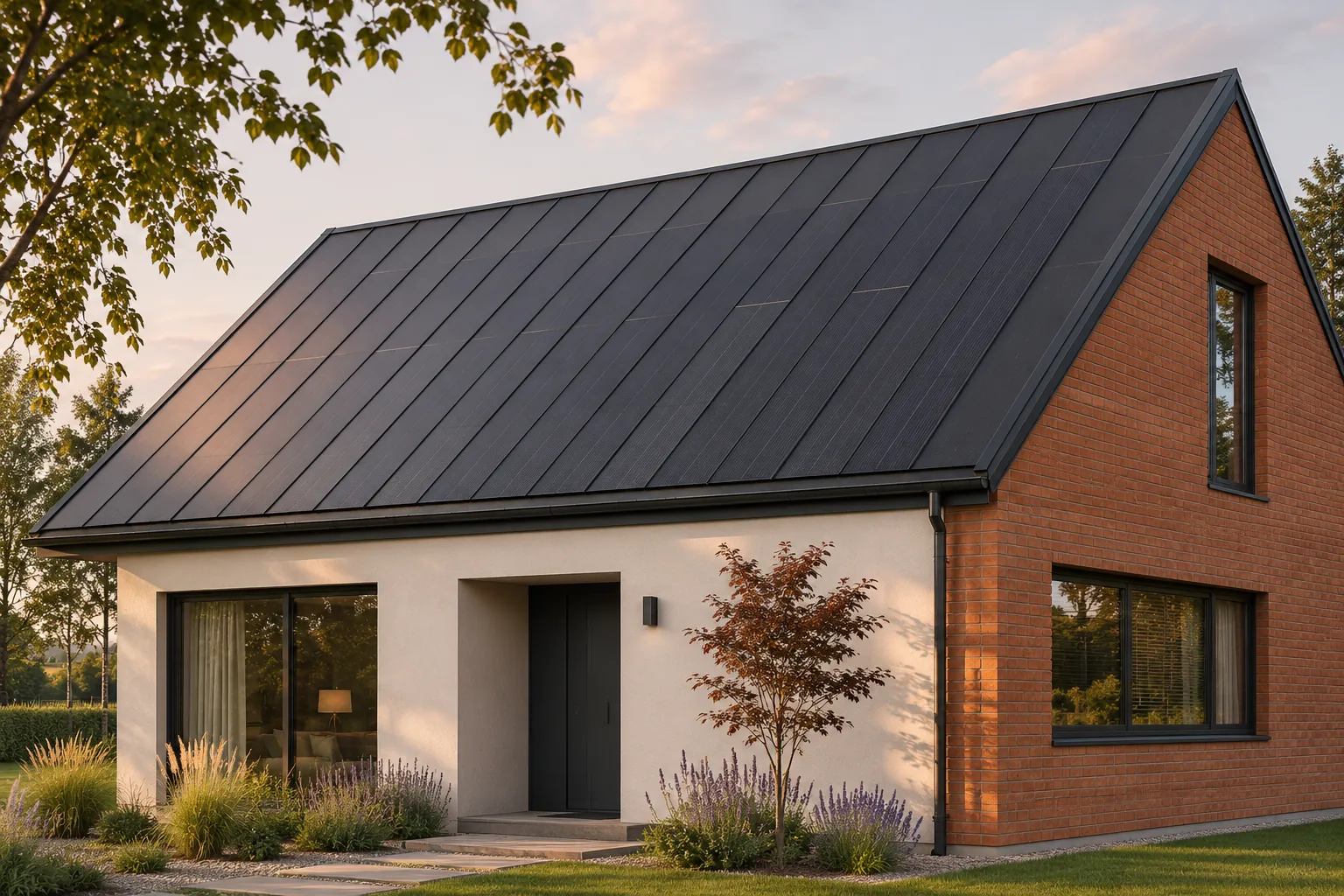
In an integrated steel roof, the connection points and cable routes can be determined in advance. This helps avoid random cables being run on a finished roof without a consistent plan. The benefit comes from coordination, not from the mere absence of visible mounting rails. A concealed cable still requires protection and access for inspection.
The design should also take into account the adjacent layers and building elements. It is not enough to assess the surface visible from the street. Details at penetrations, edges and rooftop equipment matter for the entire installation. The roofer’s and electrician’s work must come together in a single agreed solution.
What information should the owner receive?
Installation diagrams, a description of disconnection, the location of equipment and clear labelling are needed. The documentation should indicate whom to notify of an alarm or fault. Formal requirements depend on the project and current regulations. They must be established at the design stage, including when the PV system is being installed together with a new roof.
After acceptance, keep the documents in a place accessible to other household members as well. An app with an energy chart does not replace the instructions for action. If you later change the inverter, the storage unit or the circuit arrangement, the documentation should be updated. Outdated diagrams can hinder the work of service technicians and emergency services.
How can a reliable offer be recognised?
A good quote states the scope of testing, the conditions of application and responsibility for execution. It avoids assurances of completely risk-free operation. The seller should be able to separate the product warranty from the safety of the entire system. They should also explain who checks the design and who signs the protocols after installation is complete.
When choosing a roof, assess the completeness of these answers as carefully as the colour or capacity. An aesthetically integrated roof surface can be a well-planned solution. Its safety, however, results from the combination of the right products, correct design, careful installation and subsequent maintenance. No single document replaces all four elements.
Manufacturers and brands of solar roofs include Wienerberger Wevolt, SolRoof, Ennogie, ML System, MDM NT (MyRoof), Electrotile, SunRoof, Solartag, 3S Swiss Solar Solutions and LUMA Solar.
7 branches. Materials closer to your project.

- SEROCK — Dzierżenin 34 E
- BŁONIE — ul. Sochaczewska 138A
- RADOM — ul. Grobickiego 8
- ŁÓDŹ — Natolin 8
- OLSZTYN — Barczewo, ul. Prosta 9
- WROCŁAW — ul. Jerzmanowska 10C
- GORZÓW WLKP. — ul. Zielona 33/34