Installation and details
Snow guards or snow fences for a pitched roof?
In brief
Begin by identifying which zones beneath the eaves need protection, then check whether the chosen arrangement suits the whole roof slope rather than just a fragment of it. The owner should verify the roof’s pitch and length, the covering type, and the positions of entrances, walkways, cars and gutters. A linear snow fence limits the sliding of a larger mass of snow, while point snow guards can break it up and work alongside the other safeguards. Do not assume in advance that a single row will suffice — the selection depends on loads and slope geometry, not on eaves length alone.
Why must protection be planned for the entire roof slope?
Snow on the roof changes its state under the influence of temperature, precipitation and sun. The layer may begin to slide before it has completely melted. Beneath the eaves there are entrances, walkways, cars and gutters. The arrangement of these places helps to identify the zones requiring particular protection, but does not replace an assessment of loads across the entire roof slope.
The pitch, roof length, local conditions and obstacles on the surface all matter. Dormers, higher walls and installations can alter how snow accumulates. The selection should therefore not be based solely on the metres of eaves length. A protection plan is needed that is consistent with the design and with the fixing options for the specific covering.
How does a snow fence or tubular barrier work?
The linear element forms an obstacle to the sliding snow layer. Its load is taken up by the brackets and their fixings. The appearance of the grille or tubes alone does not indicate what force the assembly can transfer. What matters is the compatibility of all components, the spacing of the supports and the way the load is transferred to the roof structure.
Depending on the length and pitch of the slope, more than one row may be required. Placing the barrier close to the eaves does not mean it may be screwed to any part of the sheet. The substrate must provide the required support. The position of the fixings is determined according to the documentation, not on the basis of the most convenient place to drill.
What role do point snow guards play?
Under this name there are elements of various shapes and purposes. Some distribute the sliding layer, some participate in retaining snow in a specific arrangement. Not all small brackets should be treated as the equivalent of a continuous barrier. The task of a given system and the required arrangement must be checked.
Point elements can work together with the fence, limiting the load concentrated in one place. Their number should not result from an accidental decorative pattern. The design takes into account the snow load and the geometry of the slope. General advice of a few pieces per metre ignores differences that can have a significant effect on the performance of the protection.

How to match fastenings to tile-effect metal roofing and trapezoidal steel sheet?
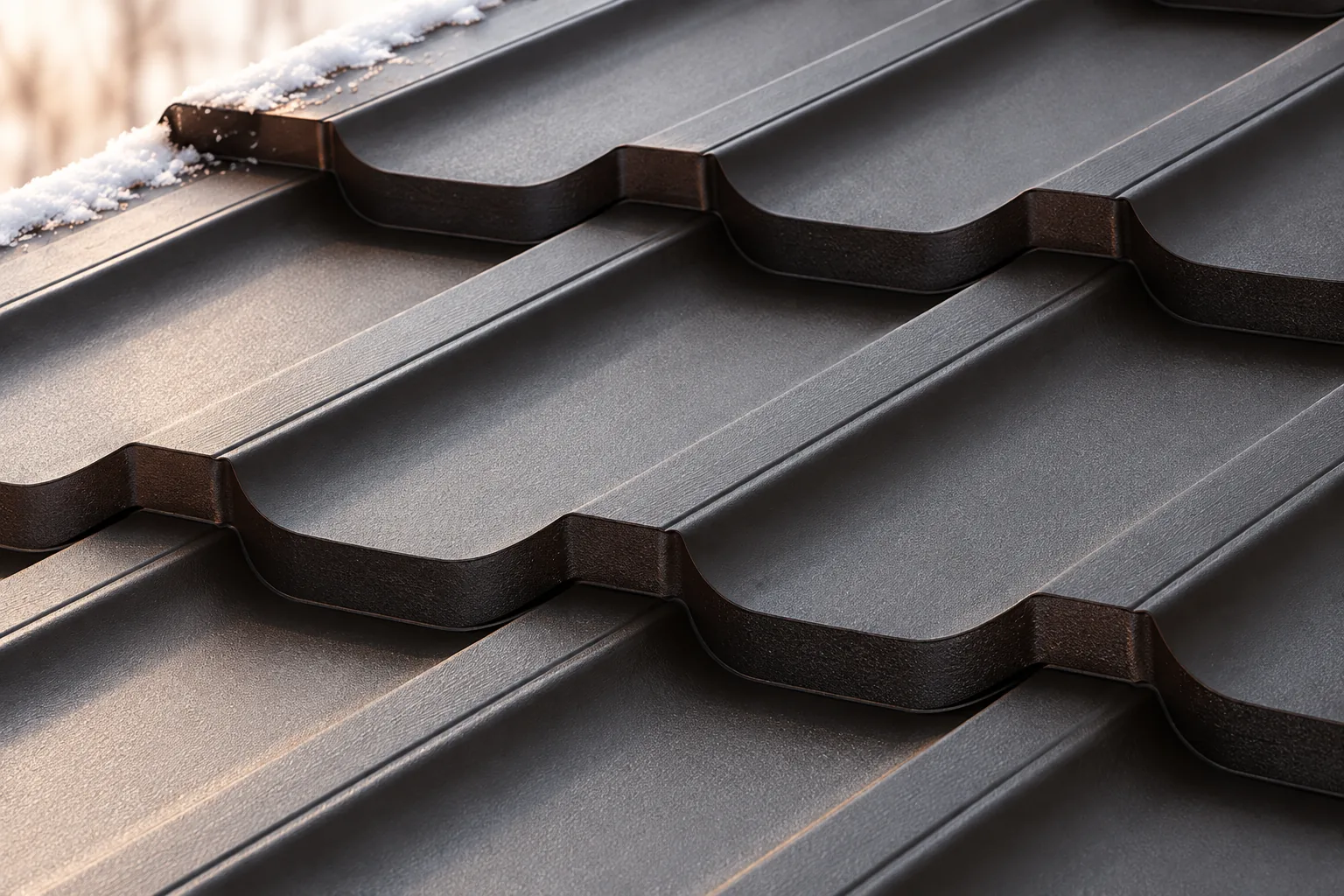
The bracket must match the specific profile and the type of support. Modular and cut tile-effect metal roofing may have different pressings, and the designation T18 or T35 does not guarantee an identical pattern across all products. A solution with confirmed compatibility should be used. It must not be assumed that a similar base will automatically ensure tightness and load-bearing capacity.
Fixings through the covering require proper sealing and suitable fasteners. When adding snow guards to an existing roof, it may be necessary to expose or reinforce the substrate. Drilling blindly should be avoided. The roofer must know where the load-bearing element is and whether its condition allows a connection to be made.
Do snow guards remove the need for snow control?
Retained snow still loads the roof. Snow guards do not automatically increase the load-bearing capacity of the structure. Under excessive loads, an assessment and organised action are required. Snow should not be cleared single-handedly by walking on an icy slope, nor should ice be struck with a tool at the brackets. This can damage the covering and create a hazard.
After the season, it is worth checking for deformation, corrosion and the condition of the fixings. A bent snow guard or a loosened support requires diagnosis of the cause. Replacing only the visible part may not be sufficient if the problem stems from incorrect spacing or a weak substrate. The inspection should also cover the tightness of the points where the fixings pass through the sheet.
How do I prepare a good order?
Selection requires the dimensions and pitches of the roof slopes, the covering model, structural data and information about the building’s surroundings. Entrances, walkways, driveways and roof-mounted equipment are marked on the plan. The quote should include barriers or point elements, supports, fasteners and seals. The linear metres of snow guard alone do not describe a complete set.
The choice is best agreed at the roofing design stage, before the fixing points are concealed. Snow guards can also be installed on a finished roof, but their installation requires assessment. A well-matched system corresponds to the actual loads and the intended purpose of the elements. The decision between a snow guard and a snow fence often leads to them working together rather than one simply replacing the other.
7 branches. Materials closer to your project.

- SEROCK — Dzierżenin 34 E
- BŁONIE — ul. Sochaczewska 138A
- RADOM — ul. Grobickiego 8
- ŁÓDŹ — Natolin 8
- OLSZTYN — Barczewo, ul. Prosta 9
- WROCŁAW — ul. Jerzmanowska 10C
- GORZÓW WLKP. — ul. Zielona 33/34