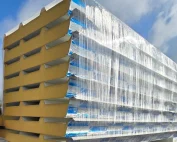
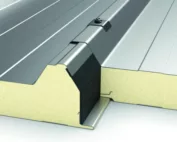
Panels in use
PIR or EPS for the roof of a pavilion used all year round?
In brief
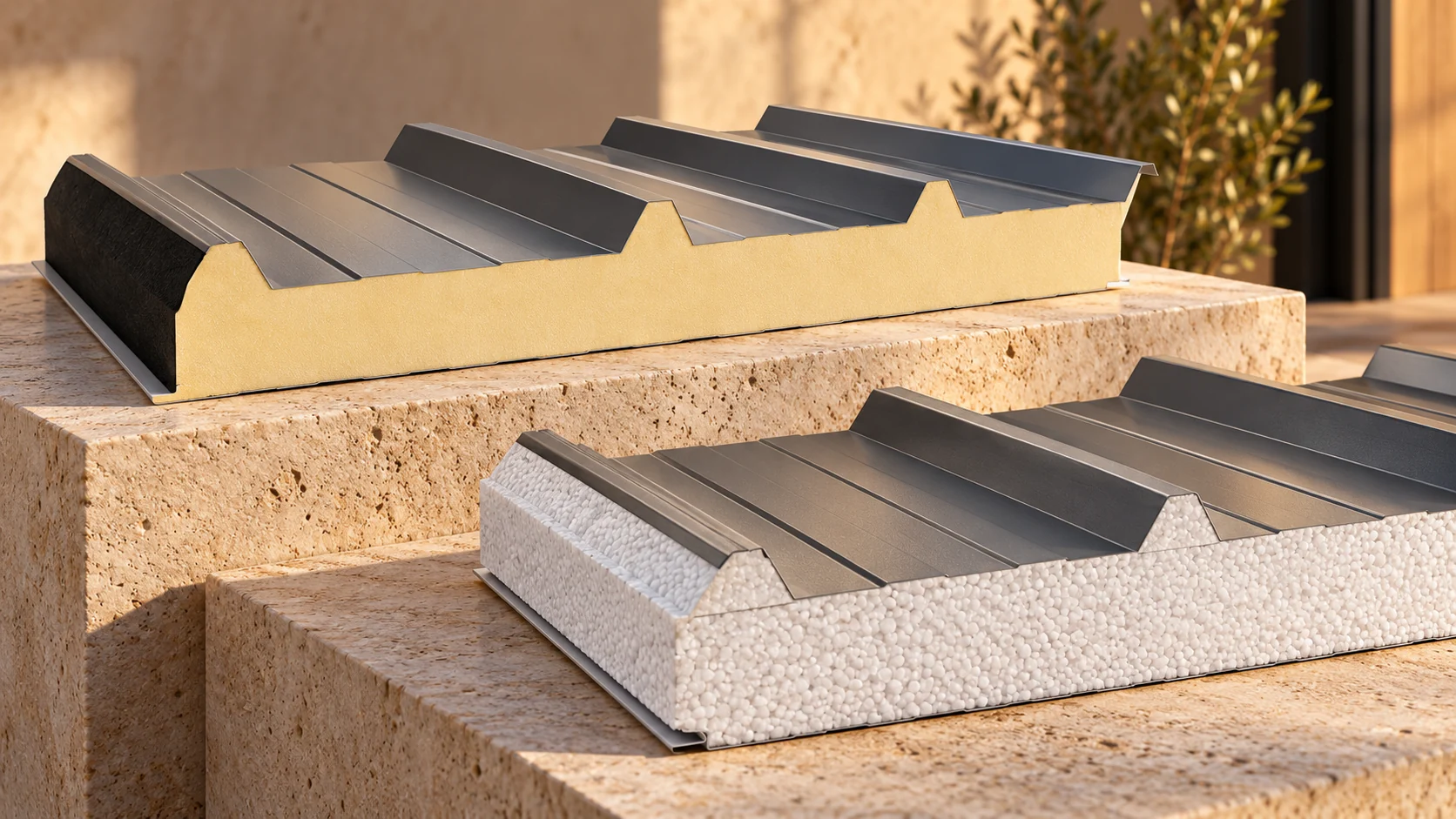
In an all-year-round pavilion, the roof should suit the heating, moisture and everyday operation of the interior. Choosing PIR or EPS therefore requires comparing whole panels. The same thickness does not mean the same thermal effect. It is also worth checking the coatings and joints, because the type of core does not solve every problem. Establish the operating temperature and heating periods. A facility opened for a few hours functions differently from a room maintained at a constant temperature. Doors, ventilation and the presence of heat-emitting equipment also matter. The roof is part of this system.
How to describe the everyday conditions in a pavilion?
Record the sources of moisture. Wet items, washing and processes carried out indoors can increase its amount. A panel should not be selected on the basis of air temperature alone. An assessment of the tightness of the joints and the possibility of removing vapour from the room is also needed.
If the function of the building is to change, take this into account before purchase. Moving more humid work into the pavilion may require different ventilation and linings. Changing the heating appliance alone does not confirm the suitability of the entire existing roof.
How to compare the thermal properties of both cores?
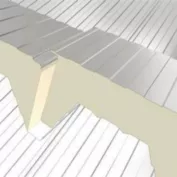
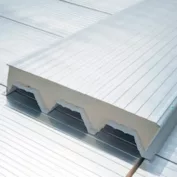
In an example PIR roof panel with a 100/140 mm section, the U-value is 0.20 W/(m²·K). The section notation takes the profile height into account. In the selected EPS panel family, a thickness of 200 mm has a Uc of 0.19 W/(m²·K). This is a comparison of two specific variants with a similar thermal result.
For the same EPS family, the 100 mm variant has a Uc of 0.37 W/(m²·K). The price of two 100 mm panels should therefore not be compared as if they provided equal insulation. First establish the project objective, then select the thicknesses that correspond to it.
A simple auxiliary calculation can be made. For an area of 42 m² and a temperature difference of 25 K, a coefficient of 0.20 gives a heat flow of 210 W, and 0.19 gives approximately 199.5 W. This is not the demand of the entire pavilion. The calculation omits, among other things, joints, ventilation and door opening.
Is a thicker panel always heavier?
The mass depends on the core, profile and facings. In the PIR 100/140 mm variant under consideration with 0.5 and 0.4 mm steel sheets, it is 12.4 kg/m². An example EPS panel of 200 mm has a mass of 11.5 kg/m² in the configuration specified for it. Thickness alone therefore does not determine weight.
This does not mean that both panels have equal load-bearing capacity. The mechanical parameters must be read separately from the data for the relevant section. The support spacing and the structural scheme are important. A lighter element is not automatically approved for a larger span.
Also check the transport dimensions and details. A thicker panel may require different flashings and fixings. In a small building, the space at the eaves and above openings is particularly important. The whole assembly should be installable without accidental compression or shortening of the required terminations.

What determines durability in the interior?
The cladding is in direct contact with the operating conditions. With regular cleaning, the approved agents, concentrations and application method must be known. The choice of core does not ensure resistance to every substance. The coating and the way the edges are finished are separate issues.
Moisture can reach the joint through a leak. Therefore, the perimeters of openings and service penetrations require proper detailing. Water should not remain in places without a drainage path. A well-chosen panel needs equally well-executed connections.
Check the fire requirements for the entire roof. Reaction to fire, fire resistance and external fire performance are not a single assessment. The same properties must not be attributed to both cores without documentation. The selection must meet all requirements, not only the thermal objective.
How can you compare the cost of solutions with a similar function?
Compile variants that meet the same operational objective. For each, count the panels, fixings and flashings. Add the effect of thickness on openings and installation cost. The difference in core price is not automatically the difference in the cost of the finished roof.
Check the required quantity of material and the delivery conditions. A different cover width may change the number of runs. Also do not assume that every variant is available in a small batch. The lead time and feasibility of the order must be confirmed for the specific specification.
Finally, compare the maintenance plan and the scope of future changes. If the pavilion is to operate all year round, the decision should take into account the actual moisture, temperature and cleaning frequency. Price is important, but it refers to a solution that is to meet these conditions over the service life.
What else is worth asking about
Does a similar U-value for two panels mean identical roofs?
No. That is a similarity of one parameter. Weight, load-bearing capacity, fire properties, claddings and connections must still be compared. The required geometry of details may also differ.
Does a thicker EPS panel necessarily impose a greater load on the structure?
Not always. The weight also depends on the core density and the facings. The mass of the specific variant must be used and the full set of roof loads checked.
7 branches. Materials closer to your project.

- SEROCK — Dzierżenin 34 E
- BŁONIE — ul. Sochaczewska 138A
- RADOM — ul. Grobickiego 8
- ŁÓDŹ — Natolin 8
- OLSZTYN — Barczewo, ul. Prosta 9
- WROCŁAW — ul. Jerzmanowska 10C
- GORZÓW WLKP. — ul. Zielona 33/34