Roof and energy
Is the minimum roof pitch the best angle for photovoltaics?
In brief
The minimum pitch permitted for a covering and the angle that favours energy yield are two different pieces of information. The first concerns the conditions under which the roof may be used. The second depends on location, the orientation of the roof slope and the expected production profile. In an integrated system, both requirements must be reconciled. The angle cannot be chosen on the basis of a power table alone, nor can the permissible minimum be treated as a universal recipe. The manufacturer specifies the conditions under which a given covering and its details may be used. The pitch influences, among other things, water drainage and the way joints are made. The permissible range should be checked in the current instructions for the specific system. A figure from the datasheet of another model or a single flashing need not apply to the whole roof.
What does the minimum pitch refer to?
Sometimes additional requirements depend on the length of the roof slope, the exposure or the build-up of layers beneath the covering. It is therefore worth giving the supplier the full geometry of the building. A general question about whether installation is possible ‘on a slight slope’ does not provide a basis for a responsible answer. Actual dimensions and site conditions are needed.
What determines the angle favourable for energy yield?
For production, the position of the sun relative to the active surface matters. It changes over the course of the day and the year. The orientation of the roof slope, the latitude and the weather affect the result. An angle that gives a high annual yield does not necessarily give the best production at every time of year or during the hours of greatest household demand.
The energy analysis should be tailored to the specific roof. One should not expect a single value to work for all orientations. In an existing building, the existing geometry is usually assessed. In a new design, several variants can be considered, but the costs and architectural effects of changing the building form should also be compared.
Is it worth rebuilding the roof for a higher yield?
The mere possibility of obtaining more energy does not determine the profitability of a rebuild. Changing the angle may mean intervening in the structure, the building height and the functionality of the attic. Design and formal issues are added. The cost must be compared with the actual difference in production, not just with an attractive percentage value.
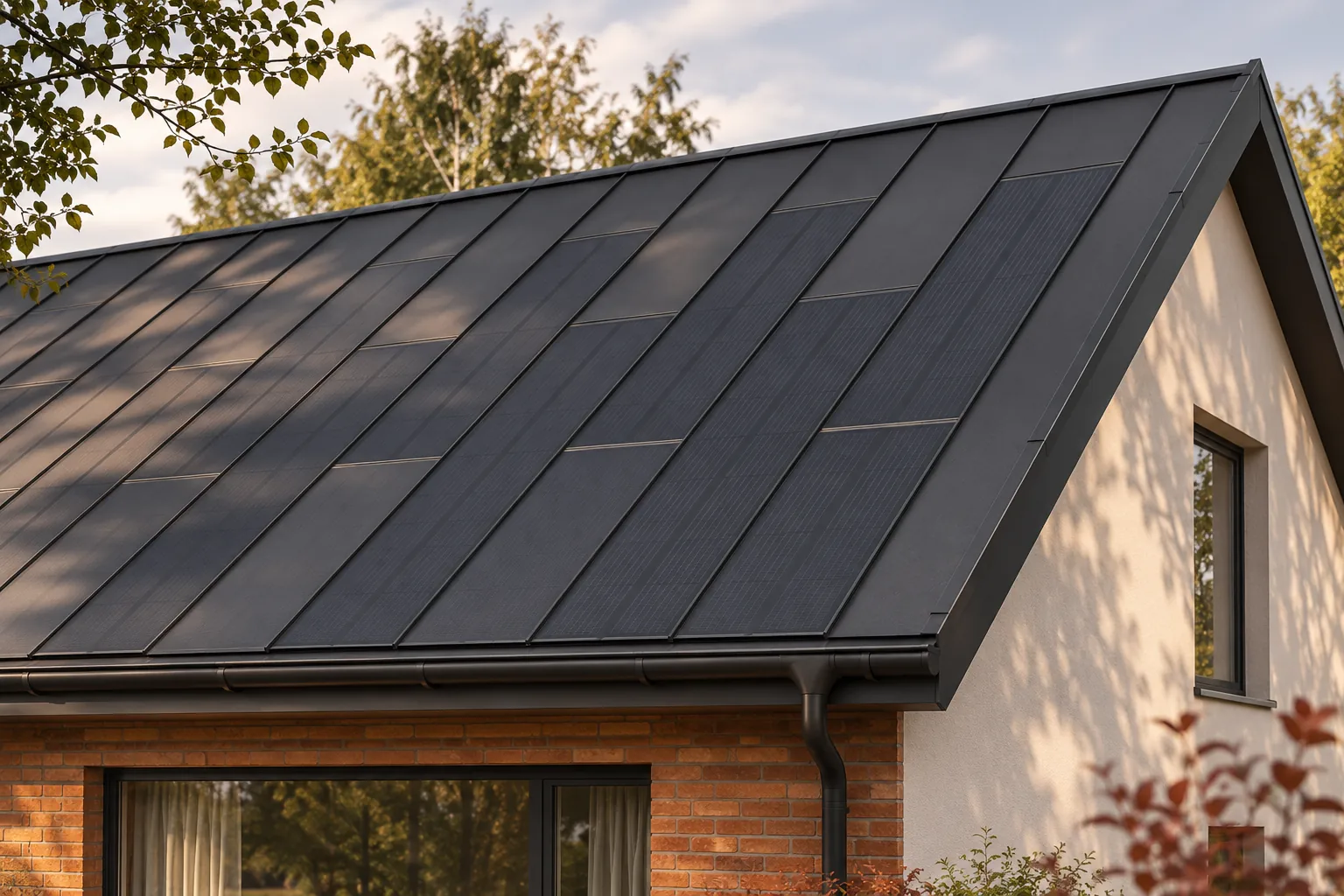
The integrated steel system has the advantage that it allows the active surface to be combined with the line of the designed roof. It does not require a separate mounting frame that changes the angle of the modules above the covering. This helps preserve the appearance of the building. At the same time, it means that the geometry and the active area should be selected together at an early stage.
How do water, snow and dirt affect the pitch?
The pitch matters for how precipitation behaves on the surface, but it does not provide a simple guarantee of self-cleaning. Accumulated snow or dirt also depend on the weather, the surroundings and the shape of the components. One should not promise that a roof with a specific angle will never need inspection or will always clean itself.
The design must take into account the safety of sliding snow and ice. This applies in particular to entrances, passageways and parking areas. Protective solutions should suit the given covering. Random brackets must not be added independently in the active field simply because a problem appeared after the first winter.
What should be compared in two quotes?
Check whether both variants relate to the same geometry and orientation. Then compare technical feasibility, expected yield and scope of works. If one offer requires additional layers or a specific detail at a low pitch, their cost should be visible. Otherwise, the lower price may result from an omitted scope.
It is good when the designer separates necessary conditions from proposals that improve the result. The technical minimum is the limit of application, not a goal in itself. The choice should be based on a solution that meets the requirements and remains sensible in everyday use. This also applies to access for inspection and subsequent repair.
How can mistakes be avoided at the ordering stage?
Provide roof slope drawings, cross-sections, the location of windows and chimneys, and information about the surroundings. Ask for confirmation that the solution is compatible with this specific project. Do not base an order on a short message containing only the angle. Minor differences in details can change the method of installing the covering or the size of the active area.
Keep current instructions and agreements in the building documentation. When the design changes, check whether the earlier assumptions still apply. Then the aesthetic integration of the roof with photovoltaics goes hand in hand with correct product application. The permissible pitch and a good yield can coincide, but they are not the same quantity.
Players in the photovoltaic roof market include Electrotile, Solartag, ML System, BIPVco, SolRoof, MDM NT (MyRoof), Wienerberger Wevolt, SunRoof, Solarstone and EDILIANS.
7 branches. Materials closer to your project.

- SEROCK — Dzierżenin 34 E
- BŁONIE — ul. Sochaczewska 138A
- RADOM — ul. Grobickiego 8
- ŁÓDŹ — Natolin 8
- OLSZTYN — Barczewo, ul. Prosta 9
- WROCŁAW — ul. Jerzmanowska 10C
- GORZÓW WLKP. — ul. Zielona 33/34