PIR insulation
Glass fleece on termPIR WS: why it differs from aluminium foil
At a glance
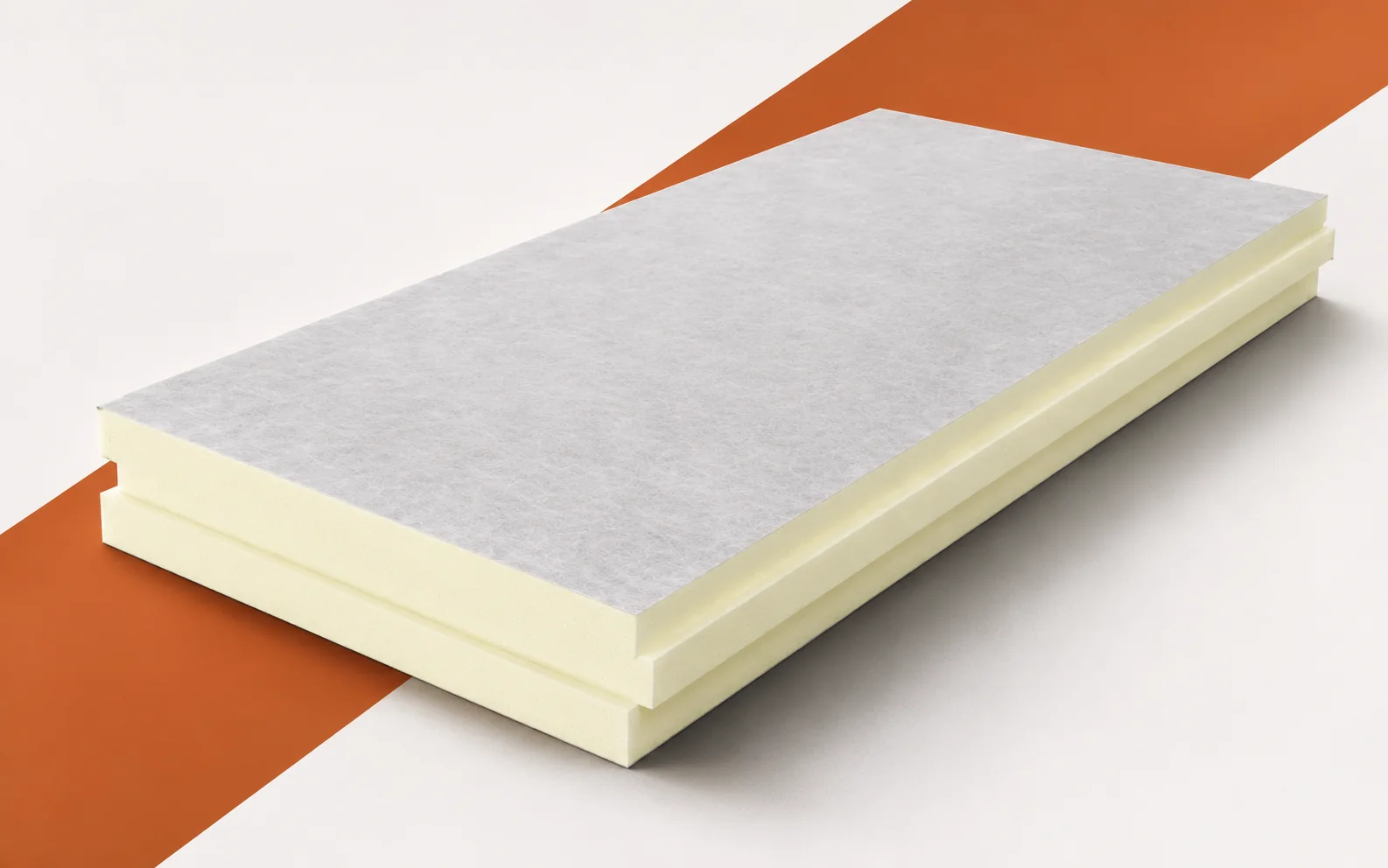
The glass fleece in termPIR WS performs a different function from aluminium foil, so the two facings cannot be treated as interchangeable. The termPIR WS board consists of a PIR core with a gas-permeable glass fleece facing on both sides, whereas the aluminium laminate is gas-tight. The colour of the core alone says nothing about the surface that the adhesive, membrane or covering will have to bond to. On an existing roof, the assessment begins by establishing which facing is actually on the board and how it connects with the other layers and with the fixing of the covering. Only this actual condition allows an assessment of whether the fleece fulfils its role in the building element.
From the name to the actual board
The same PIR core does not give the same adhesion, because the facing determines how the materials work together. During the inspection, compare the approval for the specific combination — board, fastening layer, waterproofing — with the documentation or the condition before the change. Agreeing how the materials work together before laying over a large area reduces the risk of recreating a system that has already failed.
What lambda alone does not say
For termPIR WS, the thermal conductivity depends on the thickness: below 80 mm it is 0.027 W/(m·K), in the range from 80 to below 120 mm — 0.026, and from 120 to 250 mm — 0.025 W/(m·K).
With a low parapet, the insulation narrows locally, so in the narrowed section use the lambda for the local thickness in the calculation, not the nominal thickness from the offer. The average thickness of the roof field does not describe the thinnest point at the termination. Before assessing savings, ask for the actual thickness and the thermal conductivity assigned to it in each cross-section analysed.
The termPIR WS glass fleece is sometimes assessed visually by comparison with the silver facing of other boards. Such a comparison does not determine suitability for a roof. The glass fleece has a different construction and must work together with the correct layers of the system. It should not be expected to perform the function of a rainproof covering. In the event of a leak, the path of the water through the entire assembly must be traced, instead of attributing a single cause to the appearance of the thermal insulation surface.
Moisture must be recognised, not merely covered up
The glass fleece alone in termPIR WS does not constitute a waterproof layer — the building envelope requires a separate covering, and the boards require protection during works.
Water under the insulation after rainfall requires exposing the board facings in the work area interrupted before the covering was installed and checking the protection of the end of the day’s section. The vapour-permeable facing does not protect the open assembly against rain, so the assessment must establish whether water had a path under the installed insulation before the cause is attributed to the facing. Compare the protection of the work area and the condition of the boards before they were covered with the membrane against the history of the problem’s occurrence.
Where problems at the junction come from
termPIR WS is available with a straight edge and in rebated variants depending on the order; installation requires careful butting of the boards on a stable substrate.
Around the roof outlet and the service penetration, the support of the cut pieces and the space for detailing the waterproofing are what matter. The factory rebate of a full board does not resolve the junction with an element of a different shape. Combine the layout of the last rows with the condition of their sides and the detail at the outlet in order to assess the stability of the substrate under the covering.
How to understand hardness and fire class
The designation CS(10/Y)120 in the termPIR WS documentation describes behaviour in the compression test; it is not a creep declaration or a ready permissible load for the roof. The reaction to fire of the board itself is class F for 20–49 mm and E for 50–250 mm. During delivery inspection, the class must therefore be linked to the thickness, and the assessment of the entire roof build-up must be carried out separately.
In the service zone around equipment above the roof layers with termPIR WS, consider the compressive loads together with the supporting structure and protective layers. CS120 does not on its own describe how the system performs under the sustained pressure of a support, so it is not permission for arbitrary use; keep the board’s properties separate from the roof classification, including for fire requirements. If there is a discrepancy, ask for the service access solution and for confirmation that the substrate and covering match the assessed system.
What to gather before assessment or repair
When ordering termPIR WS, specify the thickness, format, edge and the method of connection to the covering. The selected systems require a specific adhesive or fixing, so these details must be consistent with the adopted assembly of the building envelope.
The description of the board alone does not determine whether the quotation covers the bonded variant or the fixing intended for the given roof. When comparing offers, include the substrate preparation and the work at the perimeter and penetrations — otherwise the assessment of completeness and cost-effectiveness will be incomplete. The fixing method affects the quantity and type of auxiliary materials, so the order should cover the insulation together with an unambiguous scope of work needed to close the covering. Check the number of boards according to coverage, the consumption of fixing materials and the scope of flashings on the roof.
7 branches. Materials closer to your project.

- SEROCK — Dzierżenin 34 E
- BŁONIE — ul. Sochaczewska 138A
- RADOM — ul. Grobickiego 8
- ŁÓDŹ — Natolin 8
- OLSZTYN — Barczewo, ul. Prosta 9
- WROCŁAW — ul. Jerzmanowska 10C
- GORZÓW WLKP. — ul. Zielona 33/34