Installation and details
Exterior window sills: choosing a detail that protects the façade
In brief
An external sill should first and foremost channel water away from the wall. Effectiveness depends on an outward slope, a drip edge and a tight connection to the window and reveals, not just material or colour. Steel, aluminium and mineral sills have different installation details. Set dimensions against the finished façade, not the bare wall. Water from the glass and frame runs onto the sill and then beyond the façade face. Without a slope, even a wide sill will not do its job.
What path should the water take?
Water running off the glass and frame lands on the sill and then drains beyond the façade face. The surface must have an adequate outward slope. The drip edge limits water being drawn up underneath and helps the drop detach from the edge. A wide sill alone will not perform if it is set without a fall.
The ends at the reveals are also important. Water should not run into the gap between the sill and the insulation. The connection to the frame must be matched to the window construction and the sub-sill trim. The drainage openings in the joinery must not be covered. This minor error can cause problems despite the aesthetic appearance of the entire detail.
When should you choose coated steel?
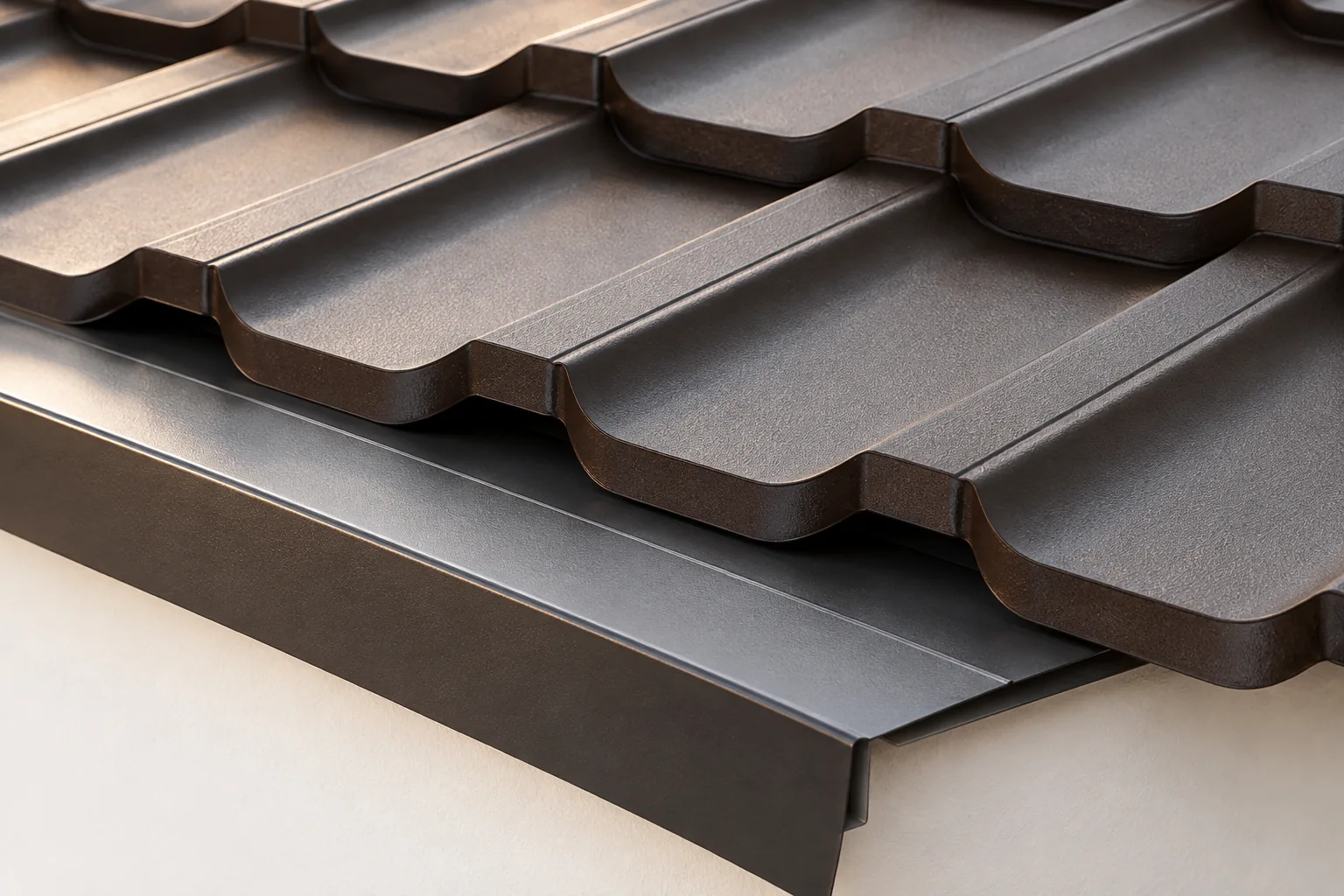
A steel sill is lightweight and can be made to measure from matched sheet metal. It offers a wide choice of colours and the option of matching the roof flashings. Durability is determined by the material, coating, edge protection and how it is used.
Thin sheet metal requires proper support. It should not deflect under typical actions or remain loose at the edge. During installation, the coating must be protected from mortar and swarf. Damage can become the starting point for corrosion. The sill should not be treated as a working step during façade finishing. Such loading can permanently deform it.
What is worth knowing about aluminium and mineral materials?
An aluminium sill can also have a coating in the joinery colour. Its thickness, profile and method of support must be checked in the documentation. Aluminium moves under the influence of temperature, so a long element requires suitable connections and ends. It should not be rigidly locked in the reveals.
Sills made of stone or other mineral materials are heavier and have a different method of installation. Their suitability for exterior use, frost resistance and the method of sealing the joints must be checked. A material used indoors does not automatically become a good façade sill. Regardless of the choice, a correct drip edge and continuous water drainage are required.

How to measure a window sill before ordering?
The width should account for the connection under the window, the thickness of the insulation and render, and the projection beyond the finished façade. The length must be determined together with the type of side ends. The dimension measured between the bare reveals need not be the dimension of the finished element.
With several windows, it is worth checking each one separately. Differences in construction may require different widths or lengths. The measurement should be coordinated with the façade team and the window fitter. If the window sills are ordered before the layers are determined, a later correction to the insulation may leave too small a projection or mismatched ends.
Which details determine tightness?
The substrate should provide stable support and an adequate slope. The area below the window requires continuity of insulation and a tight connection to the window. Assembly foam alone does not constitute a complete external seal. Materials must be used that are compatible with the window system and the façade.
The side ends serve more than a decorative function. They can allow thermal movement and direct water onto the surface of the window sill. They require proper bedding in the reveal. Accidental sealing of the joints with hard mortar can lead to cracking. The details must be matched to the specific window sill rather than repeating a single pattern for steel, aluminium and stone.
How to compare quotes and accept the installation?
The price should cover the same dimension, material, finish and ends. It is worth separating the cost of the window sill from the preparation of the substrate, sealing and installation. A rate per linear metre without a specified width is of little use. A wider element uses more material and may require additional support.
At acceptance, the direction of slope, stability, drip edge and side connections are checked. The surface should not be scratched or soiled with mortar. The protective film is removed in accordance with the instructions, without leaving it in place for a long time under exposure to the sun.
The colour is best assessed on a sample in daylight, next to the frame and the façade. There is no need to choose a material solely so that it perfectly imitates the roof. A good window sill should above all effectively drain water and remain easy to maintain. Aesthetics are then a complement to a correct detail, not a way of hiding its faults.
7 branches. Materials closer to your project.

- SEROCK — Dzierżenin 34 E
- BŁONIE — ul. Sochaczewska 138A
- RADOM — ul. Grobickiego 8
- ŁÓDŹ — Natolin 8
- OLSZTYN — Barczewo, ul. Prosta 9
- WROCŁAW — ul. Jerzmanowska 10C
- GORZÓW WLKP. — ul. Zielona 33/34