PIR insulation
Does tongue-and-groove eliminate thermal bridges? The example of swissporPIR Alu
At a glance
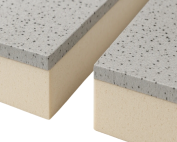
The tongue and groove in swissporPIR Alu helps to join adjacent boards, but does not eliminate all thermal bridges in the building envelope. Support, cut-to-size pieces and the continuity of the insulation around the perimeter also matter. In this family, FIT/GK means a square edge, LAP/SF an overlap, and TAG/NuF tongue and groove; these names should not be used interchangeably. A gap may result from damage to the profile, contamination or imprecise positioning. Before covering it up, the actual joint must be inspected, because a level surface does not prove that the fit beneath it is correct. The broader terms “polyurethane boards” and “polyurethane foam” do not replace identification of the specific PIR product or the geometry of its edge.
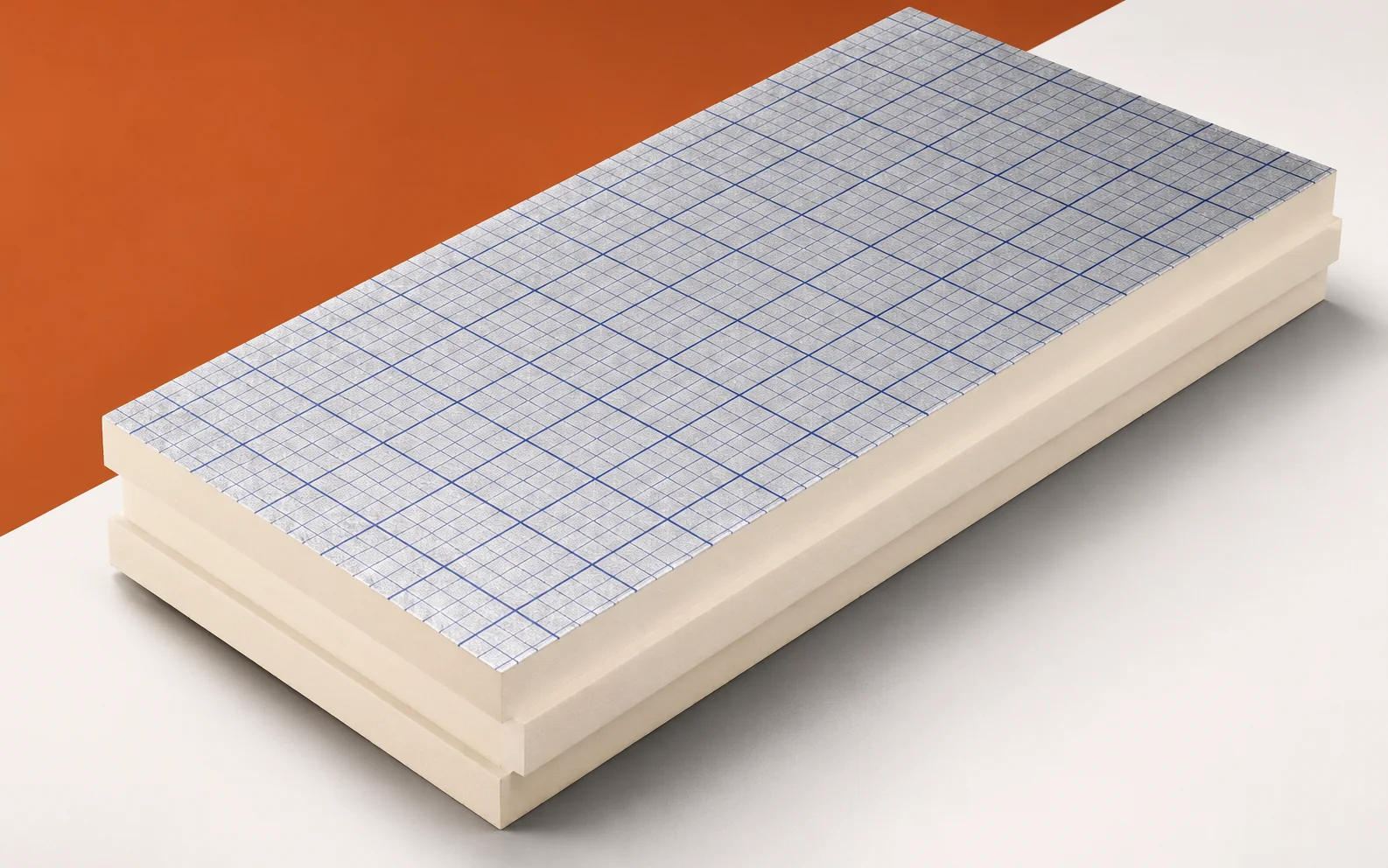
PIR boards with FIT, LAP or TAG edge
However, similar profile names do not describe the same way of fitting adjacent boards, so their functions are easy to confuse. A correct diagnosis should allow you to order a geometry that matches the laying plan and the terminations. During the inspection, compare the verbal description of the edge together with the drawing of its actual cross-section against the information on how it is made.
Core conductivity and quality of contact
The board core retains the declared lambda of 0.022 W/(m·K) regardless of the edge name, and the benefit of the profile concerns primarily the way the joints are made. When interpreting the thermal result, check this lambda and the function of the swissporPIR Alu edge, which is independent of it.
The conductivity of the swissporPIR Alu core must be separated from the quality of execution of the joints. The edge profile does not automatically improve the lambda and does not remove the influence of the other thermal bridges, so a similar wording does not have to mean the same thing. The benefit of the profile can be assessed as an aid in maintaining the continuity of the layer, and before drawing a conclusion, ask for the thermal properties of the board and the joint plan across the entire surface, so that the figures refer to the actual layer.
Polyurethane insulation after trimming the edge
The board edge must be clean, undamaged and fitted without gaps. Cutting removes the factory profile, so the assessment of execution should include the cut edge of swissporPIR Alu at the wall or at a projecting roof element.
After cutting off the factory profile of swissporPIR Alu, the correct termination of the board must be recreated. A loose tongue does not replace proper support of the edge section, so the installation rules must be checked separately. The cause of the defect allows the perimeter to be matched without open joints and unstable parts. Before accepting the connection, check the condition of the edge, the width of the cut and how it is supported.
Relative position of the layer joints
In a two-layer system, the joints must be offset relative to each other. In a single layer, the manufacturer recommends shiplap or tongue-and-groove profiles on roofs. When analysing the joints, determine whether the joints of swissporPIR Alu in two layers are offset.
Before specifying a repair, plan the relative position of the joints of the two layers of swissporPIR Alu. Appearance alone is not enough: tape on the surface does not recreate the missing core nor does it constitute independent waterproofing. The plan of both layers, the function of each seal and the history of previous work allow direct interruptions through the thickness of the system to be limited without omitting other layers.
The profile does not replace support
The edge profile of swissporPIR Alu is not a structural interlock, as in sandwich panels, nor does it give the board the ability to span any distance. In the documentation, therefore, the description of the thermal insulation joint must be separated from the load-bearing properties of the entire system.
The tongue-and-groove joint does not determine the load-bearing capacity of the support for swissporPIR Alu, and the interlock of the insulation board does not entitle you to any arbitrary spacing of supports. Correct support must be maintained even when adjacent elements join together easily; in case of doubt, the support of whole boards and the design for transferring loads to the structure are checked.
Insulation with polyurethane: the right profile in the order
When comparing edges, it is necessary to establish how the usable area is calculated and what waste arises at the edges — the quantity ordered depends on the board layout, not only on the area of the rectangle in plan. The availability of edge profiles for swissporPIR Alu from a thickness of 40 mm according to the instructions is checked when assessing an offer or completed work.
For the thin variant, the availability of the swissporPIR Alu edge must be confirmed before ordering, because the profile described for thicker elements cannot automatically be assigned to the 20 mm variant. Comparing offers therefore requires confirmation of the actual combination of thickness and edge finish, and a conclusion about cost or quality requires data covering the delivery designation, the covering area and the waste from edge processing.
A case worth considering
A gap between swissporPIR Alu boards can have various causes: a damaged tongue, a soiled groove or an inaccurate positioning of the element. It is worth establishing the source before the joint is covered. Pressing down the surface does not confirm an improvement of the concealed joint, which is why the assessment also covers the support and the geometry of the adjacent boards.
7 branches. Materials closer to your project.

- SEROCK — Dzierżenin 34 E
- BŁONIE — ul. Sochaczewska 138A
- RADOM — ul. Grobickiego 8
- ŁÓDŹ — Natolin 8
- OLSZTYN — Barczewo, ul. Prosta 9
- WROCŁAW — ul. Jerzmanowska 10C
- GORZÓW WLKP. — ul. Zielona 33/34