Steel profiles and structures
Cold-formed and hot-rolled channels: why matching their height is not enough
In brief
When buying steel, it is easy to reduce a description to two words and one number. “Channel 200” sounds unambiguous, but it does not define the full product. It could refer to a cold-formed profile or a rolled product. The differences are not only in weight. The geometry of the walls, the method of connection and the working conditions also differ. A conscious choice begins with the question of what function the element is to perform and according to which data it was selected. The web height helps describe the cross-section, but it does not say everything about the quantity and distribution of material. The flange widths, wall thickness and corner radii are important. In C profiles, there are also stiffening bends at the ends of the flanges. Two channels of the same height can therefore have clearly different properties. They must not be equated solely on the basis of external dimensions.
Height is only one dimension
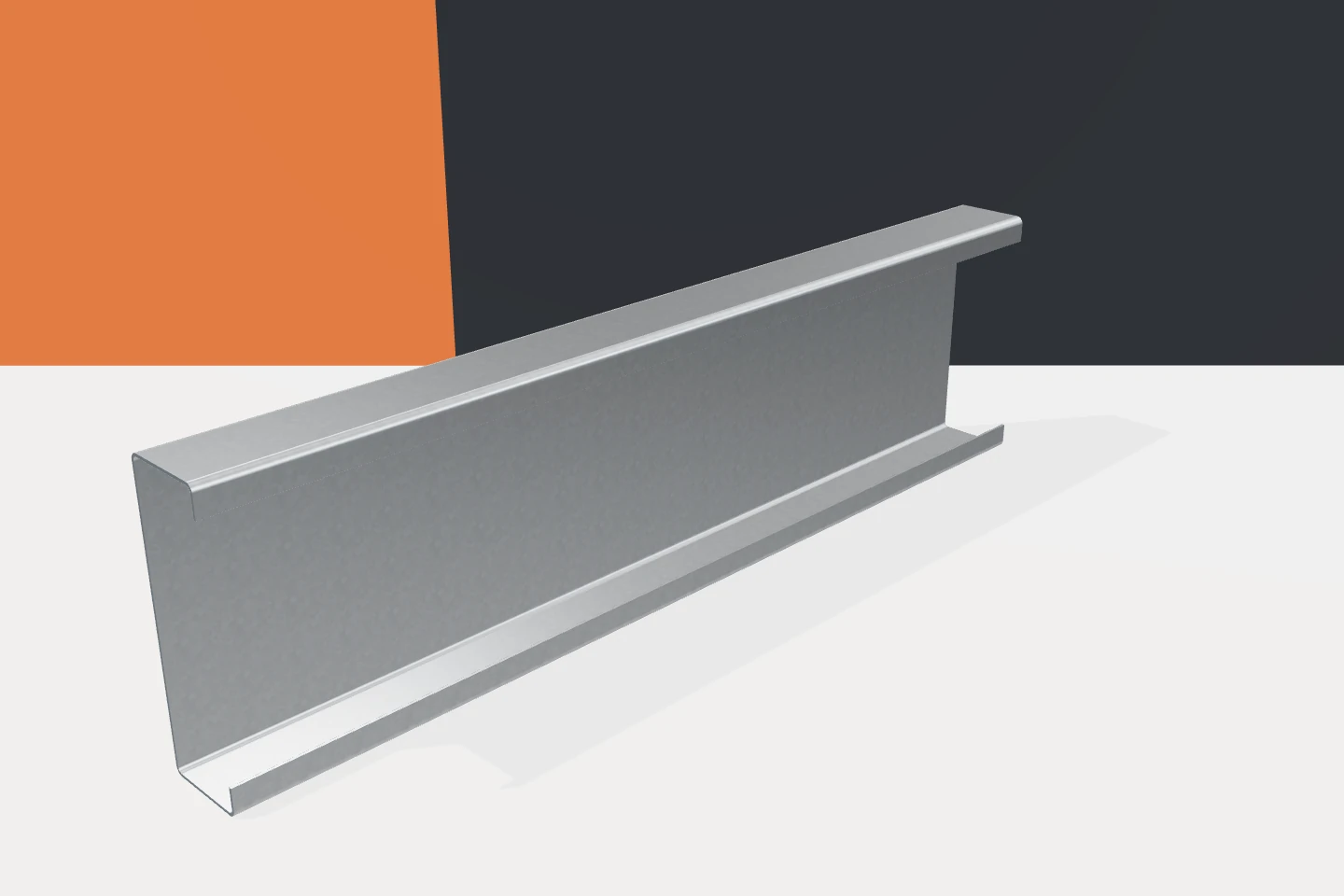
Cold-formed profiles are formed from sheet steel. In many available variants the thickness remains similar around the entire perimeter of the cross-section, apart from the influence of the bending process. Rolled products have a different geometry resulting from the manufacturing technology. The data for the specific product must be used for calculations. A drawing from the catalogue is of greater value here than the colloquial term used by the seller.
An example C profile from a catalogue series has a height of 200 mm, flanges of 62 mm, lips of 20 mm and a thickness of 2 mm. Only such a complete set, supplemented by a bending drawing, allows the specific geometry to be identified. The abbreviation C200 alone omits most of this data.
The edge bend has a specific task
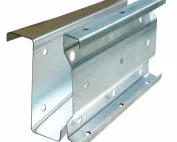
Structural C channels often have short sections of sheet steel directed towards the interior of the cross-section. These are edge stiffeners. They change the behaviour of the flanges under load. They should not be removed when fitting the element to an adjacent part. Even a small cut-out can change the local structural behaviour. An agreed detail is needed at the point of conflict.
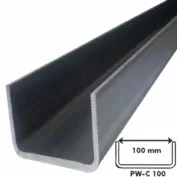
A simple U profile without such bends is a separate geometry. It can serve as a guide, a connector or another element provided for in the design. It is not the default substitute for a C profile. Likewise, omega and sigma profiles are not merely a variation on the appearance of a channel. Each cross-section has a different distribution of walls and its own set of parameters.
Lower weight can be an advantage, but it requires correct design
Cold-formed profiles allow thin sheet steel to be distributed in a three-dimensional cross-section. In a suitably designed structure this can achieve a favourable ratio of mass to the required load-bearing capacity. Lighter elements can facilitate delivery and installation. This benefit does not, however, mean that any thin channel will carry the load of a heavier equivalent. The comparison requires the same boundary conditions.
The lightest single element does not always give the cheapest system. The number of supports, connections and bracings also matters. Sometimes the profile requires additional accessories or a different spacing of the rails. The whole must be taken into account in the quotation. Galvanised profiles should be compared as part of a complete structure, not merely as kilograms of steel.
Open cross-sections can twist
The load on a channel section does not always act so as to produce simple bending alone. Its position relative to the cross-section and the method of fixing also have an influence. Open channel sections require assessment of torsion and stability. Thin flanges and webs may also lose stability locally. The calculations therefore take into account more than the strength of the steel itself.
This explains why a catalogue may give effective values that differ from the geometric ones. Not the full width of every wall has to work equally under a given load condition. Similar issues apply to Z-sections and sigma profiles. This is not a disqualifying defect of cold-formed profiles. It is a characteristic that the designer takes into account when selecting them correctly.

The connection must suit the wall thickness
A fastener selected for a thick steel component does not necessarily perform the same way in thin sheet. Its load-bearing capacity, range of application and the way it transfers forces must be checked. In channel connections, bearing pressure, edge distances and weakening by holes are among the important factors. It is not enough to count the visible bolts. Their arrangement is part of the solution.
Factory hole punching simplifies the work only when it has been well coordinated. It should correspond to the actual supports and the approved drawings. On site, the markings on the components must be compared before they are fixed. Enlarging holes independently or welding on additional plate requires assessment. Otherwise the product for which the calculations were made is changed.
Galvanising does not turn a channel into stainless steel
Galvanised profiles have a protective layer that limits corrosion. Its selection should match the environment inside and outside the building. Moisture trapped between components can be a problem even before installation. Dry storage, ventilation of packs and protection against damage are therefore important. The silver colour alone is not enough to assess durability.
A distinction must also be made between a profile made from coated strip and a component galvanised after manufacture. These are different routes of protection. Parameters and repair instructions must not automatically be transferred from one to the other. The documentation for the specific coating remains the basis. If additional painting is planned, the surface preparation and a compatible system must be agreed in advance.
How to look for a substitute responsibly
Selecting a replacement starts with the design, not with availability on site. Full cross-section dimensions, material, thickness, support and loads are required. The connections and interaction with the enclosure must also be checked. Channel sections that look similar may require different solutions. The change should be agreed before ordering and modifying components.
In many tasks, cold-formed profiles are a practical choice. They facilitate prefabrication, offer numerous dimensions and can be used in lightweight roof or wall systems. Z-sections, channel sections, sigma and omega profiles complement one another in such structures. It is worth making use of their differences. Trying to treat all similar profiles as equivalent removes precisely the knowledge that allows them to be selected well.
7 branches. Materials closer to your project.

- SEROCK — Dzierżenin 34 E
- BŁONIE — ul. Sochaczewska 138A
- RADOM — ul. Grobickiego 8
- ŁÓDŹ — Natolin 8
- OLSZTYN — Barczewo, ul. Prosta 9
- WROCŁAW — ul. Jerzmanowska 10C
- GORZÓW WLKP. — ul. Zielona 33/34