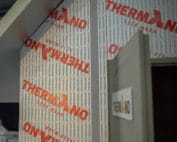
PIR insulation
Can a small Thermano Compact board eliminate a thermal bridge?
At a glance
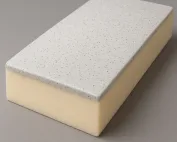
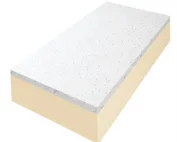
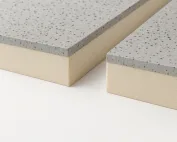
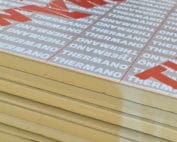
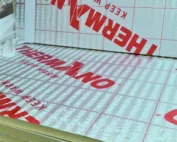
A thermal bridge in an existing building shows up wherever concrete, a metal fixing or a gap in the insulation creates a path of lower resistance than the adjacent layers. Thermano Compact, a PIR board in the 600 × 1200 mm format with a multi-layer facing containing aluminium, will help only if it is placed exactly at that point and covers the entire junction. Simply covering the visible section with a thin board does not remove the cause. The smaller format makes it easier to bring the material onto a small working area, but effectiveness depends on how well the board matches the size of that area and the available transport route, not on the appearance of the finished surface.
From the name to the actual board
Check the condition of the detail by comparing the dimensions of the installation location, the access width and the position of each junction with the documentation or with the condition before the change. The ease of handling a smaller board does not prove that the installation is correct; PIR boards are selected so that the designed layer and joint arrangement is maintained over a short section.
How to read thermal parameters
The Thermano Compact data sheet states a lambda of 0.023 W/(m·K). This is the value of the material itself, so the thermal resistance of the insert is also determined by the thickness selected for the location and the expected R.
In a narrow insulation strip whose thickness is limited by the existing detail, the insert’s resistance alone does not determine the conditions for its use. The strip’s effect on the thermal bridge depends on the geometry of the materials around it, so the R value is not transferred to the entire junction. To assess the thermal insulation of the detail, the width and thickness of the insert and the continuity of the thermal insulation in the adjacent sections are needed.
The small size of Thermano Compact does not mean that, once cut, every offcut will be equally useful. There may be a lack of support or of a preserved rebate on the required side. The assessment of the cut piece must therefore be carried out for its actual location. This explains why the total area of offcuts is not equal to the area that can be reused. The shape and the way the piece is joined also determine its suitability.
Leak, vapour or airtightness failure
The aluminium facing does not remove the need for moisture protection. Water can enter through the junction with the window, wall or substrate, so the inspection covers the flashings and edge sealing, not just the face of the board.
A small Thermano Compact insert may have an intact surface and yet still let water through at the side. So assess the detailing together with the junction between the insert and the substrate and the surrounding material. The history of leaks and an inspection of all terminations will help establish whether it is the drainage that needs improving or just the piece of thermal insulation.
Where problems at the junction come from
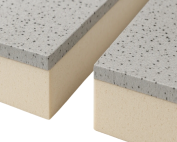
Thermano Compact is available in the BASIC and TOP variants. When cutting, the rebate may disappear from one edge, so before cutting to size establish how you will join the retained rebate to the new straight edge.
A cut piece from the TOP variant loses part of its factory rebate after cutting. The new straight edge must be joined to the retained rebate, taking into account the laying direction and the support of the strip at the perimeter. Using the offcut is only justified once the geometry of this joint and the stability of the piece have been checked.
Limits of the conclusions from the product data sheet
When assessing the suitability of Thermano Compact for a specific detail, link the compressive parameter to the board thickness: at least 150 kPa at 10% deformation applies to thicknesses up to 30 mm, and 200 kPa to thicknesses from 40 mm. The product’s reaction to fire is class E; this is not a declaration of the fire resistance of the entire building element.
Thermano Compact has a declared CS150 up to 30 mm and CS200 from 40 mm. The thickness label determines which range the board under consideration belongs to; a similar appearance is not enough. Base the assessment of pressure also on the bearing area and the way the load is distributed, because CS is not the ready load-bearing capacity of the detail.
Practical inspection of the completed assembly
Determine the number of Thermano Compact boards from the cutting plan, not from the sum of the recess areas: a narrow offcut from one place may find no use in the next, so the square metreage alone does not settle whether the requirement is complete.
Draw all the required Thermano Compact inserts on the 600 × 1200 mm format before buying packs. The total area of small fields does not give the number of full boards, and a narrow remnant does not have to fit the next detail. The cutting sketch should indicate the shapes, the number of boards and the pieces that can be reused while maintaining proper support.
7 branches. Materials closer to your project.

- SEROCK — Dzierżenin 34 E
- BŁONIE — ul. Sochaczewska 138A
- RADOM — ul. Grobickiego 8
- ŁÓDŹ — Natolin 8
- OLSZTYN — Barczewo, ul. Prosta 9
- WROCŁAW — ul. Jerzmanowska 10C
- GORZÓW WLKP. — ul. Zielona 33/34