Costs and formalities
Buying metal roof tiles: four checks before placing an order
In brief
Before comparing quotes, prepare a complete set of roof data, because without it the seller will price only the material, not the whole covering. Check whether the profile and minimum pitch suit your slope, whether the sheets can be laid out without unnecessary waste, and whether the quote includes flashings, screws and accessories. For a renovation, ask for an assessment of the structure’s condition. Compare options for the same dimensions and scope of work, and leave the choice of parameters to the designer or installer familiar with the model’s instructions.
Where to start comparing offers?
First prepare the roof data: the plan, the lengths of the roof slopes, the pitch angles, the openings and the type of substrate. For a renovation, an assessment of the condition of the structure is also needed. Without this information, the seller can quote a material price but will not prepare a reliable schedule. It is worth comparing offers drawn up for the same dimensions and the same scope of work.
It is worth writing down expectations regarding appearance, environmental conditions and the planned use of the attic. Not every parameter needs to be maximised. A house on a quiet street and a building in an aggressive environment may require different coatings. At the same time, no aesthetic expectation should replace checking the permitted pitch and system conformity.
First thing: compatibility of the profile with the roof
The instructions for a given model specify the minimum pitch, the support arrangement and the connection rules. There is no single value suitable for all tile-effect metal roofing. At a low pitch, the laps and the water drainage path become particularly important. Changing the profile after the battens have been prepared may require adjusting their spacing, so the choice should not be left until the last moment.
It is also necessary to check whether roof valleys, flashings at walls and installation penetrations can be executed. The height of the pressing affects the appearance and the fit of the accessories. If roof windows, walkways or snow guards are planned, they should have compatible fixing solutions. The mere availability of a sheet does not mean a complete system for the whole roof.
Second thing: steel core and coatings
In the documentation, it is worth looking for the core thickness, the type of metallic protection and the parameters of the organic layer. The individual data relate to different material properties. Sheets should not be compared solely by texture or colour name. Two similar surfaces may have a different level of protection and different conditions of use.
The coating should be matched to the location and to the environment on the underside. Salt, deposits, moisture and contaminants are significant. It is worth reading the warranty conditions, separating protection against perforation from appearance retention. The longest stated period does not always mean the best offer for a particular house, especially when a significant limitation excludes its location.

Third thing: format and cutting layout of the material
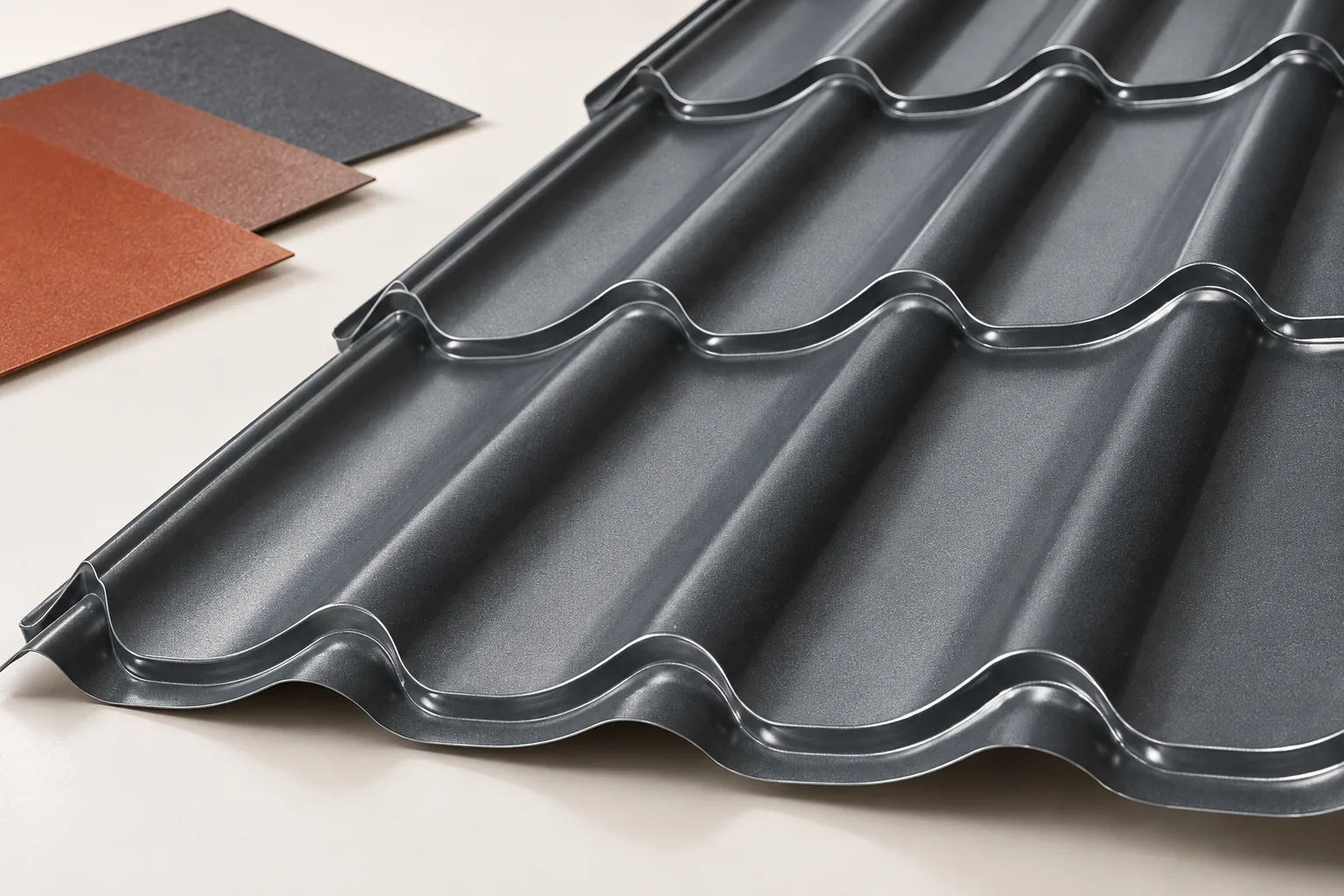
Tile-effect metal roofing cut to size can make good use of a straight, long roof slope. A modular system makes it easier to handle smaller elements and to plan many short sections. The choice should follow from the cutting layout. On a roof with corners and roof valleys, it is worth calculating the actual waste instead of assuming one universal allowance value for all geometries.
Format also affects logistics. Access, unloading, storage space and handling of the material must be taken into account. A long sheet can be damaged by improper handling, even if the product itself has good parameters. With modules, protection against moisture and the rules for removing the film must still be observed. A more convenient format does not remove these requirements.
Fourth point: a complete offer and execution
A full quote covers the covering, flashings, screws, accessories, layers under the sheet and transport. Check whether the stated unit refers to the total area or the coverage area. The labour cost should also cover the details, not just the laying of the sheets. Otherwise, the cheaper initial offer may turn out more expensive once the gaps are filled.
It is worth establishing who takes the measurement, orders the lengths and is responsible for the completeness of the delivery. The team should know the instructions for the chosen model. The method of cutting, protection of the covering during work and acceptance should be discussed. Good sheet parameters will not compensate for blocked ventilation, poorly executed flashings or damaged washers at the screws.
How to make a decision without losing track of the details?
It is most convenient to compare two or three variants in a single table. Next to the price, note the profile, format, core thickness, coating, quantity of material and scope of accessories. Add the warranty conditions relevant to the location. This order quickly shows whether the lower cost results from a better cutting plan, a different sheet quality or the omission of some of the necessary elements.
Before approving the order, look at a sample in daylight and confirm the colour of the flashings. Keep the final summary and the product documents. If the technical data are clear and the scope of the offer is complete, the choice becomes simpler. What remains is matching the appearance and the organisation of the works to the house, instead of judging the roof on the basis of a single price from the price list.
7 branches. Materials closer to your project.

- SEROCK — Dzierżenin 34 E
- BŁONIE — ul. Sochaczewska 138A
- RADOM — ul. Grobickiego 8
- ŁÓDŹ — Natolin 8
- OLSZTYN — Barczewo, ul. Prosta 9
- WROCŁAW — ul. Jerzmanowska 10C
- GORZÓW WLKP. — ul. Zielona 33/34