EPS and thermal insulation
Can EPS be bonded to a wet wall?
At a glance
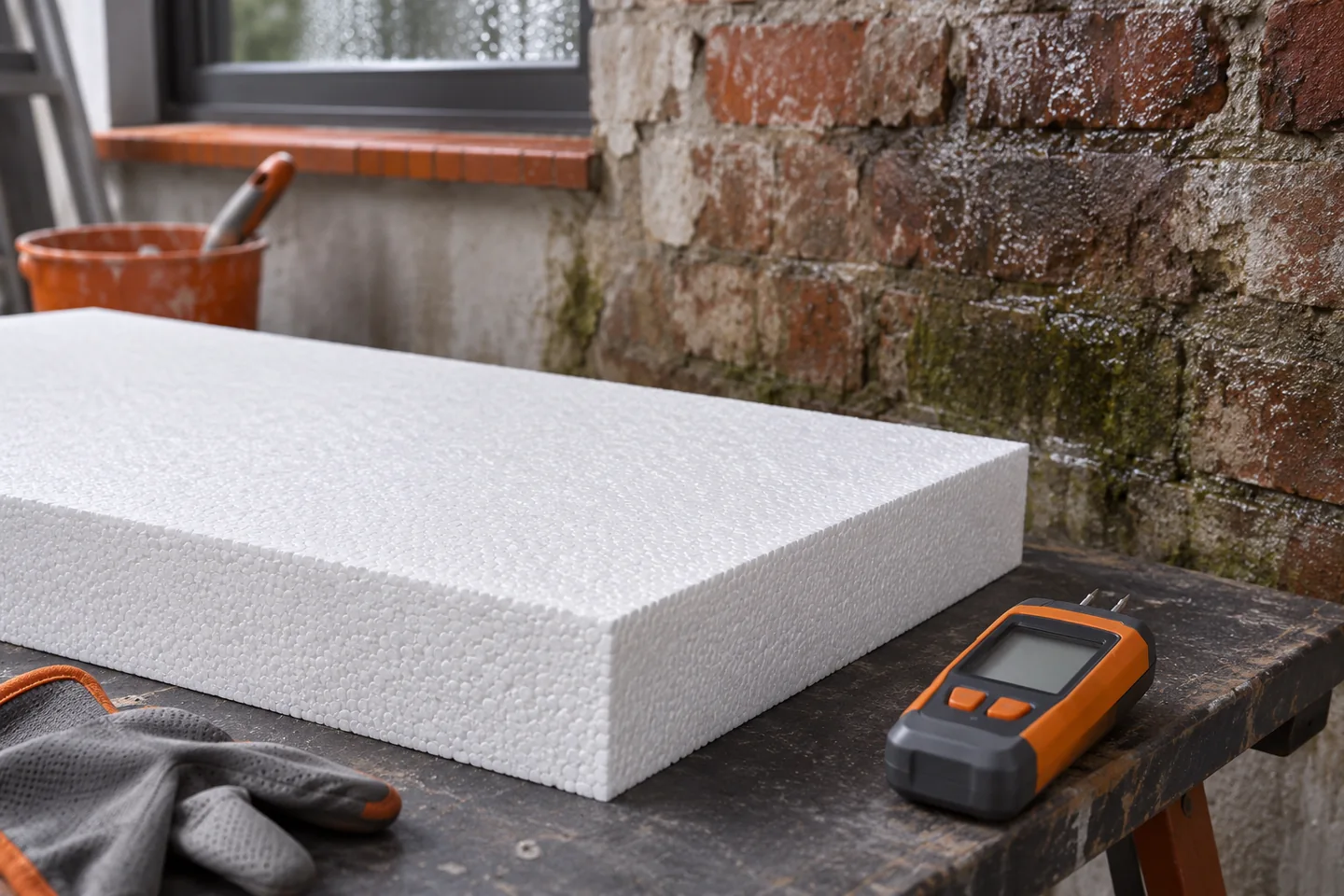
Bonding EPS to a wet wall should not be a way of hiding moisture. First, its source must be established and the requirements of the adhesive and of the thermal insulation system checked. Construction moisture is assessed differently from a permanent leak or rising damp from the ground. The timing of the work follows from the condition of the substrate, from measurements and from drying conditions, not from the calendar alone. A new wall may contain water originating from mortars and wet trades. An old building is often damp because of a leaking roof, flashings, plumbing or the lack of effective insulation against the ground. A rain stain and the uniform moisture of a fresh wall require different treatment. Before insulating, the mechanism must be identified, because the method of repair depends on it.
Where does the water in the wall come from?
An external EPS board limits heat flow but does not remove water from the structure. Covering a wet surface can make it harder to observe and can change the drying conditions. If the ingress of moisture continues, even carefully installed thermal insulation will not repair a leak. The cause must therefore be eliminated first, and only then should it be determined when the substrate is ready for further work.
Does any moisture rule out installation?
No single percentage can answer this for all walls and products. The adhesive instructions set out the requirements for the substrate, and the design may include additional conditions. The wall material, the condition of the surface and the source of moisture all matter. The wall does not have to be absolutely free of water, but it must meet the criteria envisaged for the given solution.
Assessment by hand or on the basis of colour is insufficient. The measurements should be matched to the material, because salinity and the composition of the wall can affect the result of some methods. It is worth documenting the measurement locations and the changes over time. A single reading at the surface does not always show the condition of deeper layers, especially after prolonged flooding or a leak.
What needs to be checked besides moisture?
The substrate must have adequate load-bearing capacity and adhesion. Loose plaster, dust, efflorescence and weakened joints can prevent a durable bond. In renovation work, old paint coatings must also be assessed. Bonding the board to a weak layer does not automatically strengthen it. The thermal insulation remains dependent on the substrate to which it has been fixed.
If there are deposits or biological damage, their cause must be identified and the appropriate method of preparation applied. It is not enough to paint the wall with a preparation and immediately cover it. The subsequent materials may require rinsing, drying or adhesion tests. The work steps should follow from the instructions and from an assessment of the condition of the wall, and not from a random sequence of operations.
How does the weather affect the decision?
Temperature, air humidity, precipitation and solar exposure all affect how the adhesive sets and how the substrate dries. Work is carried out within the range specified by the manufacturer. A wall that is wet after rain may require a break, even if the temperature is suitable. Strong sun, in turn, can overheat graphite EPS and make it difficult to maintain a level plane.
Scaffold sheeting helps create the right conditions, but it does not arbitrarily change the material’s requirements. Work should not be accelerated by using random additives in the adhesive. The forecast for the setting period is also important. A correct start to installation is not enough if the freshly completed layer is immediately soaked by rain or damaged by frost.
How does moisture relate to the physics of the building envelope?
After thermal insulation, the temperature distribution and the wall’s ability to dry change. The board’s low lambda value does not describe water vapour transmission. Other properties and an analysis of the entire system are used for that. Thickness, renders, coatings and conditions inside the building can matter, especially in an unusual renovation or when insulating from the room side.
Uc relates to heat transfer through the building component. Even a good thermal result is not proof that there is no moisture risk. For problematic walls, both issues need to be assessed. Ventilation of the rooms must also work properly. However, it should not be used to explain away every wet spot if its actual source is a leaking installation or precipitation.
When can thermal insulation work begin?
The decision is made after the cause of the damp has been eliminated, the substrate prepared and the conditions required by the system confirmed. It is worth recording the results of the visual inspection, the measurements and the preparations used. For a larger repair, a substrate acceptance report is helpful. It allows responsibility for earlier damage to be separated from the quality of the new thermal insulation.
There is no single number of days after which every wall is suitable for installation. The time depends on the thickness, the material, the amount of water and the drying conditions. If the contractor proposes immediately covering a damp wall without identifying the cause, it is worth halting this stage. A careful start to the work is less costly than later exposing the entire section of the façade.
Façade polystyrene is produced by, among others, Knauf Therm, Termo Organika, Ekobud and Justyr. The conditions for preparing the wall are also specified by the documentation of the ETICS system and the adhesive.
7 branches. Materials closer to your project.

- SEROCK — Dzierżenin 34 E
- BŁONIE — ul. Sochaczewska 138A
- RADOM — ul. Grobickiego 8
- ŁÓDŹ — Natolin 8
- OLSZTYN — Barczewo, ul. Prosta 9
- WROCŁAW — ul. Jerzmanowska 10C
- GORZÓW WLKP. — ul. Zielona 33/34