Polystyrene and thermal insulation
When is low-water-absorption EPS suitable for ground contact?
At a glance
Reduced-water-absorption polystyrene can perform in contact with the ground if the manufacturer has intended such an application and the design accounts for water and loads. Neither the trade name nor the colour constitutes sufficient confirmation. Before purchase, water absorption, mechanical properties and installation restrictions must be compared. The board remains a thermal insulation material. A wall in dry, permeable ground behaves differently from a wall in contact with ground that retains precipitation. Periodic water accumulation, its pressure and the possibility of frost penetration in the near-surface zone are significant. Added to this is the pressure of the backfill. That is why the word foundation on the label is the starting point for selection, not complete information about the limits of application. First, the conditions on the site and the arrangement of the waterproofing are established.
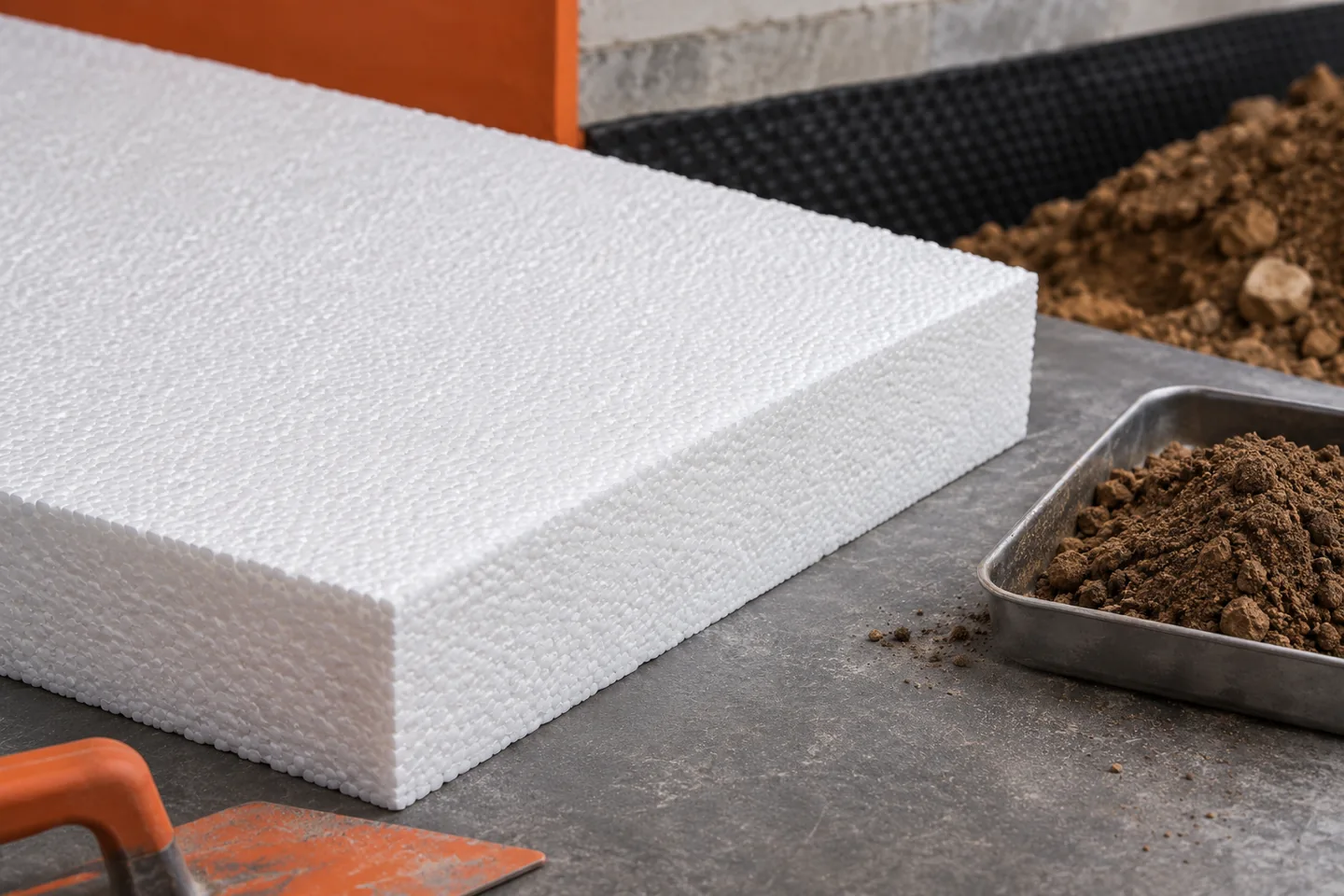
Contact with the ground does not mean a single set of conditions
Only later does one compare the boards. The manufacturer may approve EPS for damp ground but stipulate a specific method of protection. It may also specify only temporary contact with water. Such an approval must not be extended to permanent immersion without further confirmation.
What does WL(T) actually say?
The WL(T) symbol refers to water absorption in a specific long-term immersion test. The number in the designation sets the declared level. For example, WL(T)3 means a level not exceeding 3% by volume under the conditions of that test. It is not the percentage of the board’s surface that may become wet, nor a guarantee of zero change in properties after every flooding.
Different products may have other water absorption levels. A comparison is meaningful only with the same test method. The water diffusion absorption parameter, designated WD(V), relates to a different exposure. If a specific application requires resistance to freezing and thawing, that property must also be checked separately. It does not follow automatically from lambda alone.
How should ground pressure be assessed?
A board at the wall may be compressed by backfill and protective layers. The magnitude of the pressure depends on the depth, the soil, its compaction and the method of execution. The CS(10) parameter describes behaviour in a test at 10% deformation. It does not by itself answer what pressure can be sustained throughout the entire service life of the foundation.
For higher loads, information on long-term deformation and the designer’s recommendations are needed. This applies in particular to boards located under structurally loaded elements. Thermal insulation of a vertical foundation wall and insulation under a foundation slab are two different applications. Approval is not transferred from one to the other.
Format and edges help with installation
Popular EPS boards have a format of 1000 × 500 mm. There are also moulded products with other dimensions. A plain edge requires precise tight pressing, while a rebated edge helps to limit continuous gaps. The nominal board area does not always correspond to the covering area after the rebated edges are joined. The quantity of material should therefore be calculated from the tables for the given version.
Boards may be white, grey or coloured. A blue board with visible expanded granules may still be EPS. XPS is produced in a different process and has separate documentation. The label and the product standard, not a photograph, are what serve to identify the material. It is also not worth cutting your own grooves on site without checking the manufacturer’s instructions.
What should be remembered when bonding?
The surface of the waterproofing must be ready for further work. The adhesive should be compatible with the coating and must not contain components that damage EPS. The method of application and the setting time follow from the instructions for the given system. The watertight protection should not be mechanically pierced merely so that the board adheres to the wall more quickly.
Before backfilling, the continuity of the thermal insulation, the condition of the edges and the protection of critical points are checked. The protective layer should be able to bear the anticipated actions without point loads being pressed into the soft board. Soil containing sharp construction debris is not a suitable way of protecting carefully executed insulation. The method of backfilling is part of the works.
How can two offers be compared?
It is worth comparing the intended use, λD, WL(T), the required mechanical properties, format and thickness. For thermal insulation, the relevant value is the thermal resistance R = d/λ, where the thickness is given in metres. A lower lambda alone will not compensate for excessive water absorption or deformation under the expected conditions. Uc must then be assessed for the entire building element and its junctions.
Ask for the data sheet and the declaration of precisely the variant you will receive. If the documents differ in a significant parameter, clarification must be obtained before installation. You do not choose the more favourable figure on your own initiative. A good offer allows the delivery to be matched to unambiguous properties and to the specified method of constructing the foundation.
EPS boards for applications requiring limited water absorption are offered by, among others, Polstyr, Dom-Styr, Justyr and Izoterm. Their variants differ in their parameters.
7 branches. Materials closer to your project.

- SEROCK — Dzierżenin 34 E
- BŁONIE — ul. Sochaczewska 138A
- RADOM — ul. Grobickiego 8
- ŁÓDŹ — Natolin 8
- OLSZTYN — Barczewo, ul. Prosta 9
- WROCŁAW — ul. Jerzmanowska 10C
- GORZÓW WLKP. — ul. Zielona 33/34