XPS insulation
XPS and frost on the roof. How should resistance to freezing be understood?
At a glance
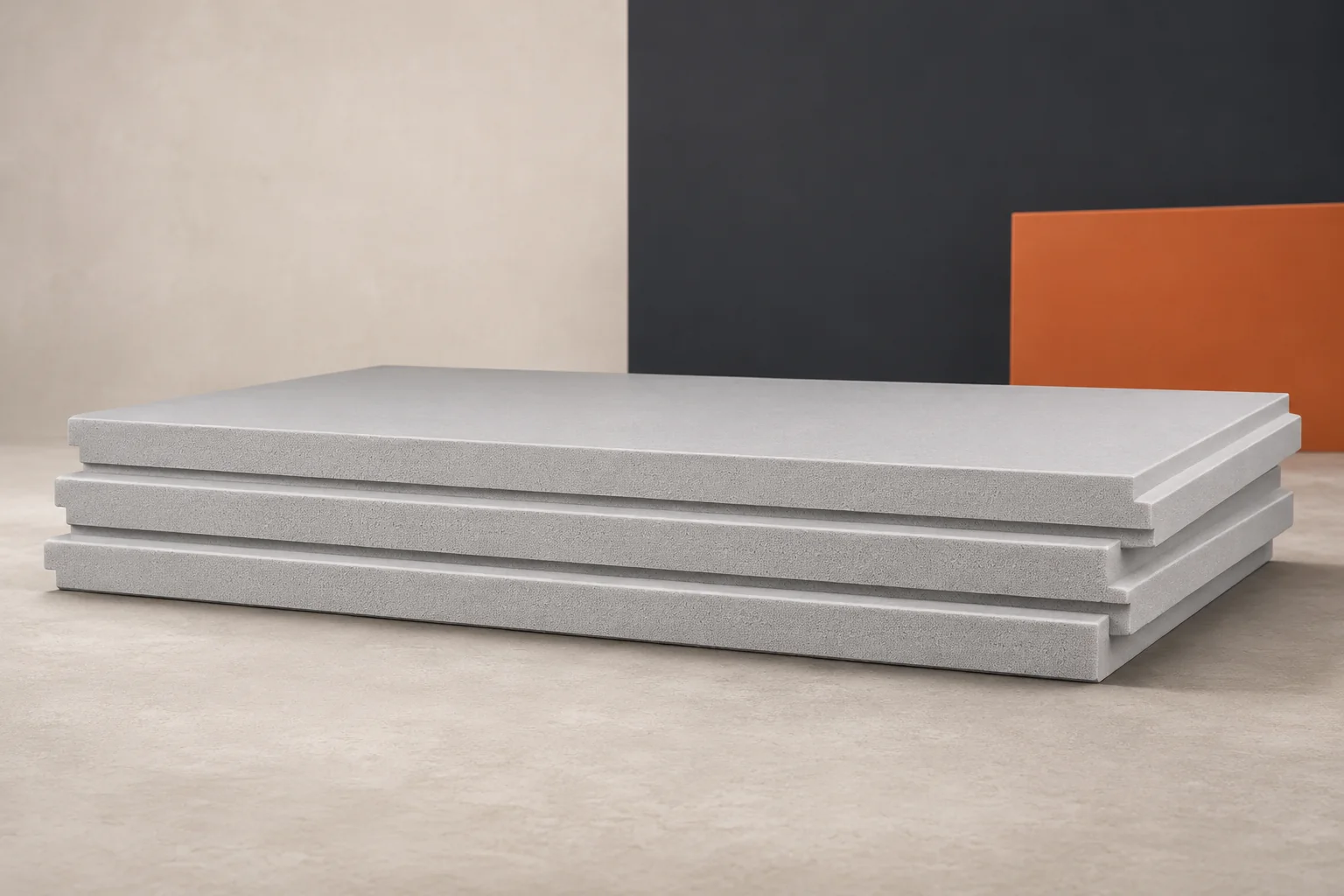
In winter, an inverted roof is exposed to temperature changes, precipitation and periodic freezing of water. XPS is sometimes used in it thanks to the combination of low water absorption and mechanical properties. However, extruded polystyrene does not by itself ensure the resistance of the entire roof to the effects of winter. The colloquial term Styrodur does not describe the test conditions. The declarations for the specific grade and the functioning of the drainage must be checked. A dry board behaves differently at low temperature from a material subjected to alternating moisture and freezing. That is why the general claim about XPS resistance to frost is too broad. A distinction must be made between the range of application temperatures and the results of cyclic tests. Extruded polystyrene has a closed-cell structure that limits water uptake.
Cold alone does not describe all conditions
However, this does not mean zero water absorption under all conditions. The documents need data that correspond to the roof application. Transferring one property to all material behaviour leads to incorrect conclusions.
Read the designations of the correct board
In XPS data sheets, declarations concerning water absorption, diffusion and freezing and thawing can be found. They relate to specific methods and criteria. They are not a promise that every building component will perform well regardless of how it is constructed. The footnotes and the range of thicknesses must also be checked.
XPS is produced by, among others, FIBRAN, Finnfoam and PNP. Their documentation covers various grades. The absence of a declaration for a given property does not mean a value of zero or the best result. When ordering, it is worth retaining the full material designation so as not to replace it with a board of similar appearance but a different range of application.
The board’s confirmed resistance to the required actions helps in designing thermal insulation above the roof covering. Combining this property with low water absorption is useful where water and cold occur together. Thanks to the documentation, the material can be selected for actual conditions.
Standing water is a problem for the entire system
The roof should drain precipitation in accordance with the design. XPS does not replace slopes, outlets and drainage layers. If water remains standing for a long time, it changes the operating conditions not only of the thermal insulation but also of the surface and the joints. The solution is not merely to choose a higher compressive stress class.
Extruded polystyrene with good moisture resistance remains part of a larger whole. The places where dirt accumulates and access to the drain must be checked. Water freezing in the wrong place can disrupt the roof’s operation even if the boards themselves meet their declared parameters.
The roof surface has its own requirements
Terrace slabs, screeds and mortars are also exposed to water and temperature changes. Their suitability for outdoor conditions must be assessed independently of the XPS. Cracking of the surface finish does not necessarily indicate damage to the thermal insulation. The cause may be incorrect support, drainage or connection of the layers.
Therefore, frost resistance should not be attributed to the entire terrace on the basis of the XPS data sheet. In a design, every element has its own task and limitations. Movement joints and the way the edges are formed also matter. Checking the cross-section together yields more than a set of good products combined without a plan.
Moisture also affects the thermal balance
Calculating an inverted roof includes the conditions under which the boards perform above the waterproofing. The role of water does not end with the risk of freezing. Precipitation moving beneath the XPS can increase the heat flux. It is therefore not enough to choose a thickness on the basis of the declared lambda alone.
Extruded polystyrene should be selected as part of a complete solution. The layer limiting water flow matters if it is provided for in the system. Replacing it with a different nonwoven fabric requires verification. Likewise, arbitrarily increasing the number of layers can change the moisture conditions between the boards.
Winter installation has its own limitations
The resistance of the finished board to cold does not mean that all work can be carried out at any temperature. Adhesives, mortars and coatings have their own application conditions. The substrate for the XPS should meet the system requirements. Snow, ice or contamination must not serve as a temporary levelling layer.
Correct storage of the material must also be ensured. XPS must be protected against damage and contact with incompatible substances. Damp packaging or soiled surfaces can make subsequent work more difficult. The completion date should follow from the ability to preserve the quality of the entire system.
Do not confuse the board test with the warranty period
The result of the freeze-thaw test indicates how the specimen behaves in a specific procedure. It is not a conversion factor for the number of winters that the entire roof will withstand without repair. Service life is also affected by tightness, loads, contamination and the manner of maintenance. In XPS documents, one should look for the actual declaration, and analyse the warranty conditions separately. This means the choice is based on comparable information, without attributing to the material promises that the manufacturer has not specified for a particular building assembly.
After winter, check the roof, not just the insulation
The inspection covers drains, the surface, flashings and areas around equipment. Unevenness or ponding should be clarified before the next season. One should not immediately assume that the XPS is to blame. It is necessary to identify which layer has stopped working as intended.
If damage is suspected, the relevant areas are inspected and, if necessary, exploratory openings are made. Well-kept documentation makes it easier to assess the grade used and the original system. The resistance of XPS to winter cycles is an asset, but a durable roof also requires effective tightness, proper support and regular maintenance.
7 branches. Materials closer to your project.

- SEROCK — Dzierżenin 34 E
- BŁONIE — ul. Sochaczewska 138A
- RADOM — ul. Grobickiego 8
- ŁÓDŹ — Natolin 8
- OLSZTYN — Barczewo, ul. Prosta 9
- WROCŁAW — ul. Jerzmanowska 10C
- GORZÓW WLKP. — ul. Zielona 33/34